Is ‘back to normal’ even possible? Long year tests NC mountain town’s resilience
AI-generated summary reviewed by our newsroom.
- Hurricane Helene left Swannanoa heavily damaged, with normalcy still missing.
- Nonprofits have been indespensible with helping residents get back into homes.
- Some residents still need aid for essentials, including clothing and shelter.
READ MORE
Healing from Helene
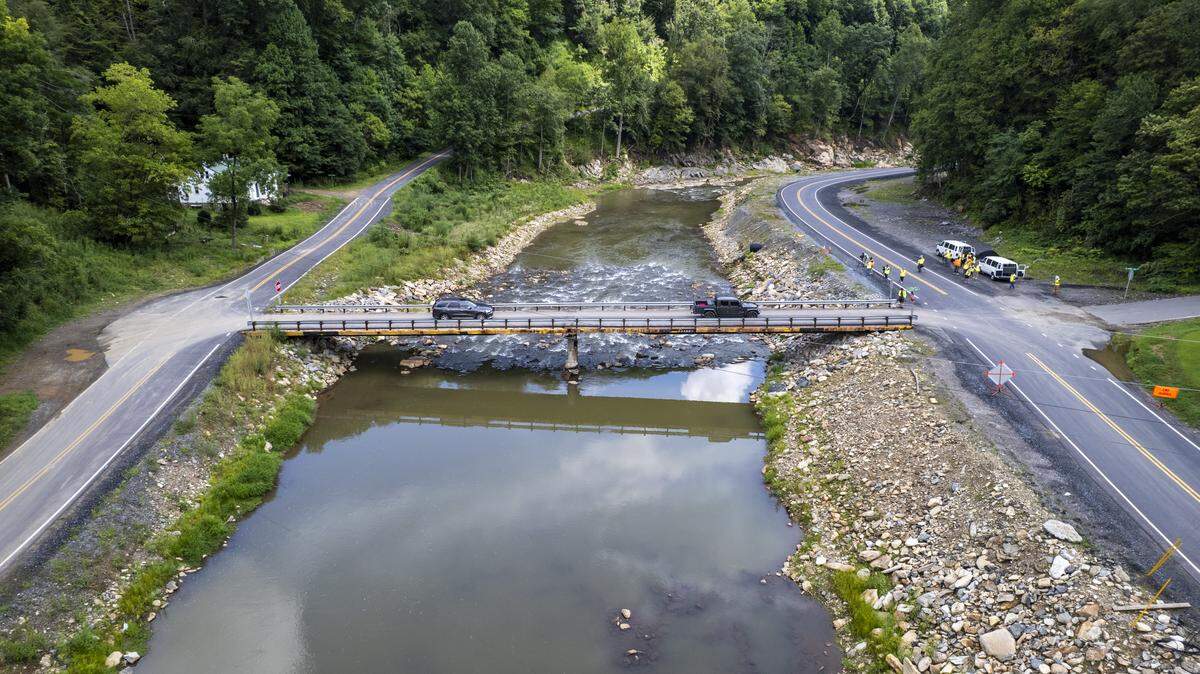
On Sept. 27, 2024, remnants of Hurricane Helene devastated Western North Carolina, killing 108 people and leaving a nearly $60 billion clean up bill statewide. In the year since, the people of Western North Carolina have made progress putting their beautiful part of the state back together.
Expand All
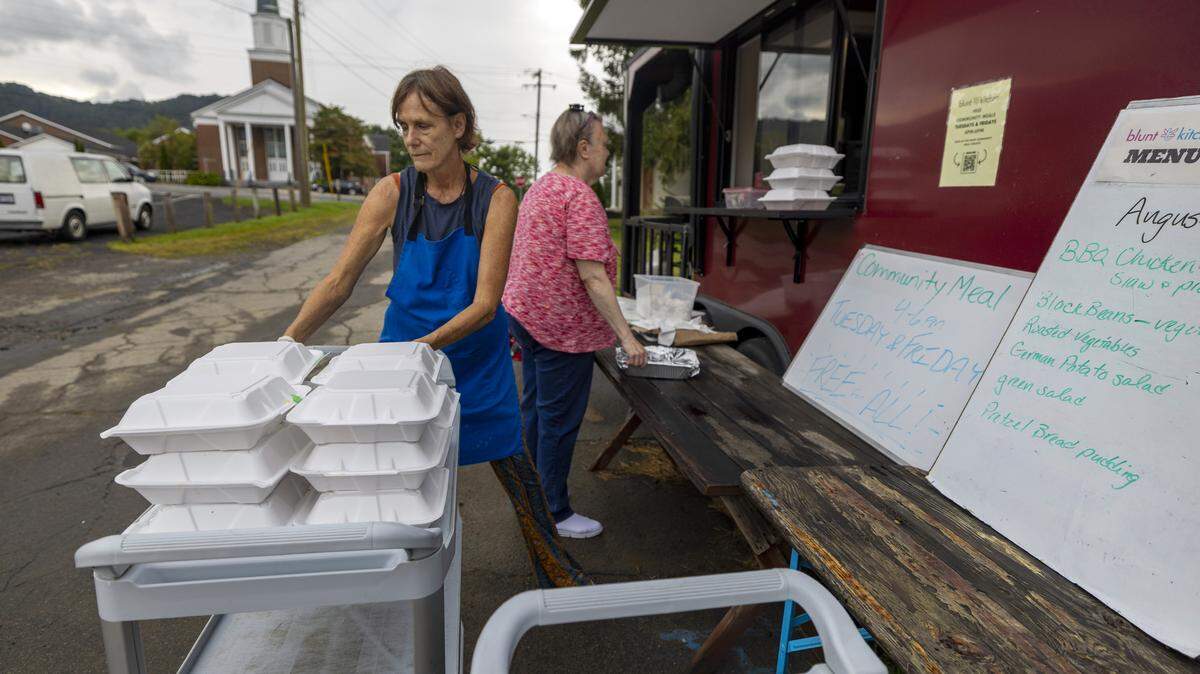
In the parking lot of her hillside church, Pastor Ramona Nix sits in a folding chair under a large circus tent on a Saturday morning, watching a dozen mothers with their children sort through what charity she can provide: a tub full of used T-shirts and pants, a row of second-hand jackets on hangers, two copies of the Bible and one ladies’ bra.
One of the mothers, a toddler in one arm, asks, “Do you have any diapers?”
“Oh no,” says Nix, shaking her head. “We gave those all out.”
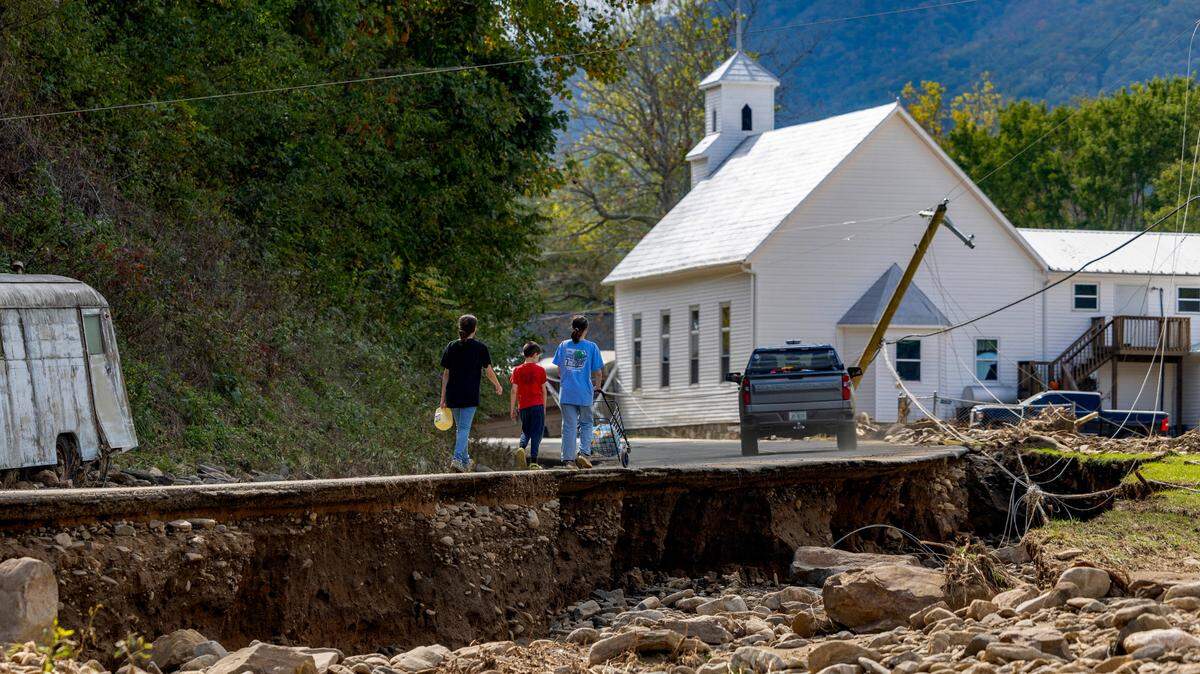
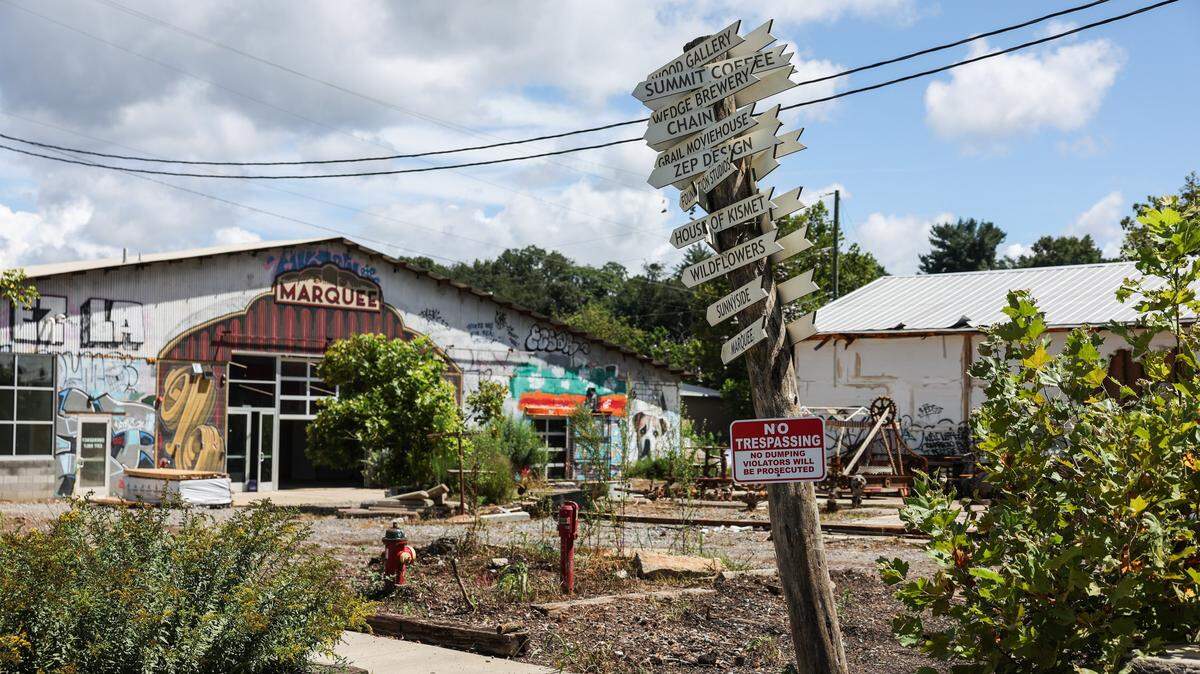
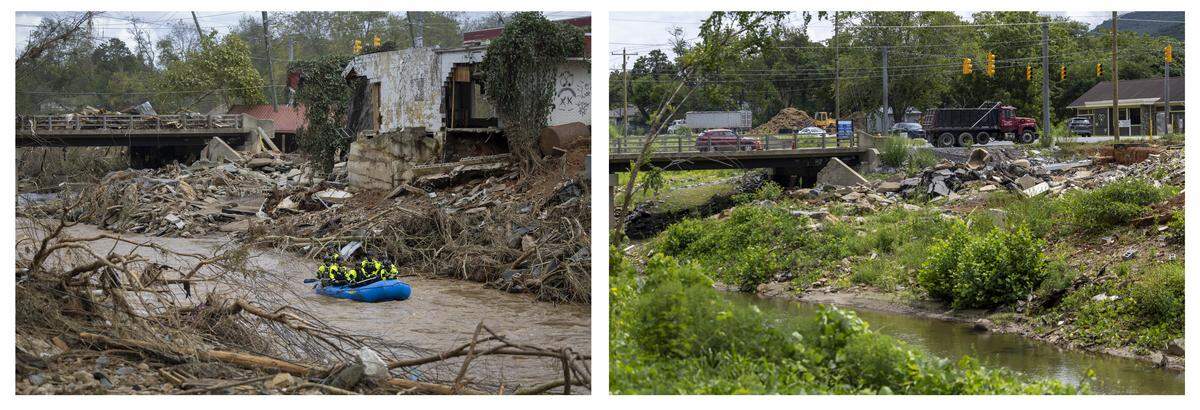
The tent at Eagle Rock Church went up one year ago, just after Hurricane Helene sent a 14-foot wall of water through Swannanoa, flooding houses up to their chimneys, carrying dozens of cars down the main street like toy boats, washing away the mountain town’s only grocery store, its post office and a good portion of its heart.
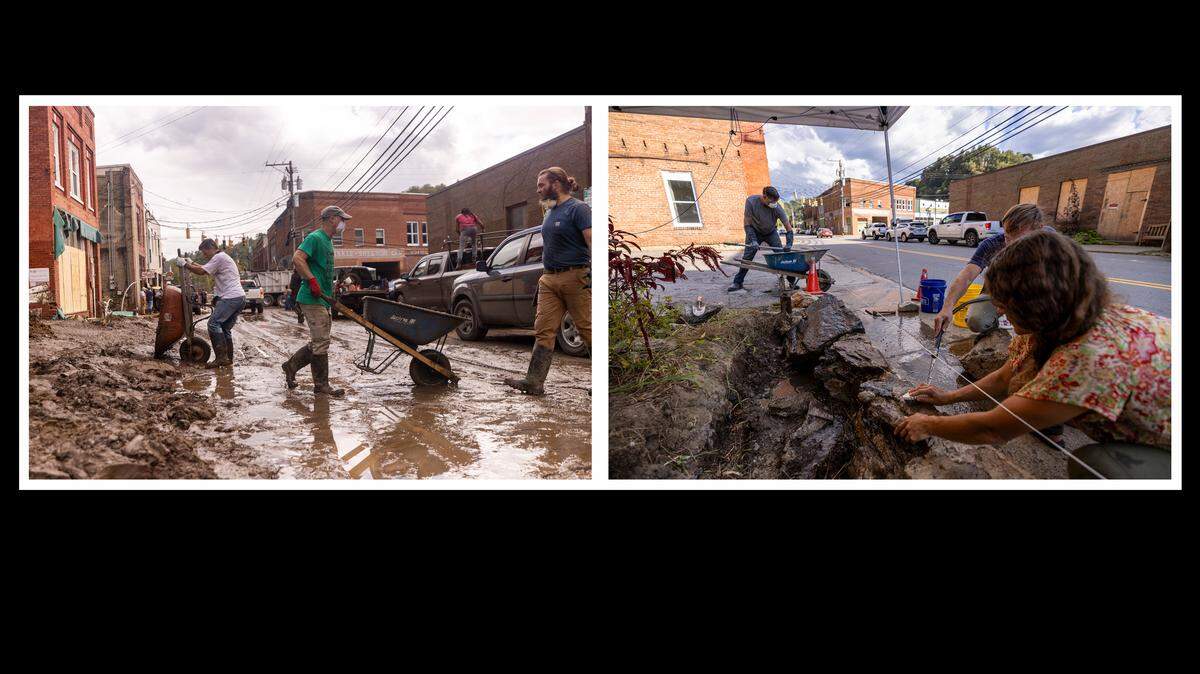
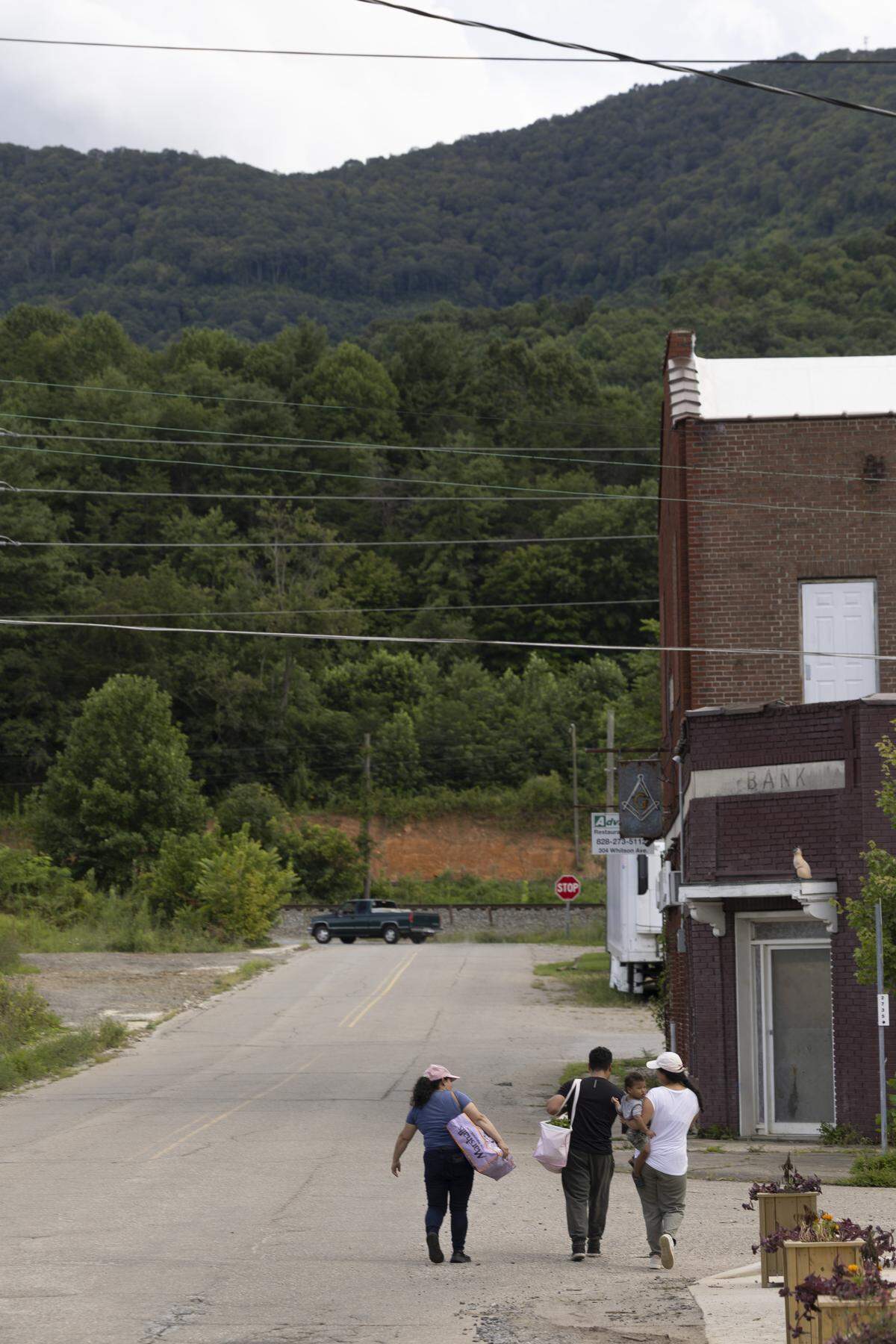
But unless people drive through Swannanoa on this anniversary month and see volunteers still clearing out 10-foot piles of rubble, or the people still living in sheds, campers and tents along the river, or the empty parking lot where a homeless woman is sleeping under the drive-through of a ruined bank, they might assume everything is back to normal.
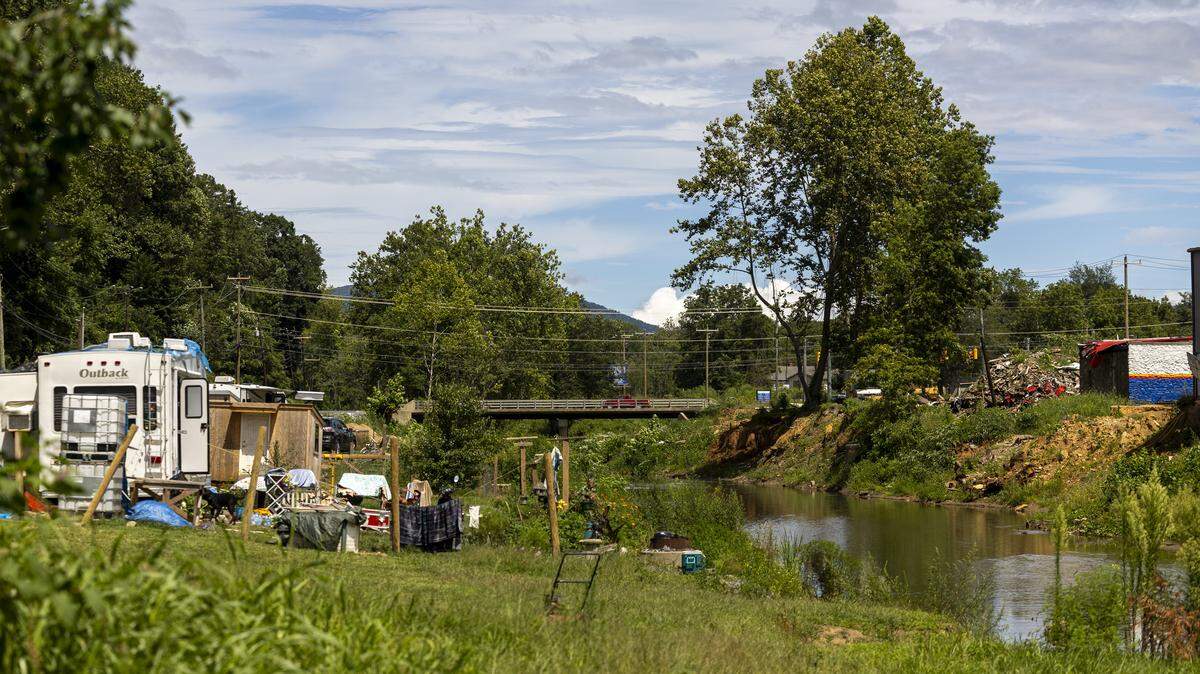
“I don’t know if we’ll ever be back to normal,” says Nix from under her tent. “If you go through here, down River Road, it still looks like a disaster. That woman there was just telling me her rent is $1,900. That’s for a two-bedroom mobile home. I don’t know how they can live.
“We had people camped over there,” she says, gesturing down the hill, “and we fed them. They made them move because of no bathrooms. We don’t know where they went. If you don’t come and see, you don’t know.”
‘Swanna-nowhere’
Even in a storm that killed 108 people in North Carolina alone, causing nearly $60 billion in damage statewide, the tiny community of Swannanoa managed to stand out.
Only 6,000 people live there, squeezed between Asheville and Black Mountain, but 3,154 of its households, which would include roughly everyone in town, qualified for aid from FEMA. The relief fund for Swannanoa alone totaled $22.3 million.
Beyond that, it is hard to know how much assistance reached Swannanoa because it is not incorporated, lacking a mayor or town council that could apply for and receive money. So a patchwork of nonprofits plug away at the damage, celebrating small victories.

For much of its history, Swannanoa has served as an underdog sibling to its larger, flashier, more expensive neighbors, which draw a steady tourist trade that mostly passes by. Some locals jokingly called their hometown “Swanna-nowhere.”
Until 2002, the Beacon Manufacturing Co. dominated the local job market as the largest blanket-maker in the world. But a year after it closed, an arsonist burned the factory down.
“This was a mill town, and it kind of died,” said Tonia Allen, director of the Swannanoa Resilience Hub, the local nonprofit aiding long-term recovery. “But it’s reviving in a different way.”
‘Mountain Strong’
Anywhere along the Blue Ridge, they talk of being “Mountain Strong,” a survivor’s credo that appears on billboards across Appalachia.
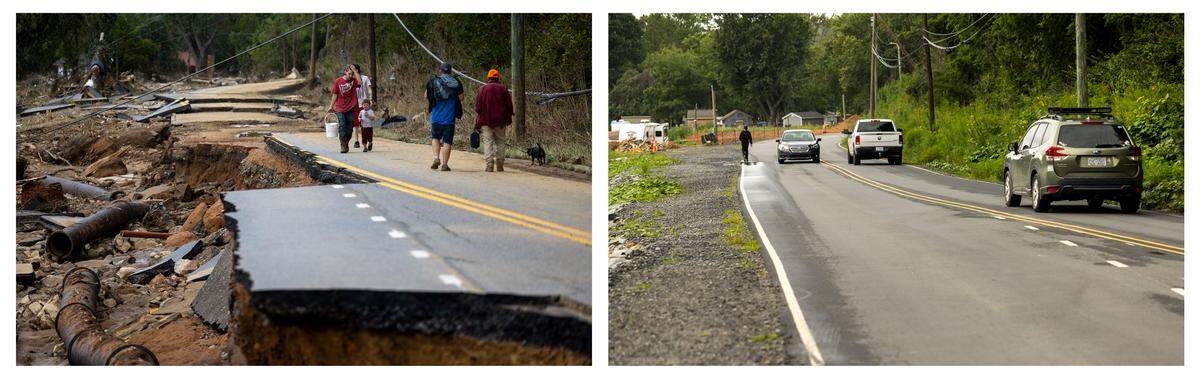
And in Helene’s aftermath, that spirit has shown clear progress:
- In December, anyone passing through town would have seen a canyon of debris stacked 20 feet high running through entire neighborhoods. Inside Village Barber Shop, which miraculously survived the flooding despite being perched on the riverbank, the Saturday haircut crowd credited that work entirely to volunteers. Last week, they cleared the final pile.
- Beacon Village, a community of mill houses dating to the 1920s, lost 24 homes on a single street. All but a few of those historic homes are being rebuilt, and nearly every family there opted to return to Swannanoa and start over.
- Daniel and Emily Lancaster were just set to open their new coffee house when the storm hit Swannanoa, and they figured their dreams were dashed. But they stuck around town and roasted what beans they had on hand, giving it out for free. So many people encouraged them to stay, being part of the local family, that they plowed ahead and opened Short Sleeves Coffee in May, just eight months after the storm.“It maybe felt unwise to open a new business in a town that’s completely distraught,” Daniel Lancaster said. “We decided, ‘Whatever.’ We rarely have a morning we don’t have every seat full, and more than that, people meeting each other for the first time. We’re seeing regulars. We’re seeing little groups. There’s the Old Geezers Group. They call themselves that, just to be clear.”
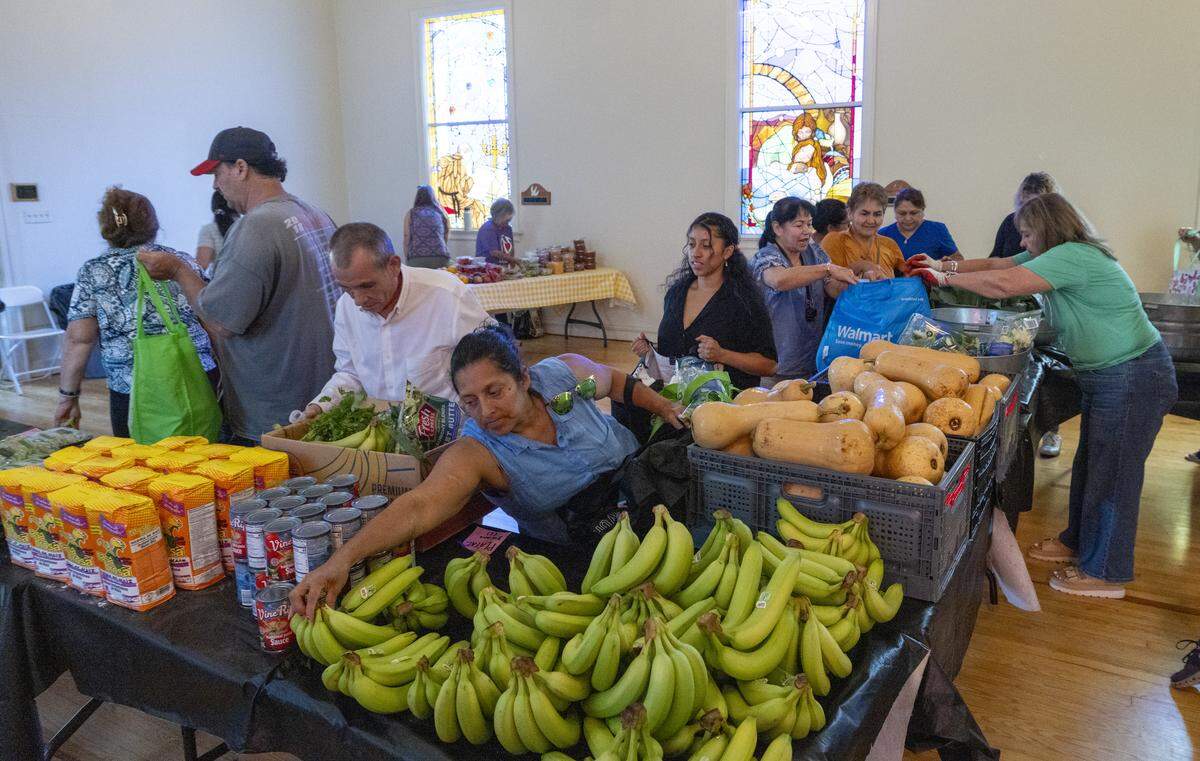
- Since the storm, Swannanoa has a new community center housed inside a vacant Methodist Church on Whitson Street. There’s a farmers market there every other Saturday, and a neighborhood meeting twice a week, and various food giveaways during the week. The bulletin board inside “The Hub” offers help with cars damaged by the flooding, a free eye-care clinic and a grant program for hazard mitigation. Most every day, it is full of hopeful people.“I’m strangely excited about the future,” said Deana Lytle, a founder of Swannanoa Resilience Hub and a fifth-generation resident. “You can’t really depend on anyone to save you. You have to save yourself, or we will become one of those towns that is a statistic, that still has all the dilapidated buildings and rubble. And I will not stand for that. I have a 4-year-old and I refuse for that to be his story.”
‘Make us whole again’
Down Edwards Avenue, the houses of Beacon Village saw 14 feet of water pour across U.S. 70 and into their living rooms the day Helene arrived, climbing so fast that residents scrambled onto their rooftops and screamed for help.
Some took shelter in the attic, only to chop through the roof when the river followed them upstairs. Some swam onto their roofs and hunkered there until rescuers arrived in kayaks.
Daniel and Mariah Wright escaped just in time, along with their two sons and two cats. When they returned, their house of 20 years looked like someone had gone through it with a leaf blower that spat out chunks of concrete and mud.
“I dug through it and found some jewelry, her Dad’s ashes, my kids’ collectibles,” said Daniel Wright.
At first, the Wrights questioned whether they wanted to come back at all. Even when they gathered socially, Edwards Avenue felt to the Wrights like “the saddest street party you ever saw.”
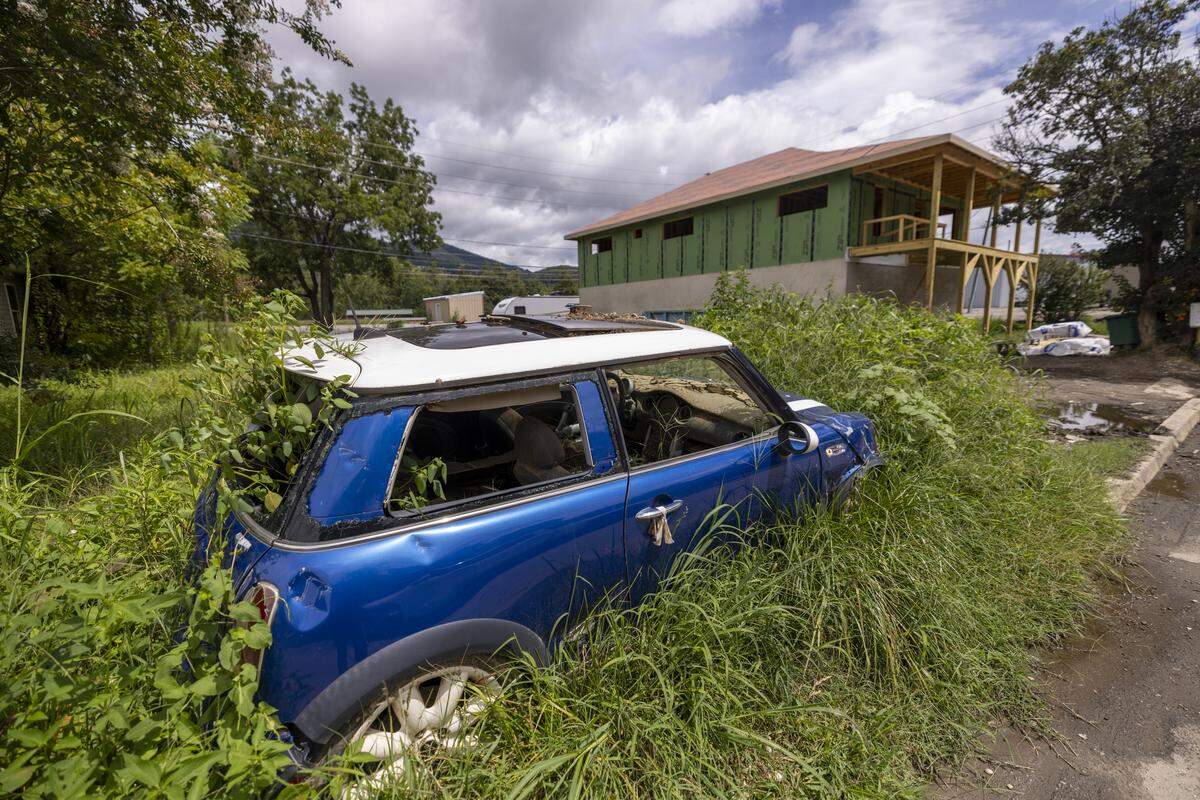
Next door to their house, a Mini Cooper still sits parked with its windows smashed a year after Helene. Tall weeds are growing out of the front seat and out the back window.
But the neighborhood rallied to save these houses where their grandparents lived, built with sturdy bones. And it wasn’t just the government, with all its rules and limitations, that showed up to help.
Before long, the Wrights opted for a rebuild from the ground up, making way for a new two-story home 10 feet higher than the first. But seeing their house demolished felt like losing it all over again.
“I feel like a lot of people have been able to move on,” Mariah Wright said. “For us, we’re still living the hurricane.”
Two strokes of luck appeared. First, they found rental housing from a friend in West Asheville — a cushion unavailable to many victims.
Second, the nonprofit BeLoved Asheville approached them about a total rebuild, this time putting the living space on top of a 10-foot concrete foundation. They didn’t ask for FEMA money — though the Wrights gave it — or dictate any floor plans.
“They just want to make us whole again,” Mariah Wright said. “They just operate out of pure love.”
In most of the front yards on Edwards, a sign is posted by the nonprofits rebuilding the street: BeLoved Asheville, The Fuller Center for Housing, the familiar PBS show “This Old House.”
The Fuller Center took on five rebuilds along Edwards, most of them within sight of the riverbank where FEMA rescuers looked for victims’ bodies.
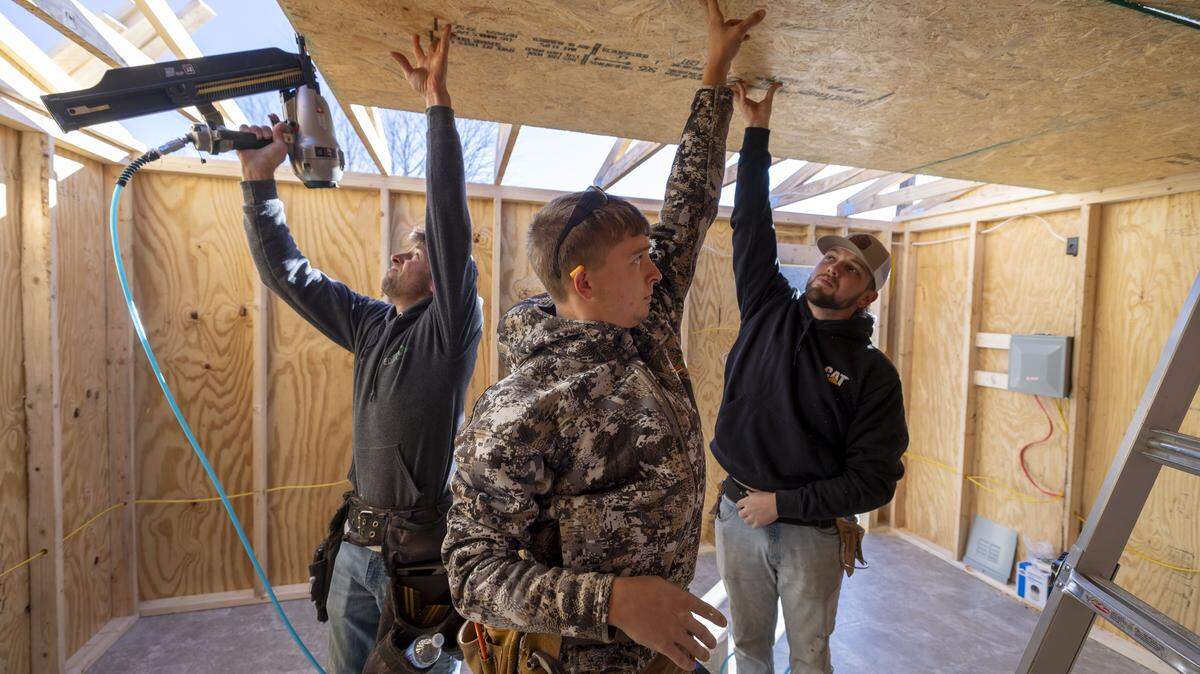
A century old, these houses were built to last with brick foundation and dimensional lumber. Still, workers gutted them down to the studs using all-volunteer labor from as far away as California.
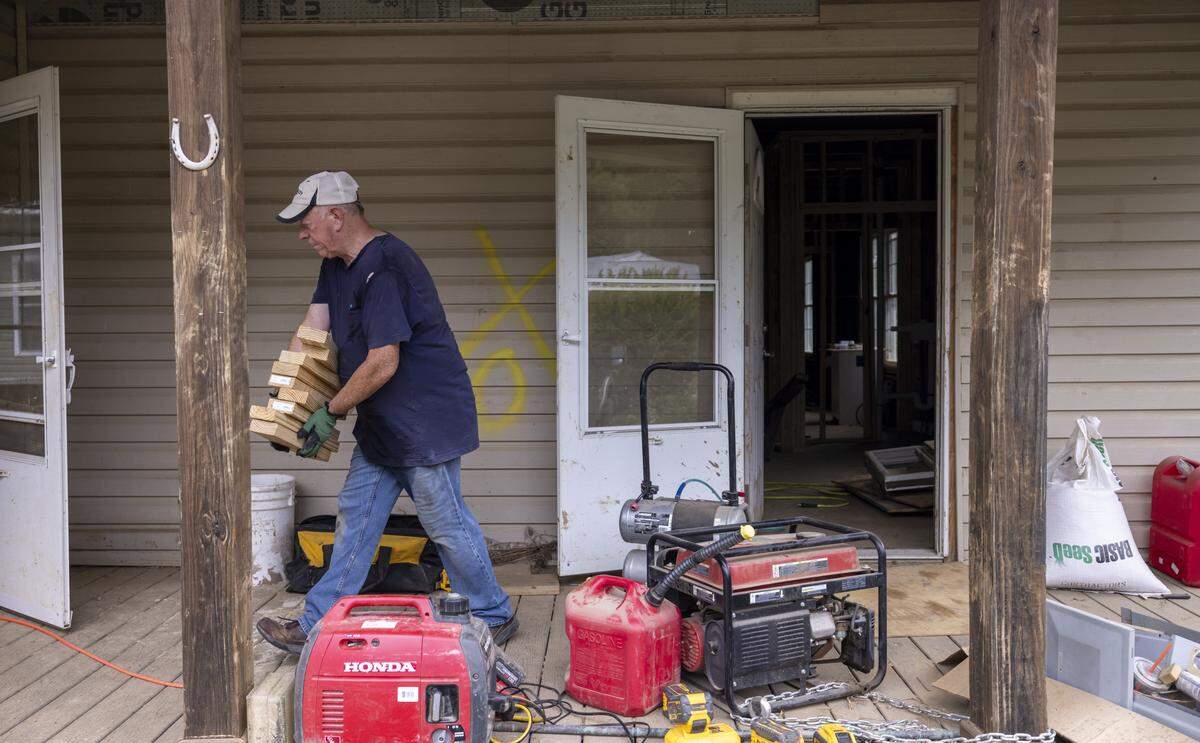
Construction manager Jacob Churchman last month showed off the work where a family just moved back in, the third as of August.
“Spirits are good,” he said, “but every day you drive past and still you see restaurants that were busy and are now just blown in. All the back wall you can see through. It’s hard to say if it’s good or not. It’s better. It’s not to the point where the cute quaintness of this mountain town was.”
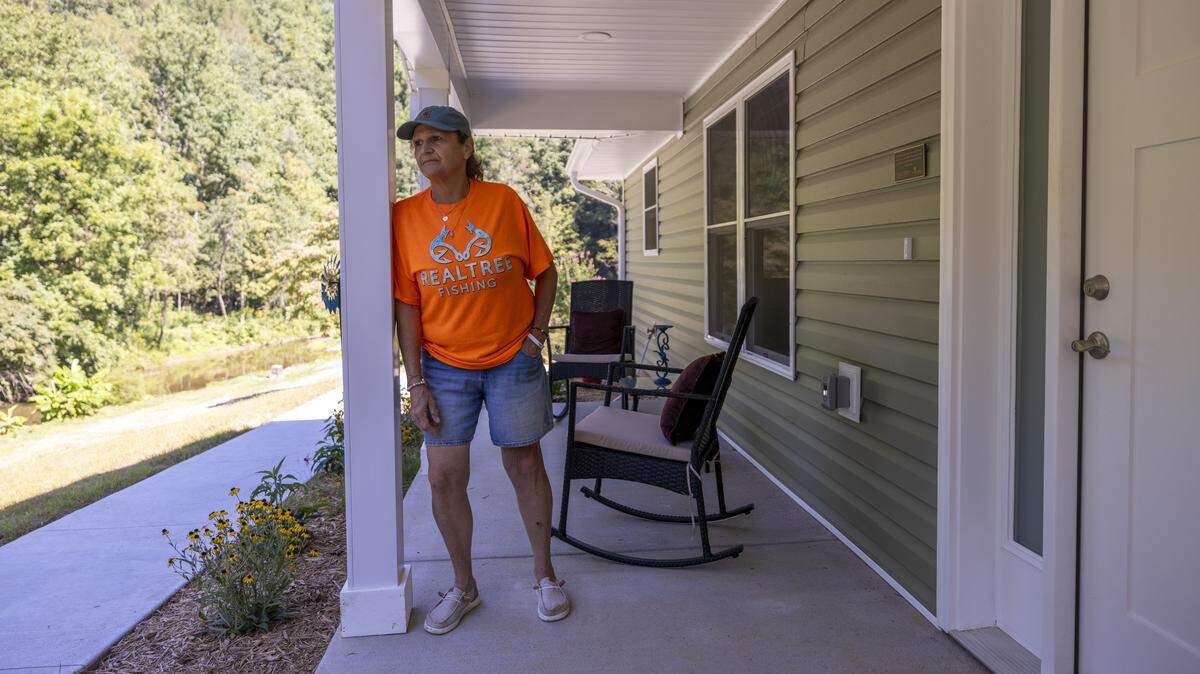
Mariah Wright worries about living so high above the ground, almost like being at the beach. But she has a second bathroom now and a “real” closet.
“Last summer,” Daniel Wright said, “I could stand out here and say, ‘What a beautiful little tiny nowhere town.’ You’re in the valley. You’re practically a rain forest. The river is right there. … It may never get back to what it was.”
“I think it will be different,” his wife said. “But I think it’ll be home.”
‘Technically, I’m still homeless’
The nonprofit Swannanoa Communities Together says affordable housing is the biggest problem post-Helene, and it still serves roughly 300 people a month with help of all kinds.
Even if someone is lucky enough to find a camper to live in, the lots where they might park them have risen from around $300 a month to $800 a month, said Summer Whelden, an organizer there.
“Even if you’re given an RV or a camper, where can you afford to put it?” she asked. “Maybe you had a cheap informal setting for 10 years, living on somebody’s land, and now you’re paying an application fee, submitting ID. Say you have that ID, can you pass the background check, have no evictions?”
Just across the river from Beacon Village, a half-circle of dirt road called Good Loop is home to perhaps a dozen people living in campers, tiny houses and single-wide mobile homes still with the letter X spray-painted on the side — a sign they were searched after Helene.
Gas cans and propane tanks clutter the yard space, a sign that many are still living on generator power. Many use a community bath house consisting of a shed and pit toilet where residents dump ashes from campfires. One of the vacant mobile homes still has power inside, so residents on Good Loop run extension cords through the open window to charge their phones.
Over in one corner, a man introduces himself as Bob Thomas, though people living around Good Loop all know him as Shae, and he explains that he has spent the year since Helene living in a cone-shaped tent with a wood stove inside, acting as a sort of caretaker for the community.
In a truck nearby, he keeps a 300-gallon water tank that he fills from a spring in Black Mountain several times a week, passing out water to his neighbors in smaller containers. He has a small garden and a pantry of donated food, along with a kettle attached to a propane tank. He tends to a dog named Aurora, rescued as a puppy from under a trailer.
With his dreadlocks, medallion and bead bracelet, he explains how he has struggled to keep a communal mentality.
“For a while it was great,” he said. “We’d have big prayer circles out here with people of different faiths. It was pretty wild. It was amazing. Lot of magic. Then greed kicked in.”
People started stealing supplies out of a shipping container. Others insisted on keeping campers that had been loaned. Some just left.
“We were all transcending void, overcoming the greed,” Thomas said. “It reminded me of how an atom gives an electron and becomes more positive in return. Some people forgot about that.”
Good Loop serves to remind that many people around Swannanoa lived in a marginal state even before the storm. Asheville, with its New Age tendencies and hippie history, has always attracted nomads and a sizable homeless population.
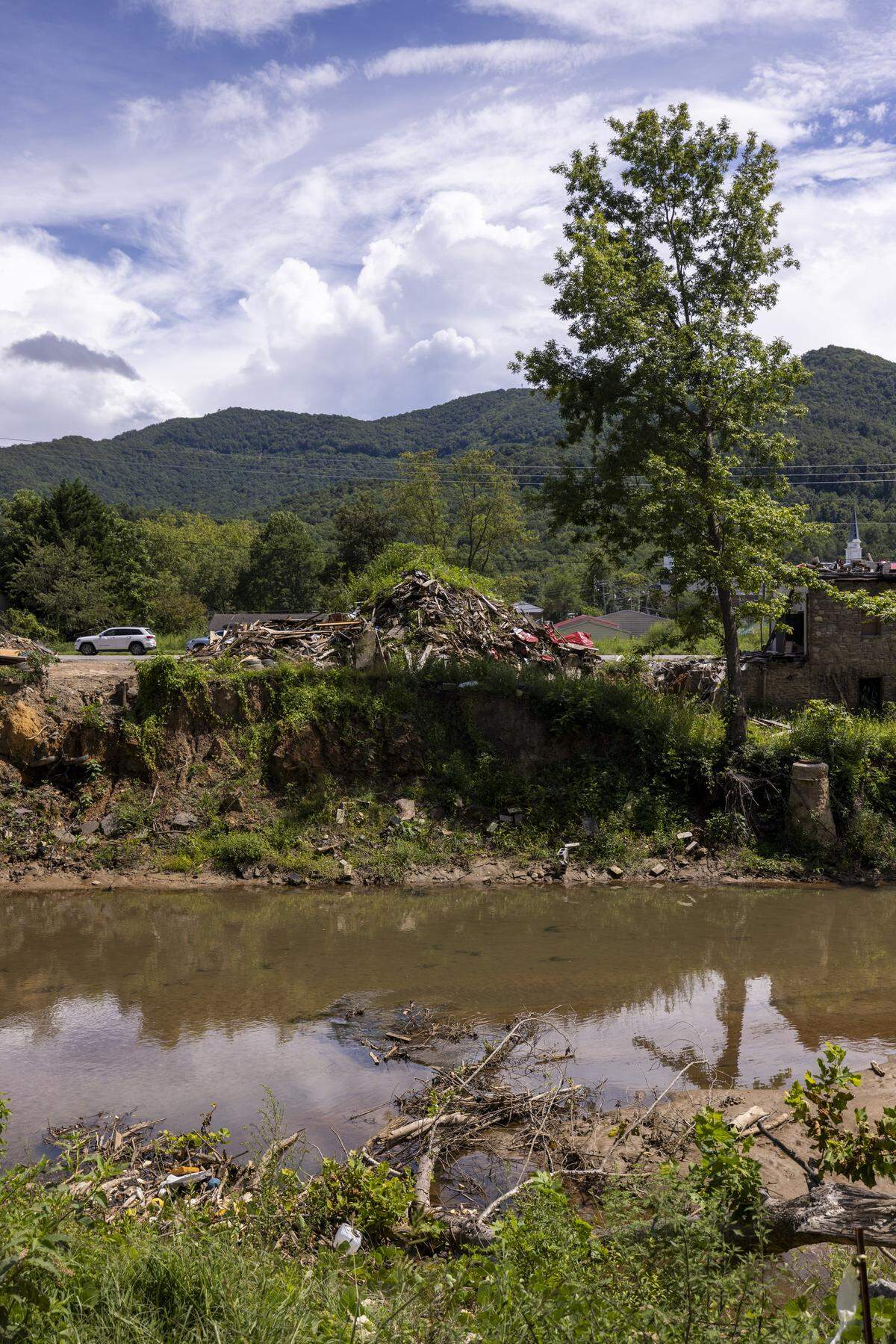
Around Swannanoa, many of the locals talk of how Buncombe County plans to build a greenway along the river where the debris still sits and the poorest residents live.
The Ingles grocery remains closed after a year, to residents’ constant frustration. So many lost cars that a trip to Black Mountain for food can be tricky to arrange, especially when the local bus line forbids carrying multiple bags.
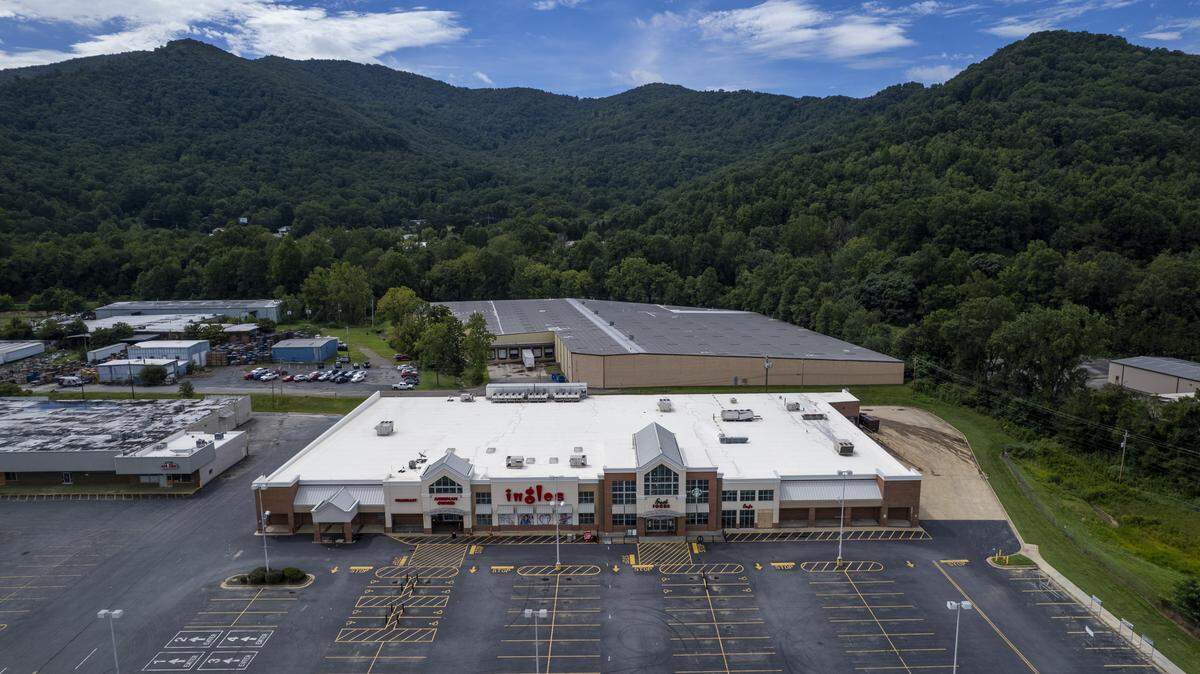
Hearing now that Ingles plans to build a new store and place new businesses inside the old one — a project that could take two years to complete — worries them even further.
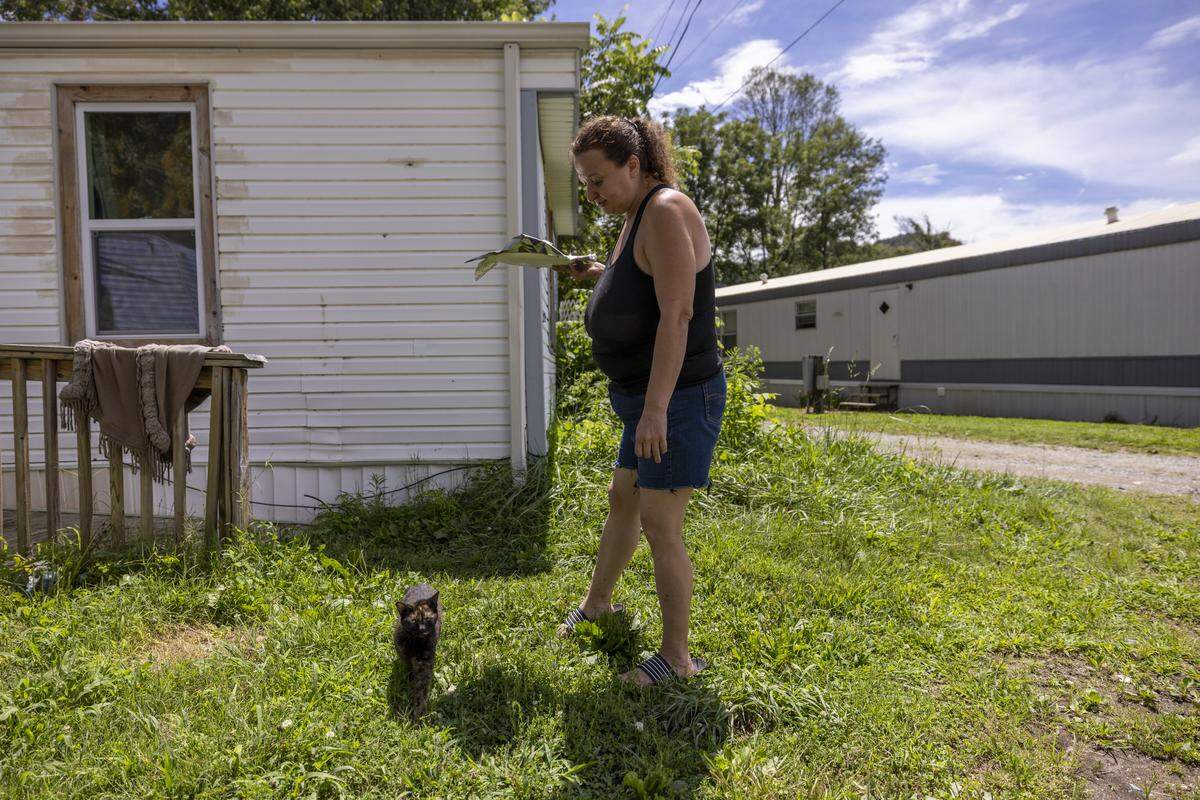
April Roe, a Good Loop resident, walks from the mobile home she shares with her daughter, granddaughter and uncle to buy cat food at the BP station.
“For me, not having a car, I have to rely on the generosity of strangers,” she said.
An elderly man with a braided white beard can often be seen riding his bicycle up and down U.S. 70, and he leans it up against a camper he has parked next to a solar-powered laundromat that Helene destroyed.
Knock on the door there and he introduces himself as Ray Sunshine, a name he laughs at and attributes to being part Scottish and part Cree. Before the storm, he says, he played guitar and harmonica around Black Mountain and Asheville, living in a tent until a friend gave him shelter as the water rose.
Once the flood receded, he ended up in a hospital, where doctors explained he’d suffered a mini-stroke. He didn’t believe them until they held up a magazine and he couldn’t read it. But he attends regular meetings at Swannanoa Grassroots Alliance, and he has landed comfortably in a camper.
“Technically, I’m still homeless because I don’t have running water,” he says. “I can usually get enough gas to fill the generator.”
Yeshua, he says, using a Hebrew term for Jesus, assures him that he’s only experiencing a form of rebirth. “A complete reset,” he says.
A wish list
Swannanoa has struggled at times with “disaster tourism,” fielding questions from curious tourists passing through along Interstate 40, enduring snapshots of their ruined homes.
But some say they are grateful for attention, fearing time and fresh disasters elsewhere will drain away much-needed help.
Asked what they would say if they had all of the state’s attention, locals cite three big priorities:
- More money.“And getting funding to people on the ground, who know where it needs to go,” said Allen, with Swannanoa Resilience Hub.
- More organization.Buncombe County is creating a small-area plan for Swannanoa, and many of the nonprofits’ leaders sit on a steering committee that will direct spending and future building. But the nonprofits agree they need to come together and pool their know-how. “So we don’t work in silos,” Allen said.
- More building supplies. Beacon Village needs fill dirt, drain pipes, volunteer laborers with expertise and of course money.“Everyone showed up in the beginning,” said Lytle. “Everyone was still operating with adrenaline. Then you get to the point where all of that is trickling away.”
The crisis isn’t over
Back at Eagle Rock Church, Pastor Ramona Nix explains how at times it seems that nothing, even this many months after the storm, comes easy. She can no longer give out food because a distributor in Tennessee stopped donating it, believing the crisis to be past.
She also recently learned her church would have to take down its tent, lacking a permit. The fire marshal told her the county could no longer be lenient.
“I didn’t know you needed a permit to put up a tent on your own property,” she said.
As she speaks, a young woman approaches with her elderly mother and tells Nix that her rent costs $750 a month, impossible to raise since Helene closed the restaurant where she worked.
Nix politely tells her they can speak in a little while, but the woman seems flustered and quickly corrects herself, changing the amount. The rent is only $650 a month.
Nix again asks her to wait, but the woman confers with her mother and presses Nix once more, lowering the price again and sounding more desperate. The rent is $395.
Then, frustrated, she leaves.
“It’s not back to normal,” says Nix. “No, it’s not. But we’re survivors.”
This story was originally published September 17, 2025 at 5:00 AM with the headline "Is ‘back to normal’ even possible? Long year tests NC mountain town’s resilience."