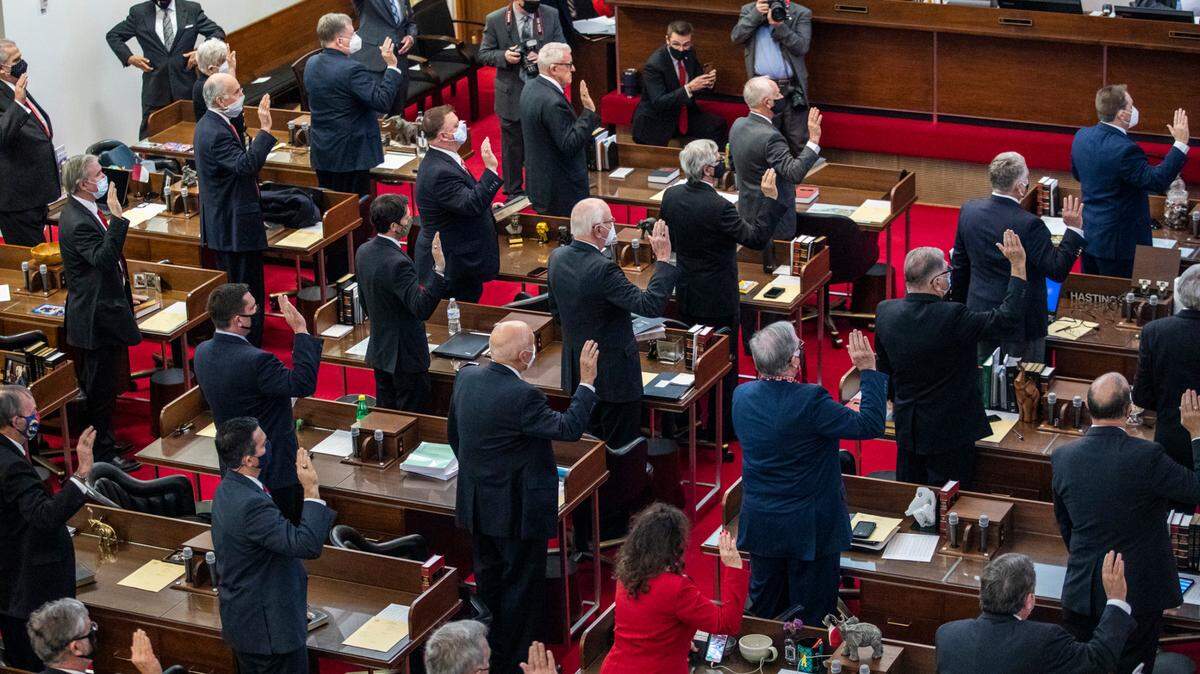
NC’s new state budget has raises, bonuses and tax cuts. Find out what’s in it for you.
READ MORE
Your Share of the Budget
With NC’s new state budget, everyone should see a bit extra in their bank accounts. When it comes to income taxes, anyone who files their taxes with a standard deduction will pay less next year, and possibly nothing at all. Every teacher in the state will get at least a $2,300 bonus and every state employee will get at least a $1,000 bonus. What’s in it for you? This is The N&O’s special report.
Expand All
Whether it’s through tax cuts or raises for state workers, one of the main selling points that helped North Carolina lawmakers finally pass a new state budget was that just about everyone will have more money in their pockets.
Passing a full budget for the first time since 2018 means long-delayed projects are getting funded and raises are getting approved. Not only was the state sitting on large reserves from years without a budget while the political parties fought to a standstill, but coronavirus pandemic relief from the federal government helped budget writers pay for much of their spending wish list while also cutting taxes.
The new budget has a somewhat complicated mishmash of raises and bonuses for state employees — and retirees, too. But the bottom line is that everyone will get at least something, most state workers will get a 5% raise spread out over the next two years, and some will get a lot more.
On the tax front, it’s a bit more simple. When it comes to income taxes, anyone who files their taxes with a standard deduction will pay less next year — and possibly nothing at all. Anyone with kids will pay less. Anyone with a military pension will pay less. And corporations will soon have to pay nothing at all.
The budget had wide bipartisan support from every Republican and most Democrats. But a few Democrats voted “no” because they said too many of the benefits were going to people who didn’t need them — namely in the form of corporate tax cuts. The new tax law included in the budget will gradually drop North Carolina’s corporate income tax rate to 0% by 2029.
But while Democrats and Republicans disagree on whether cutting corporate taxes will be a good idea in the long run, everyone cheered the raises and bonuses for state workers — and some of the other projects the budget funds, like expanding broadband internet access to rural areas.
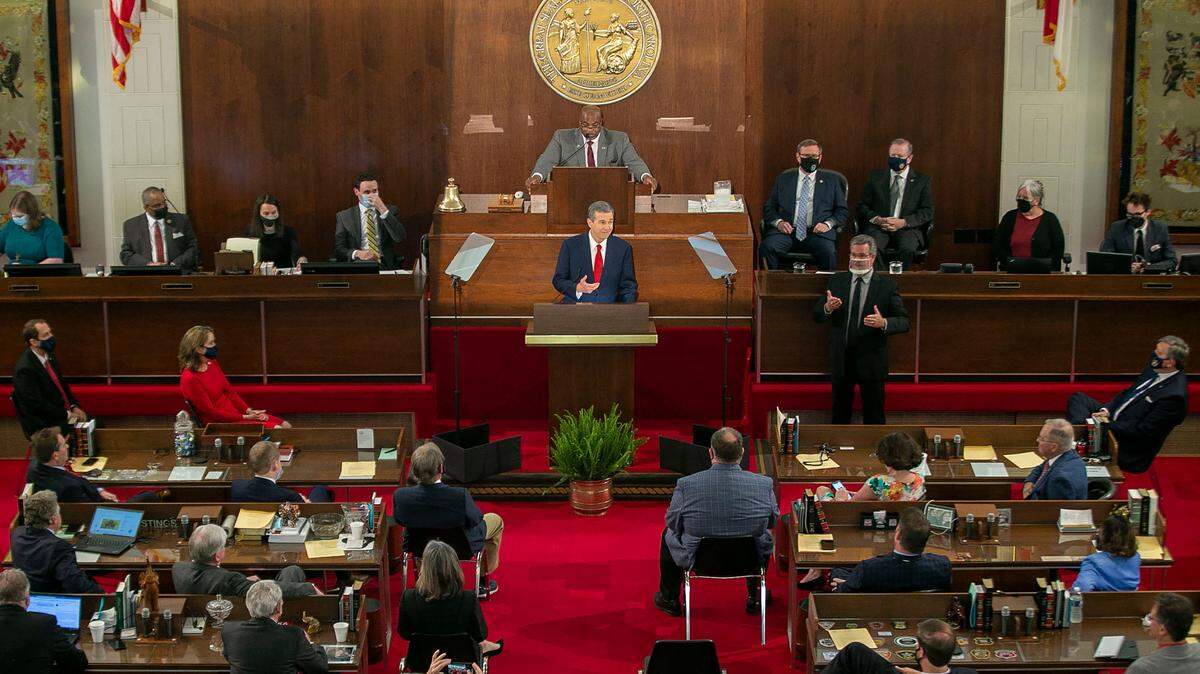
“This budget moves North Carolina forward in important ways,” Democratic Gov. Roy Cooper said when he signed it into law. “Funding for high speed internet, our universities and community colleges, clean air and drinking water and desperately needed pay increases for teachers and state employees are all critical for our state to emerge from this pandemic stronger than ever.”
Keep reading to get an idea of how much extra money you might expect to see in the bank, whether it’s from raises and bonuses or the tax cuts.
Future tax bills
There are three main ways the budget will cut people’s taxes: a lower income tax rate, a higher standard deduction and bigger child tax deductions.
There are also other pieces to the cuts that will affect smaller numbers of people, like that corporate income tax elimination and special carve-outs for veterans or business owners who got Paycheck Protection Program loans from the federal government earlier in the pandemic.
Here’s how the tax changes might affect you.
▪ Lower tax rate: The state’s current 5.25% personal income tax rate will drop to 4.99% starting in 2022 and will keep gradually dropping until it hits 3.99% in 2026 and beyond.
Cutting the income tax rate, whether for individuals or businesses, disproportionately helps wealthy people. But Republican Rep. John Szoka of Fayetteville said that by also raising the standard deduction, lawmakers are helping lower-income workers.
“It takes tens of thousands of taxpayers off the state tax rolls, and those are the folks who can least afford to pay tax,” he said. “Those are the folks where it makes the biggest difference.”
▪ Higher standard deduction: The standard deduction is the amount of income the state doesn’t tax. Working-class people who make below that limit won’t have to pay income taxes at all, at least not to the state. And for middle-class and wealthy people, raising the standard deduction means they’ll have to pay less.
Starting in 2022, the new standard deductions will be $25,500 for married couples filing jointly, $12,750 for single people or married people filing separately, and $19,125 for single parents or others who file with “head of household” status.
Each of those is $2,000 to $4,000 higher than the current limit and a significant increase from a decade ago, when Republicans took control of the Legislature and began cutting taxes. The standard deduction for married couples has risen from $6,000 to $25,500 in that time.
▪ Bigger child tax credits: People with kids will also have a lighter tax bill, due to changes that both grow the state’s existing child tax deductions by $500 and expands it to more wealthy families.
Exactly how much of a child deduction you get depends on how much you make. The new cutoff is at $140,000 for married couples, up from $120,000 currently. And the $500 increase for each income level doesn’t mean people will get an extra $500 off their tax bill per kid but rather that an extra amount of money will be deducted from their income in order to determine their tax bill.
Sound confusing? Here’s an example.
Consider a married couple with three kids making a combined $100,000 a year. Currently that family would pay taxes on $75,500 of their income, due to the standard and child deductions, at a 5.25% tax rate.
But for 2022, since the budget increases both the standard and child deductions, that same family will have to pay taxes on just $70,000 of their income — and at the new 4.99% rate. All combined, they will save about $470. Their state income tax bill should drop from $3,964 to $3,493.
▪ Veterans’ tax breaks: Several lawmakers said North Carolina’s new budget could position the state to be even more of a haven for military retirees than it already is, due to a change that exempts veterans from paying taxes on their military retirement pay.
North Carolina used to exempt up to $4,000 of that pay from taxes, but Republicans got rid of that in 2014 in order to make up for revenue losses from other tax cuts they passed at the time, WRAL reported. The new state budget brings it back and then some, with a total exemption.
The News & Observer previously reported that it was a major factor in Republicans winning support for the budget from at least two Democrats who represent veteran-heavy districts near Fort Bragg and are veterans themselves.
▪ No more corporate income tax: North Carolina already had a relatively low corporate income tax rate when Democrats controlled the General Assembly, at 6.99%. Republicans took control in 2011 and since then have dropped it to 2.5%, which is the lowest rate of any state that has a corporate income tax, according to the conservative Tax Foundation think tank. The new budget will drop it to 0% by 2029, joining six other states with no corporate income tax: Nevada, Ohio, Texas, Washington, South Dakota and Wyoming.
Rep. Marcia Morey, a Durham Democrat, said the corporate tax cuts mean North Carolina will be giving up nearly $1 billion a year in revenue so that wealthy business executives, many of them living in other states, can pocket the money instead.
“This revenue could be used to help education, the environment, mental health, substance abuse and address the ravages of increasing gun violence,” she said.
Republicans, though, said eliminating corporate taxes should attract more businesses to move to North Carolina and hire people here rather than somewhere else. Rep. John Bradford of Mecklenburg County, who as the CEO of a company called Pet Screening stands to benefit from the corporate tax cuts, said it “sends an incredible signal to the whole country.”
“If you’re thinking of fleeing another state because frankly you’re tired of bloated tax policies, well, we hope you’ll give us a look,” Bradford said during a House debate last month, shortly before House members approved the budget.
▪ PPP loans: North Carolina business owners, including some lawmakers, who received a loan from the federal Paycheck Protection Program will now qualify for a tax deduction on items they paid for using the loan. This applies even if the government forgave a PPP loan.
The House passed a bill including similar language earlier this year ahead of the tax filing deadline — over the former House finance committee chair’s objections due to ethical concerns — but the legislation stalled in the Senate before being added into the budget.
Raises and bonuses
The budget contains many different ways of getting state employees money — whether through raises or bonuses and depending on what part of state government they work for.
Here are the highlights.
▪ Raises for teachers: On average, from raises as well as step increases for different levels of experience, teachers all across the state will see an extra 5% boost spread out over the next two years.
And from a separate fund, teachers in 95 of the state’s 100 counties will get additional raises. The five being left out are the heavily Democratic counties of Wake, Mecklenburg, Durham, Guilford and Buncombe. Lawmakers said they weren’t trying to punish teachers in urban areas but rather used a formula to identify less wealthy counties that needed extra help.
▪ Bonuses for teachers: Every teacher in the state will get at least a $2,300 bonus. They’ll get an extra $500 if they make less than $75,000 a year. Teachers and support staff who worked with students with visual or hearing impairments during the pandemic will get an additional bonus of up to $350. Every principal will get a $1,800 bonus.
Teachers with career and technical education, Advanced Placement or International Baccalaureate classes can also get up to $50 per student who passes certain tests or workforce certifications, for a bonus of up to $3,500. Some bonuses for teachers in lower grades are on hold, however, with the money going to fund the broader bonuses for all teachers.
Schools are also allowed to ask permission to give signing bonuses up to $5,000 to recruit school psychologists. In small or low-wealth counties, schools will also be allowed to offer new teachers a signing bonus of up to $2,000, half of it funded by the state.
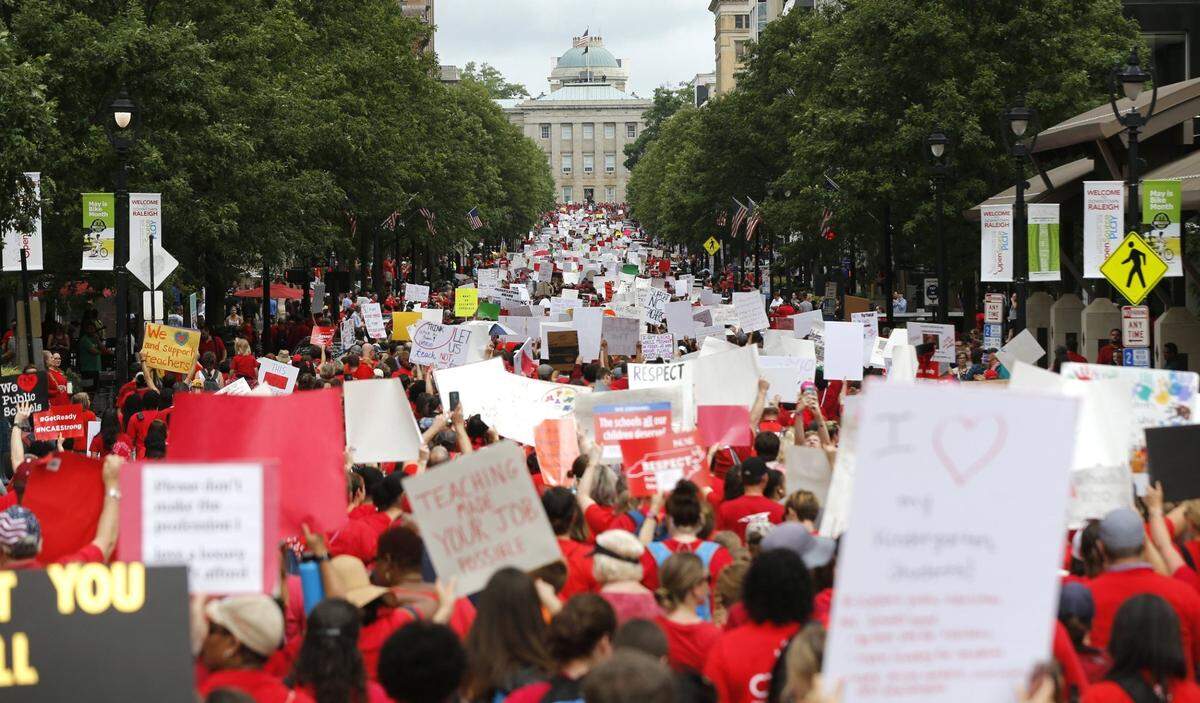
▪ Raises for state workers: Most state workers will get an average raise of 2.5% this year and again next year, for 5% total, just like teachers.
Some types of state workers will get different treatment, though. Corrections officers will get a 7% raise over the two years, on average, and probation and parole officers will get an average 17% raise.
School principals will see a 2.5% increase to their salary schedules. Noncertified school employees, which include bus drivers and cafeteria workers, were previously among the few state workers not to be guaranteed at least $15 an hour. But the state budget now says all such workers will get either a raise to $15 an hour within two years or a 2.5% raise for each of the next two years, whichever is greater.
▪ Bonuses for state workers: Every state employee will get at least a $1,000 bonus. There’s also an extra $500 for anyone making less than $75,000 or anyone who works in a state-run law enforcement agency, in a Department of Public Safety corrections job “requiring frequent in-person contact” or in a 24-hour medical facility run by the Department of Health and Human Services, such as one of the state’s mental hospitals.
▪ Adjustments for retirees: Retired state workers have, for years, been demanding a cost-of-living adjustment raise. Their pensions have not kept up with inflation since the Great Recession. Republican leaders, wary of other states with hefty retirement obligations, have consistently declined to approve permanent raises to state pensions. But they have given some one-time supplements — including in this budget, with a 2% bonus this year and 3% next year.
For more North Carolina government and politics news, listen to the Under the Dome politics podcast from The News & Observer and the NC Insider. You can find it at link.chtbl.com/underthedomenc or wherever you get your podcasts.
This story was originally published December 1, 2021 at 6:00 AM with the headline "NC’s new state budget has raises, bonuses and tax cuts. Find out what’s in it for you.."