Inside Lenovo’s RTP labs, cooling data centers is more than half the battle
READ MORE
Data Centers in North Carolina
Data centers are the dedicated areas few ever see that enable the technology we see, touch and listen to. They can be huge and loud, but they employ relatively few people. In this special report, The News & Observer looks into the rapid growth of data centers, their value to the state economy, and the massive amount of electricity needed to power them.
Expand All
VA, now home to hundreds of data centers, is tapping the brakes. Is that good for NC?

Duke Energy says it needs to ramp up new energy to serve data centers. Is it right?
Data centers are coming to NC. Can Duke power them while keeping your lights on?
Data centers in NC: Secret locations, hyperscale giants and Raleigh’s next ‘edge’ site
Inside Lenovo’s RTP labs, cooling data centers is more than half the battle
The problem Lenovo faces at its Research Triangle Park campus is one of increasing complexity.
Modern life runs through computing servers. These boxy machines enable Google searches, Netflix streams, “smart street lights,” and organizational system backups. They are in telephone poles, the backs of grocery stores and, frequently, squeezed into racks that fill mammoth data centers operated by the world’s largest tech companies.
Compared even to a few years ago, energy demands of these servers have surged. While a typical one might use 750 watts, a new artificial intelligence-compatible server — with two central processing units (CPUs) and eight graphics processing units (GPUs) — can consume 10 times more.
All computing produces heat, a principle of thermodynamics that explains why most laptops contain small fans. And more power means more heat. This is the challenge for Lenovo and a handful of smaller systems solutions providers in the Triangle: With finite energy resources, how do you cool servers that have gotten ever-hotter in the AI age?
Blast them with fans? Chill them with surprisingly warm water? Or lower these frames into liquid vats like chickens in a deep fryer? Everything’s on the table.
“The biggest game that we’re playing is how do we move the heat efficiently from the chips that are actually doing the useful (computing) into the universe,” Lenovo thermal engineer Scott Holland said during a recent tour of the company’s North American headquarters in Morrisville.
When it comes to decreasing temperature within data center buildings, the traditional industry answer has been to run massive, deafening, air-cooling units.
Earmuffs are advised inside one of Lenovo’s air-cooled data center labs, where the noise near certain server racks approximates that of a passing subway train. This is the cooling unit in action.
Fans expel hot air out the backs of servers. If each server were to face the same direction, this hot air would funnel to one side of a data center and cause a climate imbalance. So operators position racks to create alternating “hot” and “cold” aisles. An air handling unit then collects the hot aisle air, chills it, and recycles it to the front of the servers through a raised, pressurized floor.
Air-cooling remains the dominant industry method, but this process is very energy intensive.
“(Air cooling is) easy and people know how to do it,” said Scott Tease, Lenovo’s general manager of AI and high performance computer division. “But it’s just kind of wasteful.”
Alternatives have been around for decades, but interest in replacing (or at least augmenting) fans grew after November 2022, when the California nonprofit OpenAI released the large language model ChatGPT. This set off a race among multinational corporations and startups alike toward power-hungry generative AI.
“We’re starting to get all these (AI) applications rolling out,” said Tom Wilson, principal technical executive at the nonprofit Electric Power Research Institute. “Nvidia is selling more GPUs, and that’s anticipated to keep growing given the current orders.”
Fans can be added to cool denser AI servers to a point, but data center operators like Amazon, Microsoft and Meta must weigh how much power and money goes toward cooling versus actual computing.
Cooling with 113 degree water
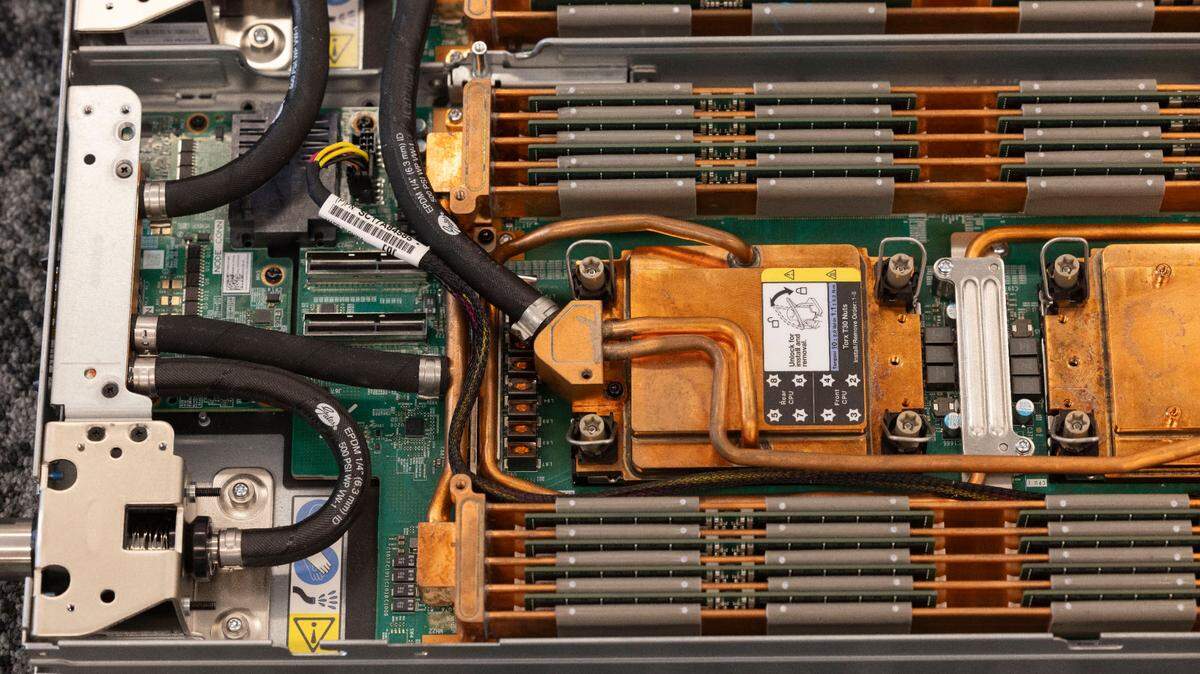
Server solutions companies like Lenovo have made the Triangle an important development ground for liquid cooling. This approach flows liquid as near to the individual server parts — the CPUs, GPUs, memory and hard drives — as safely possible.
“The closer the water is to the heat, the better the cooling is,” Holland said.
Lenovo’s flagship liquid cooling apparatus is called Neptune. The system pumps treated water through copper tubes at 113 degrees Fahrenheit. This might seem like a counterintuitive temperature, but liquid is capable of carrying significantly more heat away per volume than air. This is why the human body cools off faster by jumping in a pool than standing in front of a fan.
This heat can then more easily be dissipated afterwards, as pretty much anywhere in the world has a surrounding climate cooler than this water leaving the data center.
“(Nvidia GPUs) lead to higher density racks, and that heat needs to go somewhere,” said Sean Graham, director of data center research at the analytics firm International Data Corp. “Liquid cooling is a much more efficient way for heat dissipation.”
At its Triangle labs, Lenovo experiments with another alternative called immersion cooling, which sees servers submerged in tubs of insulating material known as dielectric fluid.
Liquid cooling isn’t new; IBM designed the first water-cooled system on its System/360 mainframe computer in the 1960s, and Lenovo introduced a liquid cooling system in 2012. Last year, the Triangle added another major liquid-cooling company when the United Kingdom-based Iceotope established its North American headquarters in Raleigh.
Iceotope uses both types of liquid cooling — direct to chip and immersion — to remove heat without needing any fans. The company takes clients’ servers out of the rack and swaps out fans for its two-prong approach.
“What we’re seeing is that traditional air cooling is not able to keep up with the real density of what these servers are asking for,” said Francesca Cain-Watson, Iceotope’s head of North American sales. “So we’re seeing the market move towards liquid cooling.”
Momentum for more solutions
Some say the technology will, for now, continue to focus on limited applications.
“Liquid cooling makes me really squirrelly,” said David Brain, a chief systems architect at the Research Triangle Park-based broadband service nonprofit MCNC. “You’ve got water and power in close proximity. It’s going to be (for) specialized use cases for things like AI.”
Yet momentum behind liquid cooling has grown.
“I would say it is significant,” said Tony Atti, CEO of Durham-based Phononic, a solid state cooling solutions company that works with data centers containing liquid-cooled and air-cooled servers. “I don’t like to give forecasts, but when you just look at the build pattern and the timing of these projects, I expect in late ‘26 and in the first half of 2027 you will see broader, wider-spread liquid cooling adoption.”
The pace of this adoption may depend on how much energy future AI requires. Artificial intelligence is a protean technology, and projections about its energy demands vary. In January, the release of the Chinese generative AI platform DeepSeek caused industry stakeholders to reflect on whether top-end power projections will actually be needed to fuel future advanced artificial intelligence.
“DeepSeek was one example of somebody making a jump in terms of potential efficiency,” Tom Wilson at the Electric Power Research Institute said. “The dust will still settle on exactly what they did and how they did it.”
The ongoing AI boom, though, has undoubtedly sparked an appetite for denser, energy-devouring servers. On a professional level, it has made the work inside Lenovo’s RTP labs more interesting.
“As a thermal engineer, how do I cool these ever-increasing component powers?” Hollands said. “Do I have an existent tool, or is it time to innovate and invent?”
The News & Observer’s Inside Look takes readers behind the scenes to illuminate the people and places in our community.
This story was originally published March 7, 2025 at 5:00 AM with the headline "Inside Lenovo’s RTP labs, cooling data centers is more than half the battle."