Watch out NC drivers. It’s dark earlier and a million deer are on the move.
Shortly after watching the Carolina Panthers fall to the Kansas City Chiefs last month, Dan Henderson and his teenage son were driving home to the Iron Station area in Lincoln County.
The sun had already dipped behind the trees lining N.C. 73, a two-lane road bordered by patches of woods that runs west from Lake Norman.
Then, in a flash, Henderson saw it, a doe sprinting in front of his Toyota Tundra pickup truck.
“I saw the left eye of the deer and the face of the deer for about a half second before it hit the truck,” Henderson said. “I didn’t hit the break. I didn’t do anything. It was in full speed, and I was in full speed.”
The deer smashed into the truck’s bumper, spun and slammed its rear into the passenger door before cartwheeling to the right and off the road, where it lay dead.
Henderson and his son were uninjured. But not everyone who strikes a deer while driving in North Carolina is so lucky.
October through December is the peak time for vehicle wrecks involving deer in this state, according to a Charlotte Observer analysis of state data.
About half of the roughly 20,000 reported collisions with deer that happen annually take place in the final three months of the year, Department of Transportation data show.
That’s mating season, when deer are more likely to be on the move, said Falyn Owens, wildlife extension biologist with the N.C. Wildlife Commission. Plus, with daylight savings time, more drivers are on the road in the dark dawn and dusk hours, when the animals are about.
Deer are crepuscular, meaning they’re most active just before sunrise and sunset, Owens said.
“Be aware,” she stressed.
Some wrecks are deadly
Each year, the Department of Transportation collects data on roughly 22,000 vehicle collisions with animals that either injure someone in a vehicle or cause $1,000 or more in damage.
State officials estimate that 90% of these dangerous crashes involve deer. Most of the other wrecks involve bears, officials said.
Most wrecks with animals do not injure drivers or passengers, data show.
But about 40 people each year in North Carolina receive a major injury or are killed in crashes with wildlife, the Observer’s analysis found. About 40% of those wrecks happen in the final three months of the year.
The dangers extend beyond vehicles striking an animal shooting into the road.
In October, just before sunrise, a Volkswagen SUV hit a deer on Interstate 485 near West W.T. Harris Boulevard. Then a Dodge Caravan smashed into the disabled Volkswagen, killing the Caravan’s driver.
“Sometimes there’s not a lot that you can do,” said Christopher Casey, master trooper for the N.C. State Highway Patrol. “They’re going to come out at the spur of the moment. If it hits the front of your vehicle, we’ve seen them go through radiators.”
Urban deer populations
White-tailed deer are everywhere in North Carolina, including the state’s urban counties. They thrive in suburban communities, Owens said, where there is little hunting, no natural predators and ample native plants and landscaping to eat.
In some places city officials have tried to cull their numbers. Town leaders in Tega Cay, across the South Carolina border from Charlotte, spent more than a quarter million dollars this year sterilizing and shooting about 240 deer. The city’s deer population ranges between 800 and 1,200 animals, city leaders said.
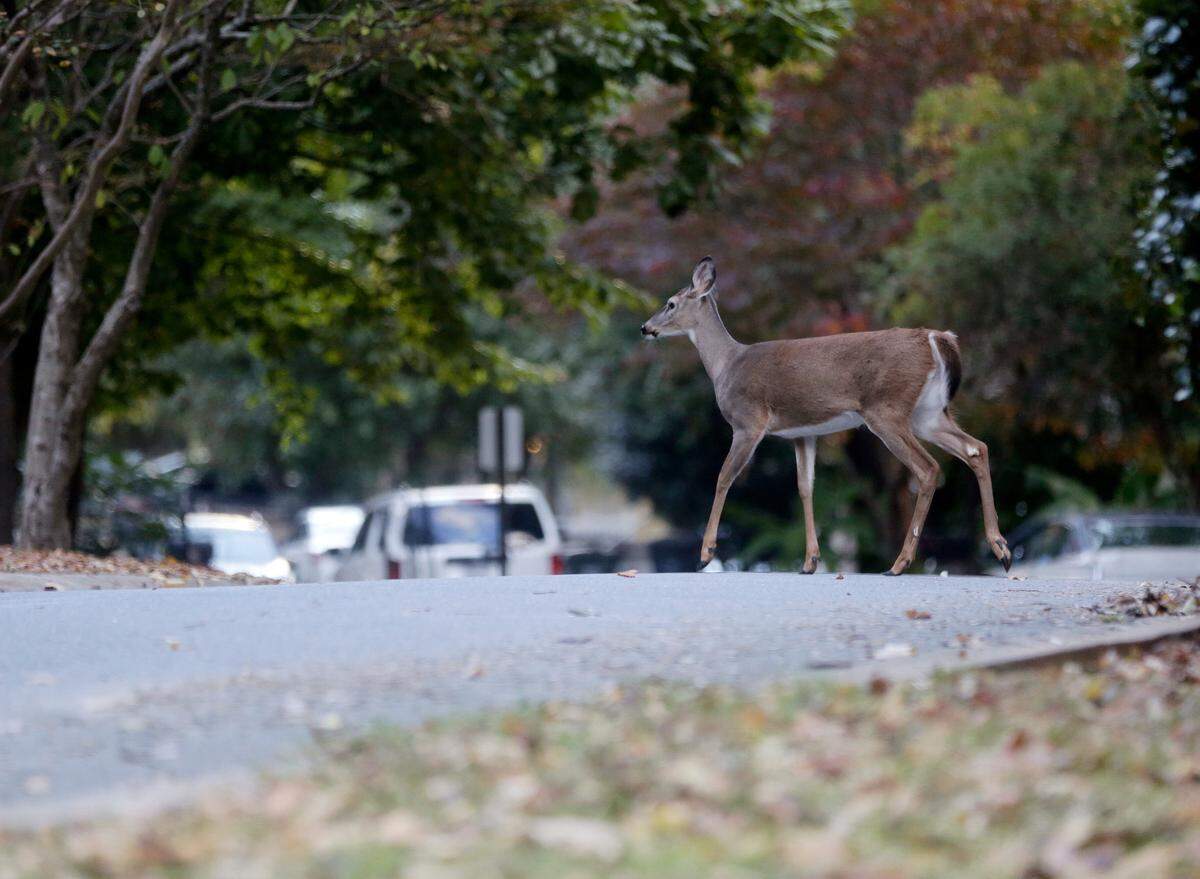
With a deer population that is still thriving and hundreds of thousands of cars, crashes happen.
Vehicles hit more wildlife in Wake County, the state’s most populous county, than any other county in North Carolina, according to DOT data. More than 4,500 animals — nearly all deer — have been hit there since 2020, records show. Mecklenburg County had about half the number of animal-involved wrecks.
One indicator that Charlotte is not immune: the city’s 311 call center buzzes with requests to remove dead animals.
Rodney Jamison, director of Solid Waste Services for Charlotte, said the center receives about 1,000 calls a year for dead deer in the city’s right of way. Many phone in from southeastern Charlotte, which has some of the city’s densest canopy coverage.
In a pickup truck outfitted with a forklift-like device, a city maintenance worker criss-crosses Charlotte, scooping up dead animals, big and small. They’re taken to a designated spot at the Concord landfill, where they’re disposed of, Jamison said.
“That person’s day is full,” he said. “It’s jam-packed. They start out at 7 a.m. and they’re not finished until 3 or 4 p.m. and it’s nonstop moving all over the city.”
This time of year is the worker’s busiest, Jamison said.
This story was originally published December 17, 2024 at 5:30 AM with the headline "Watch out NC drivers. It’s dark earlier and a million deer are on the move.."