
Prehistoric predator — with three eyes — found as new species in Canada. See it
Hundreds of millions of years ago, animals didn’t follow the same “rules” of biology we know today.
Winged reptiles flew above armored sea creatures, and the planet looked unrecognizable compared to modern day.
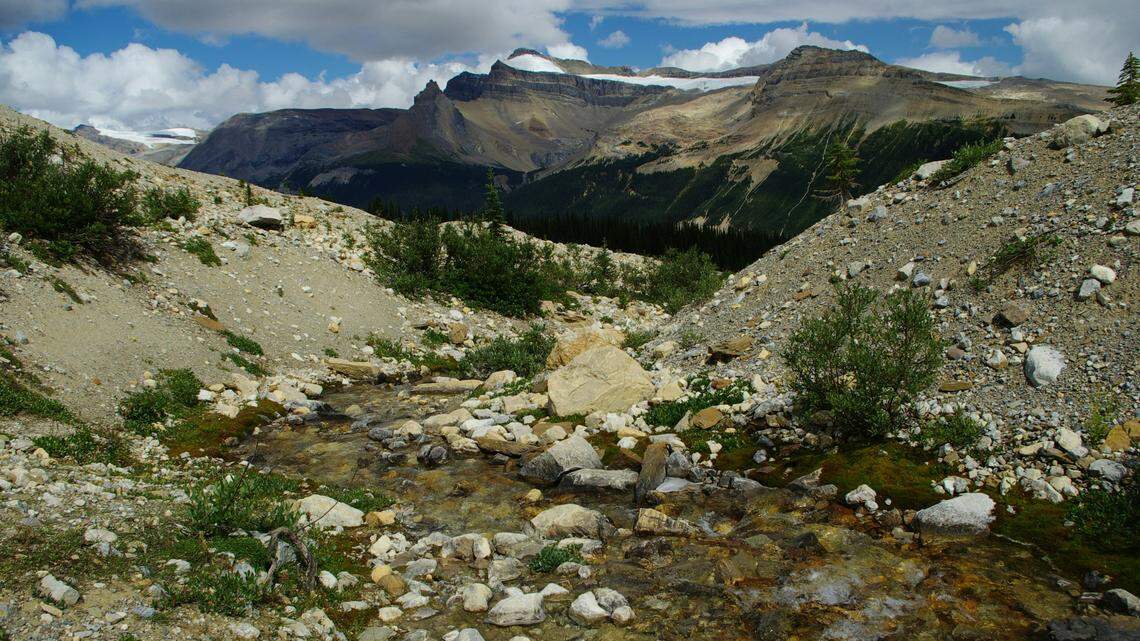
During this time, what is now the Canadian Rockies was covered in water, and animals swam above the ground that would later become mountains.
In Yoho National Park, fossilized sea creatures are found in the Burgess Shale Formation, a layer of rock dating back to the mid-Cambrian period.
Paleontologists excavating the formation found 60 specimens of an unidentified creature over nine field seasons between 1990 and 2022, and now, those fossils have been identified as a new, and peculiar, species.
The animal is a new species of radiodont, according to a study published May 14 in the peer-reviewed journal Royal Society Open Science.
“Radiodonts were the first group of arthropods to branch out in the evolutionary tree, so they provide key insight into ancestral traits for the entire group,” study author Jean-Bernard Caron said in a May 14 news release from the Royal Ontario Museum. “The new species emphasizes that these early arthropods were already surprisingly diverse and were adapting in a comparable way to their distant modern relatives.”

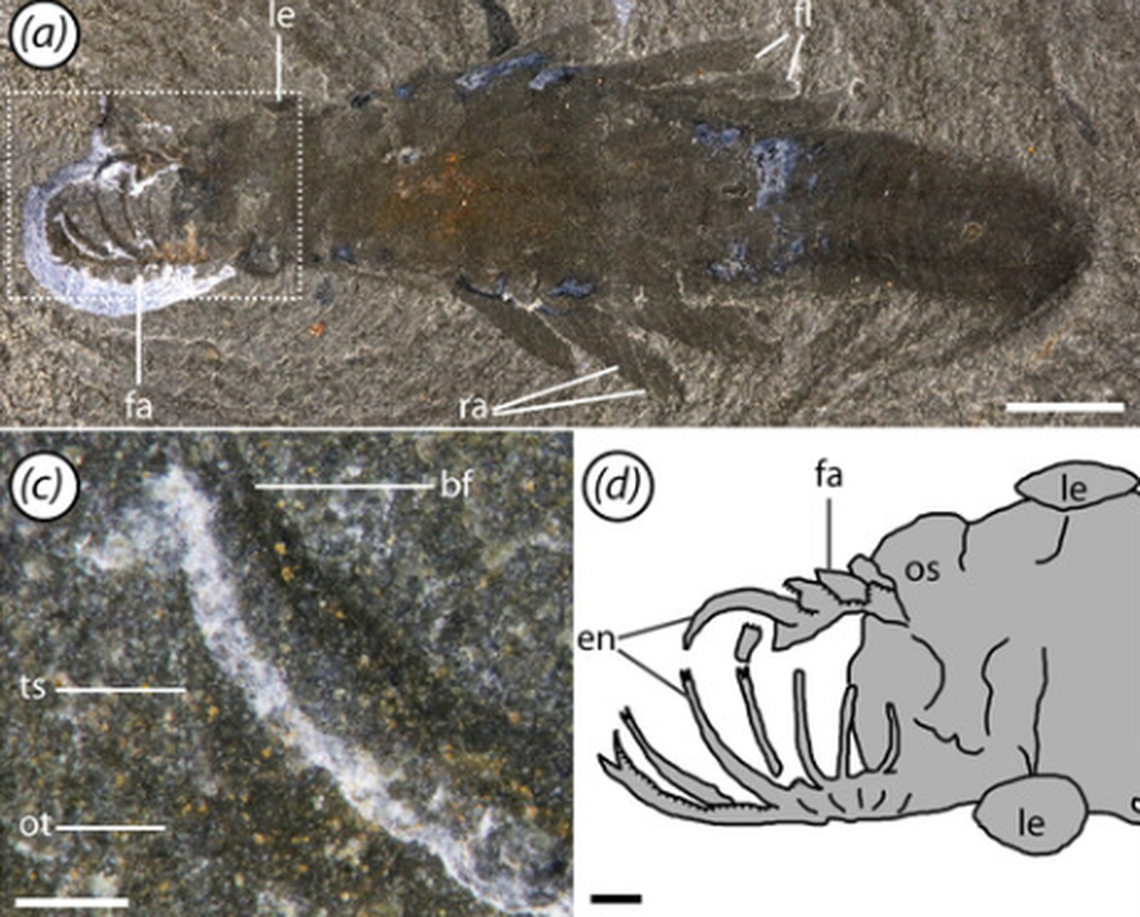
The holotype, or primary specimen of the new species, was completely preserved, unlike many fossils where just a few parts survived the test of time, according to the study.
The animal was “about the size of your index finger,” researchers said, ranging in length from about 0.6 inches to 2.4 inches long.
The radiodont’s body was divided into a neck with four segments, a body with six segments, and a secondary trunk with 16 segments, according to the study.
The new species was also notable for its “three eyes, spiny jointed claws, a circular mouth lined with teeth and a body with swimming flaps along its sides,” according to the release.
This was a predatory species, researchers said, related to Anomalocaris canadensis, the largest animal known from the Burgess Shale and an apex predator.
The new species was named Mosura fentoni because of the “broad swimming flaps near its midsection and narrow abdomen” that reminded researchers of the fictional Japanese kaiju Mothra, earning the species the nickname “sea-moth,” researchers said.
The species name, fentoni, honors Royal Ontario Museum technician Peter E. Fenton for 40 years of service and friendship in the invertebrate palaeontology section, according to the study.
The specimens were incredibly well preserved, researchers said, meaning they could see not only the hard exterior of the body, but also some of the internal anatomy like the nervous system, some circulatory features and a digestive tract.
“Very few fossil sites in the world offer this level of insight into soft internal anatomy,” Caron said. “We can see traces representing bundles of nerves in the eyes that would have been involved in image processing, just like in living arthropods. The details are astounding.”
The sea-moth also didn’t have a real circulatory system made of arteries and veins, but rather their hearts would pump blood into a large internal body cavity called a lacunae, which were preserved as “reflective patches” inside the body and out into the swimming flaps, according to the release.
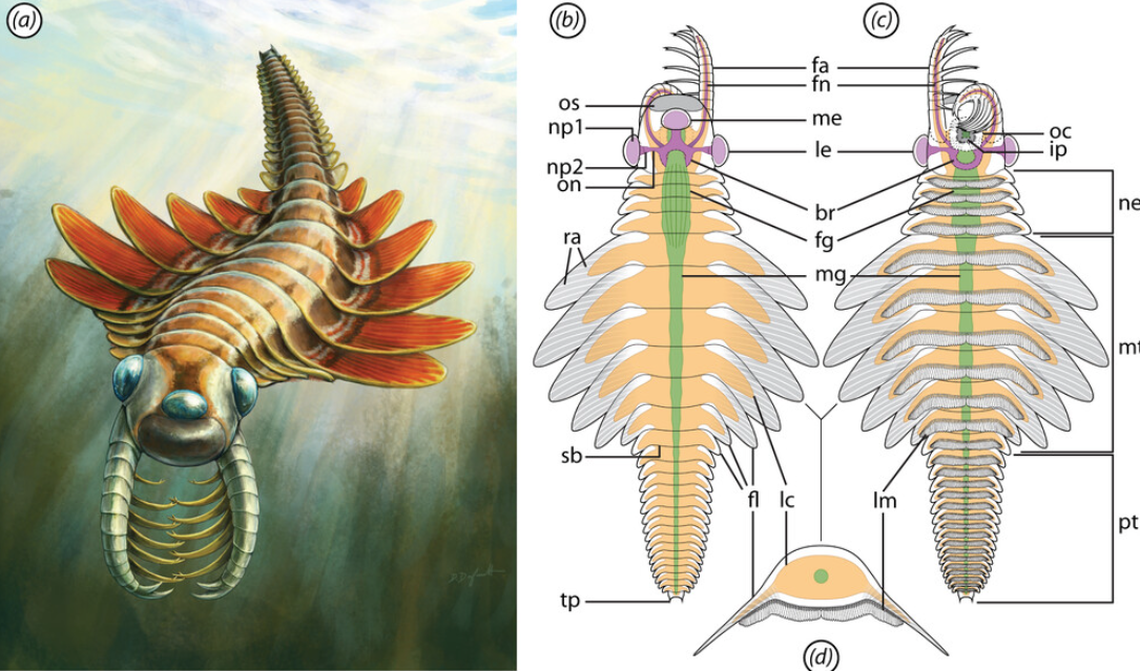
“The well-preserved lacunae of the circulatory system in Mosura help us to interpret similar, but less clear features that we’ve seen before in other fossils. Their identity has been controversial,” study author Joseph Moysiuk said in the release. “It turns out that preservation of these structures is widespread, confirming the ancient origin of this type of circulatory system.”
The new species fossils were dated to about 506 million years ago, during the Cambrian period but after what is known as the “Cambrian Explosion,” according to the National Park Service.
Starting around 545 million years ago, there was a burst of new species taking over the world’s oceans including animals with hard shells that were more likely to be preserved, according to the NPS. The diversity of life expanded in a way that has never been seen in any other era.
Evidence of this explosion is present throughout the Burgess Shale, leading to its establishment as a world heritage site by UNESCO in 1981, NPS said.
Yoho National Park is in the Canadian Rockies of southern British Columbia, about a 150-mile drive west from Calgary.
This story was originally published May 15, 2025 at 11:00 AM with the headline "Prehistoric predator — with three eyes — found as new species in Canada. See it."
