19th-century toddler may have died from doctor’s mercury treatment, bones reveal
The Industrial Revolution changed the world, bringing new technology and development to the masses.
It began in the United Kingdom in the 18th century, but the transformation took a bit longer to cross the English Channel.
The industrialization of France — split in two phases between 1830 and 1914 — brought about advances in biology, public health, chemistry, pharmacy and medicine.
Now, researchers analyzing human remains buried in a French cemetery believe it may have also been a time for medical experimentation.
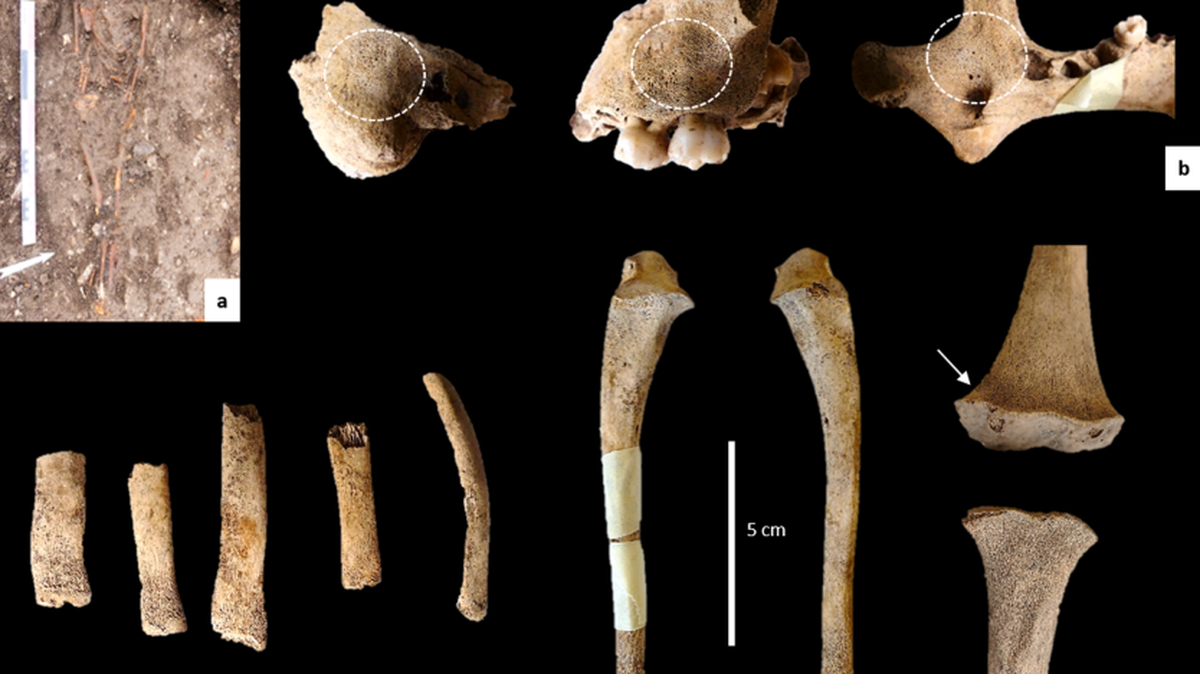
During excavations of the “rue Thubeuf” necropolis, archaeologists uncovered 53 graves of people buried between 1780 and 1883, according to a study published Feb. 25 in the peer-reviewed International Journal of Paleopathology.
One burial belonged to a young child and dated to the late 18th to early 19th century, according to the study.
A few of the bones were selected for more advanced scans and chemical analysis, allowing researchers to know about the child’s short life, from their age to their nutrition.
“Individual SP5 died at the estimated age of 3-4 years old and displayed multiple signs of deficiencies, probably linked to rickets and scurvy,” researchers said.
Rickets is a disease seen in children caused by severe vitamin D deficiencies, according to the study. Archaeologists can detect rickets in human remains because the disease “impairs the mineralization of newly formed bone and can lead to skeletal deformities,” which can be observed centuries later.
Scurvy, a vitamin C deficiency, commonly occurs in conjunction with rickets and can cause weakened connective tissues that can be fatal if left untreated, according to the study.
Both afflictions can be caused by a combination of environmental factors and malnutrition, and were not altogether uncommon during the time period this toddler lived.
However, another feature of the young child’s chemical analysis was peculiar.
Researchers found an “abnormal” concentration of mercury when they analyzed the inner sections of bone, according to the study. The value was “within the higher range of other cases of mercury detection.”
While mercury was present in the environment as the country industrialized, the high concentration, particularly at the child’s young age, suggests it was given intentionally, possibly as a treatment for the symptoms of rickets and scurvy, according to the study.
“During the industrialization period, major cities had mirror or hat factories, where craftsmen frequently used mercury for mirrors’ reflective layers and hats’ felt production,” researchers said. “Even though mercury contamination of working adults in this area remains possible, it is unlikely that very young children were exposed to the same extent. Given the young age at death of Individual SP5 and their pathological status, exposure due to labor conditions appears unlikely, and the hypothesis of poisoning through medication or food, favored.”
Historical records suggest mercury may have been a relatively common medical treatment in the 18-19th centuries, but if the child was given the metal intentionally, their remains are now “the first paleopathologically documented case of mercury treatment associated with vitamin deficiencies,” researchers said.
The child’s mercury poisoning was likely “severe,” researchers said.
Mercury poisoning can cause coughing, trouble breathing, a metallic taste in the mouth, nausea or vomiting, bleeding and swollen gums, a burning sensation in the stomach, diarrhea, blood in vomit or stool, changes to urine color, feeling numb, tremors, blurry vision, memory loss, seizures and death, according to the Cleveland Clinic.
The cemetery is in Rouen, in north-central France.
The research team includes Alexandra Zinn, Aminte Thomann, Yannick Lefrais, Olivier Dutour and Antony Colombo.
This story was originally published April 4, 2025 at 11:40 AM with the headline "19th-century toddler may have died from doctor’s mercury treatment, bones reveal."