
Prehistoric ‘gentle giant’ — nearly 23 feet long — found in Argentina. See new species
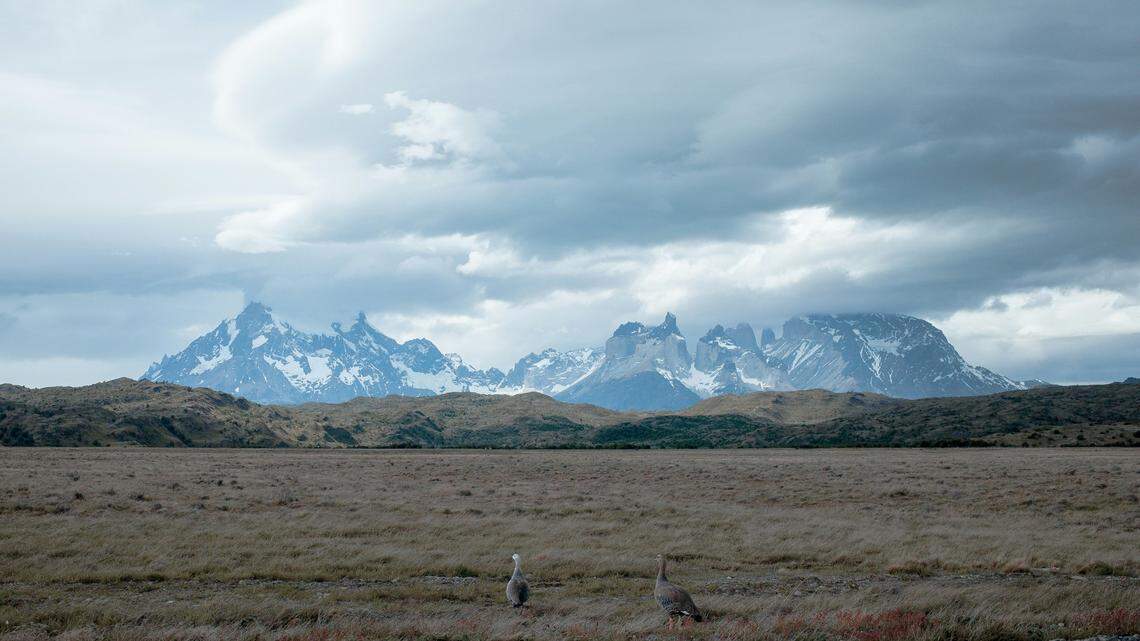
Nearly 80 million years ago, a small pond oasis was home to a variety of creatures both in the water and on land.
Tropical air-breathing snails lined its shores and shelled creatures lay just below the surface.
The water hole was surrounded by palm trees and sand dunes during the late Cretaceous period, but since then, the environment has changed drastically.
Today, this area is known as the Anacleto Formation in northern Patagonia in Argentina and consists of a massive salt flat.
It’s also the site of a new prehistoric species discovery.
A group of paleontologists and researchers from Argentina and Uruguay, led by National Geographic explorer Diego Pol, were working in the salt flats when they discovered fossilized bones, according to a March 5 news release from National Geographic.
Paleontologists uncovered nine vertebrae, parts of the front leg, and part of the pelvis and bones from the back legs, as well as toes that couldn’t be attributed to one limb, according to a study published March 5 in the peer-reviewed journal Revista del Museo Argentino Ciencias Naturales.
The bones belonged to a new species of titanosaur, a long-necked and herbivorous dinosaur considered a “gentle giant,” researchers said.
Chadititan calvoi, or the “titan of the salt,” was a “very small and gracile-built” titanosaur compared to other related species, according to the study.
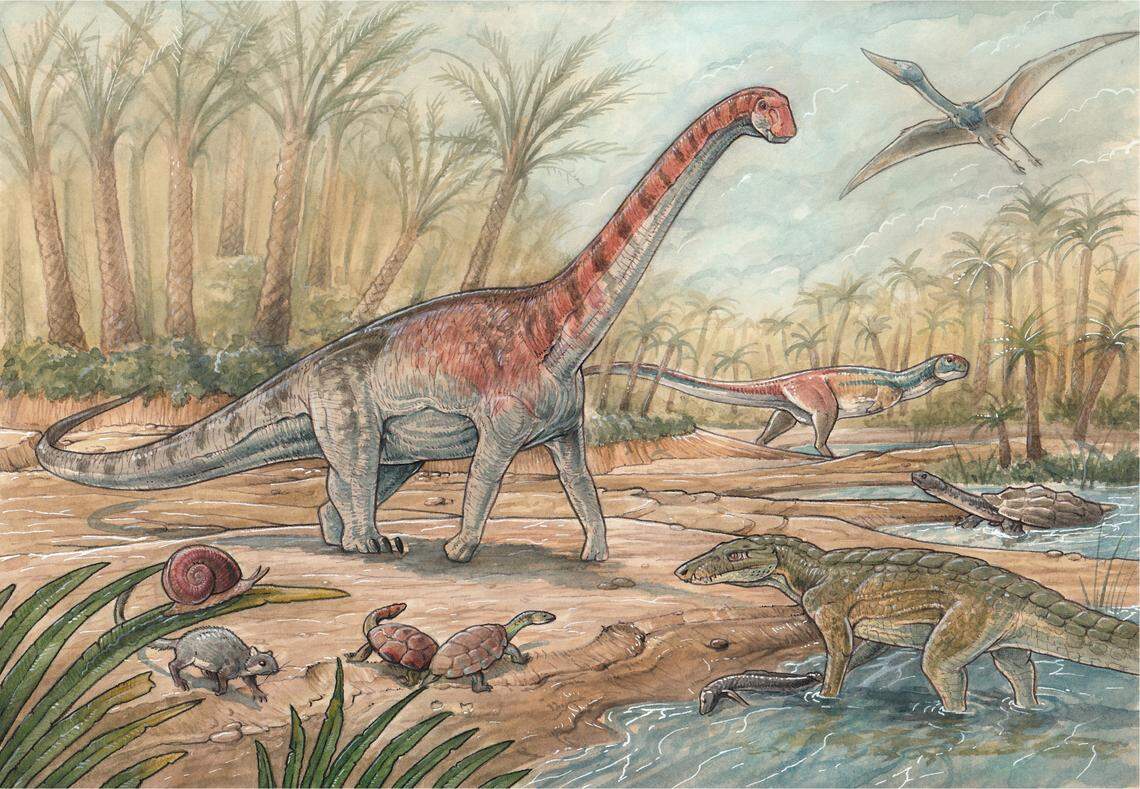
Based on the lengths of the bones discovered, the animal was likely about 23 feet long, researchers said, while other titanosaurs could reach lengths of up to 100 feet long.
The dinosaur’s “slender” body was evident from “its well-preserved bones” that show “it had elongated (vertebrae) and delicate limb bones that set it apart from its relatives,” according to National Geographic.
.jpeg "new-dino-2024-12-21 at 13.06.32 (1).jpeg")
While the new species was the most significant part of the paleontologists’ discovery, they found other evidence of prehistoric life at the same site.
“In addition to Chadititan, the fossils we identified of mollusks, fish and turtles enriches our understanding of this ancient ecosystem and expands our knowledge of life in Patagonia near the end of the dinosaur era,” Pol said in the release. “In this case, the abundance of turtles and scarcity of crocodiles compared to regions in Europe and North America during the same period further highlights how Patagonia ecosystems were distinct as the continents drifted apart during the Cretaceous.”
The fossils and Anacleto Formation were dated to roughly 78 million years ago, researchers said.
“One of the most remarkable aspects of the discovered fauna is the overwhelming abundance of freshwater turtles, which make up more than 90% of the recovered fossils. This percentage is highly unusual,” said Federico Agnolin, the first author on the paper.
Pol’s work in Patagonia has yielded exciting results before.
In April, National Geographic announced the discovery of another new species of small titanosaur found at the La Colonia Formation in Patagonia by Pol and his team, McClatchy News reported.
The team did it again in May, announcing the discovery of a new species of abelisaurid, a short-armed predator, McClatchy News reported.
Patagonia is a geographic region in southern Argentina and Chile, covering the entirety of the southern tip of South America.
The research team includes Pol, Agnolín, Matías J. Motta, Jordi Garcia Marsà, Mauro A. Aranciaga-Rolando, Gerardo Álvarez-Herrera, Sebastian Rozadilla, Federico Brissón-Egli, Mauricio A. Cerroni, Karen M. Panzeri, Sergio Bogan, Silvio Casadio, Juliana Sterli, Sergio E. Miquel, Sergio Martínez, Leandro M. Pérez and Fernando E. Novas.
This story was originally published March 5, 2025 at 3:39 PM with the headline "Prehistoric ‘gentle giant’ — nearly 23 feet long — found in Argentina. See new species."
