
Mysterious tooth pendant — at least 7,900 years old — found in Lithuania, study says
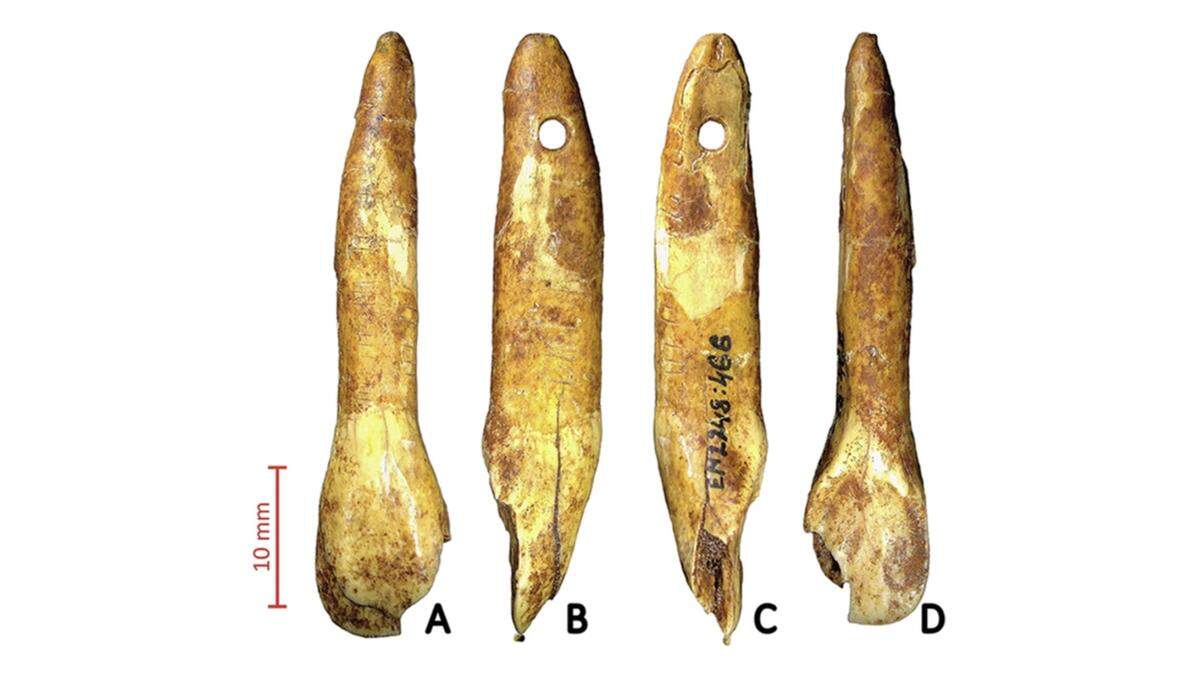
Archaeologists in Lithuania recently uncovered an unusual animal tooth pendant with mysterious engravings.
The carved tooth — which dates back thousands of years — was found during the reexamination of a Stone Age burial site in Donkalnis, in western Lithuania, about 60 miles from the Baltic Sea.
The site, which was first excavated in the 1980s, was revisited to better understand its animal remains, which have not received much attention, according to a study published on Feb. 20 in the journal Antiquity.
Examining the rare pendant
The pendant was found alongside the remains of two children — both under 8 years old — in a burial known as Grave 5. It was radiocarbon dated to between 6000 and 5900 B.C.
Measuring about 1.5 inches and distinguished by a circular perforation, the artifact was fashioned from a Eurasian elk incisor.
The fact that a pendant was found is not unusual. In fact, more than 40 other animal tooth pendants — including from European bison and red deer — were discovered inside the same grave.
What is so extraordinary is that this artifact was engraved with a series of tiny, horizontal grooves, researchers said. Specifically, there were three clusters of six, 12 and 18 incisions.
“In our experience, engraved tooth pendants are rare in European hunter-gatherer burials,” archaeologists said.
Adding to the fascination, the grooves appeared to follow a pattern, with each grouping being a multiple of six.
“This indicates a particular logic and intent motivating the incisions,” archaeologists said.
While it’s impossible to know the intent behind these markings, several hypotheses were put forward. Archaeologists wondered whether they could have served as a mnemonic device, which can help recall information, or as a form of communication. It’s also possible they had no significance and were simply engraved as decorations.
Researchers also noted that Eurasian elk were highly regarded by the prehistoric inhabitants of northern Europe, perhaps lending extra significance to the artifact.
Concluding, the archaeologists said the “discovery is a valuable reminder of the importance of detailed (re-)examination of any seemingly ordinary find, including small objects such as tooth pendants.”
The study authors were: Adomas Butrimas, Marius Iršėnas, Aija Macāne, Kristiina Mannermaa, Kerkko Nordqvist and Tomas Rimkus.
This story was originally published February 20, 2025 at 5:53 PM with the headline "Mysterious tooth pendant — at least 7,900 years old — found in Lithuania, study says."