Part 3: Gambling donations go to NC sheriffs, legislators, Supreme Court campaign
AI-generated summary reviewed by our newsroom.
- Gaming operators donated to judges and lawmakers amid pending legal appeals.
- Court of Appeals reversed Robeson ruling; Griffin alone dissented.
- Operators funneled funds while criminal probes and equipment seizures continued.
READ MORE
Inside the Triangle’s illegal gaming cafés
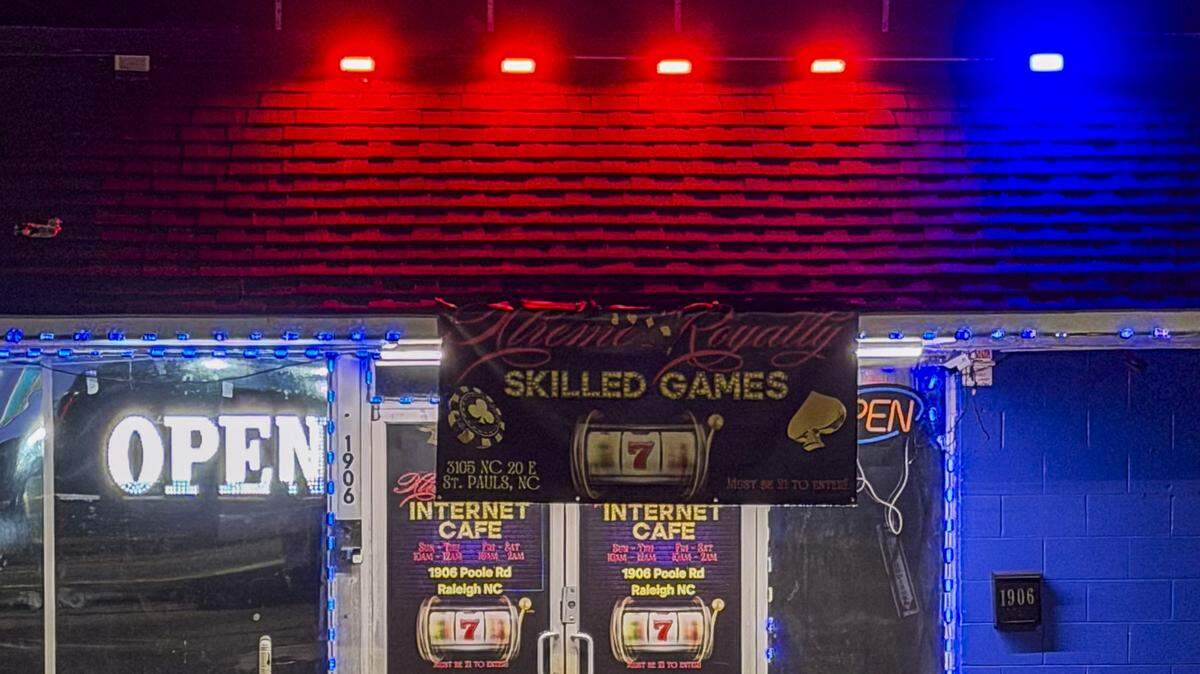
The News & Observer visited a dozen area electronic gaming businesses and found their continued, unregulated existence is due less to any legal loopholes and more to authorities in Raleigh, Durham and Cary choosing not to close them.
Expand All
.jpg)
.jpg)
In 2023, a man named Daniel Storie sued the Robeson County sheriff for threatening to shut down Storie’s business, No Limit Games, which operated video sweepstakes in the rural county along the South Carolina border.
Gaming was a family affair; four years earlier, Storie and his father, Danny Storie, had been arrested for running illegal gambling operations in neighboring Bladen and Columbus counties.
Robeson County Superior Court ruled in favor of No Limit Games, concluding its sweepstakes weren’t unlawful contests of chance because players could reveal outcomes on computer terminals without playing the animated slot-like games. North Carolina quickly appealed.
The next month, July 2023, Daniel Storie donated $6,500 to the campaign of Judge Jefferson Griffin, who was running for a seat on the North Carolina Supreme Court. Danny Storie, the father, contributed the same amount to the Griffin campaign the same day. When the Stories made these donations, Griffin was among 15 North Carolina appellate court judges who could have been selected to a three-judge panel that would hear the son’s appeal.
A few months later, the Griffin campaign refunded the Stories $100 each to comply with campaign financing limits. According to North Carolina State Board of Elections records, the Griffin campaign then refunded the younger Storie $4,000 in May 2024. The next day, the Court of Appeals randomly assigned Griffin to serve on the panel that would hear Storie’s case.
Two months later, after Judge Griffin had heard but not yet ruled on the No Limit case, Daniel Storie gave his Supreme Court campaign a second donation of $4,000.
On Dec. 31, 2024, the North Carolina Court of Appeals reversed the lower court decision, with two of the three judges determining that No Limit operated an illegal, chance-based sweepstakes. Griffin dissented, contending in part that the instant reveal function did not use an unlawful “entertaining display.”
In early February, Daniel Storie appealed the ruling to the State Supreme Court, citing Griffin’s dissent. Later that month, local police arrested Storie, 40, in his hometown of Mooresville for operating illegal video sweepstakes machines in Greensboro — more than 100 miles from Robeson County. His pending charges included felony gambling, felony money laundering and misdemeanor possession of slot machines.
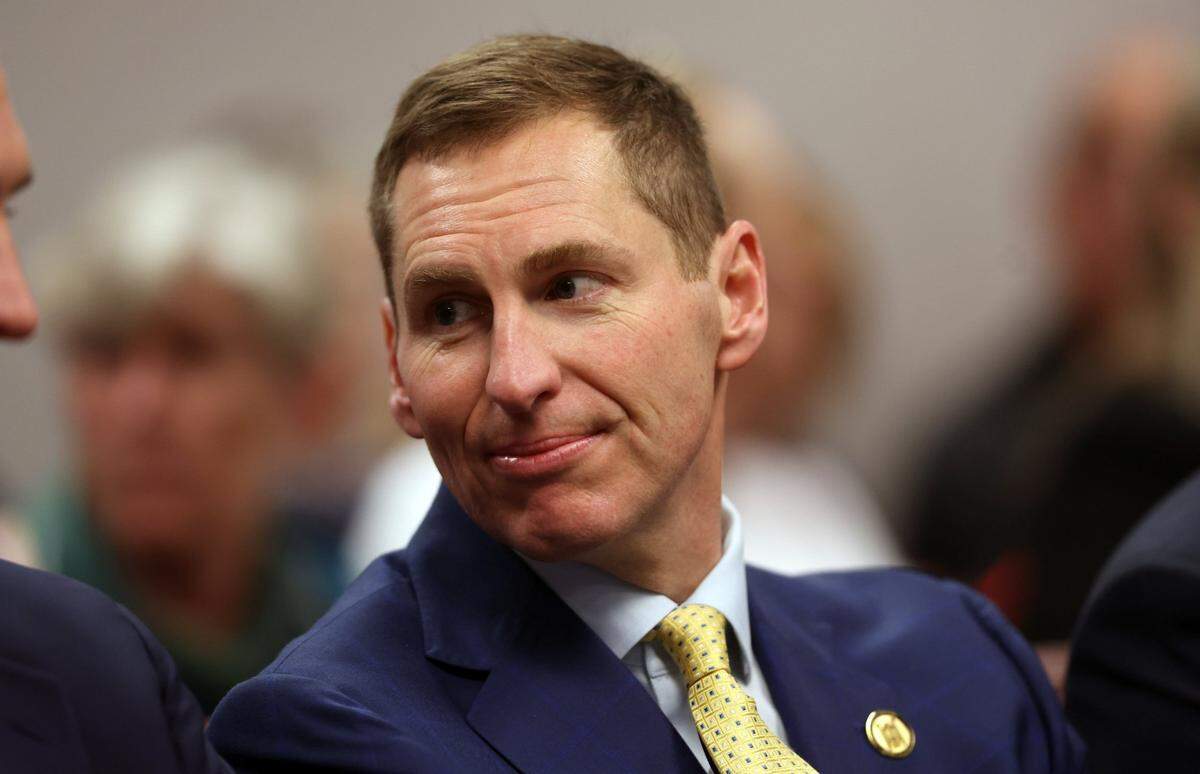
Storie had not been a frequent political donor. According to available data on the state’s campaign finance database, he had given to two previous campaigns — $2,500 to help reelect Forsyth County Sheriff Bobby Kimbrough in 2021 and $1,000 to elect Chris Carney as Mooresville mayor two years later. State records show his father gave once before, $300 in 2021 to a losing candidate in the race for Chatham County sheriff. But between the primary and general elections, Danny Storie contributed $10,400 to the Griffin campaign.
Asked about the motivation for these donations, Danny Storie told The News & Observer that that would be a question for his attorneys and hung up. Griffin did not respond to questions from The N&O about the campaign contributions.
Gambling operators have donated to other recent judicial and law enforcement campaigns across North Carolina, a dynamic some see as problematic.
“Their campaign money comes with a warning for the recipient,” said Bob Hall, founder of the advocacy nonprofit Democracy North Carolina. “Are they trying to get me to do something to help them with what likely is an illegal activity? The warning is a bright red flag for sheriffs and judges and district attorneys.”
Hall noted the 2008 sentencing of former Buncombe County Sheriff Bobby Medford, who died in federal prison after taking payments to protect a local video-poker operation. In 2016, Hall filed a campaign finance complaint against Judge Phil Berger Jr., claiming the then-appellate court judge, now a NC Supreme Court justice, had incorrectly listed two Pittsboro donors as owners of an alpaca farm rather than as the owners of an internet sweepstakes parlor operation in Rockingham County, where Berger previously served as district attorney.
North Carolina sheriffs say the campaign money doesn’t sway their decisions.
In 2018, a Southern Pines gaming operator named Richard Frye contributed $5,000 to help elect Ronnie Fields as Moore County sheriff. In an email to The N&O, Fields called Frye, who died last year, a friend and “successful businessman.” Like officials in Wake and Durham counties, Fields deferred the “primary authority” to enforce gambling laws to the state Alcohol Law Enforcement (An ALE spokesperson said “any department has authority to enforce the laws of our state.”)
And in 2022, a previously convicted gaming operator named Michael Macke donated $1,000 to Brent Holbrook’s successful campaign to become sheriff of Macon County. Macke told The N&O he has known Sheriff Holbrook and his family for “over 25 years.”
Not every North Carolina county reports its sheriff campaign financing figures electronically for the State Board of Elections to include on its searchable online database. But among those that do, no sheriff has received more support from gaming interests over the past few elections than Forsyth County’s Sheriff Kimbrough. Democracy NC found more than a third of Kimbrough’s 2018 and 2022 combined campaign contributions, $60,500, came from donors with links to the video gaming industry.
“As sheriff, I accept donations from individuals, not entities,” Kimbrough, whose county includes Winston-Salem, said in a statement to The N&O. “There is no exhaustive vetting process for each contribution, and donors contribute as private individuals. However, my responsibility is and always will be to uphold and enforce the law — regardless of who donates to my campaign.”
The News & Observer did not find any direct gaming operator contributions to the recent campaigns of Wake County Sheriff Willie Rowe or Durham County Sheriff Clarence Birkhead. Neither sheriff agreed to an interview for this story.
BEHIND THE STORY
MOREHow this story came about
In May, I met two friends for dinner at Himalayan Nepali Cuisine in Cary. Afterwards, we walked around the surrounding strip mall and saw a business with blacked out windows and single-word signage that simply read “Bingo.” Inside, it looked like a mini, 24-hours-a-day casino.
In an adjacent row of shops, we saw H&P Business Center which, despite its name, was clearly geared for gaming with slot machines and rows of sweepstakes computer terminals.
Knowing that gambling is illegal in North Carolina, my curiosity was piqued. I began researching the laws governing these establishments, spoke to law enforcement and visited a dozen area businesses. I played games in each of the storefronts I visited.
I didn’t identify myself as a reporter upfront. But after I began to form experiences that went into this package of stories, I called or revisited stores, identifying myself as a reporter, and asking for on-the-record interviews.
—Brian Gordon
If you or someone you know has a gambling problem, call the North Carolina Problem Gambling Helpline: 877-718-5543.
What the Durham and Wake DAs say
As general counsel of the North Carolina Sheriffs’ Association, Eddie Caldwell Jr. didn’t know why specific North Carolina sheriff’s offices ignore illegal gaming operations. But he offered three possible reasons — none having to do with campaign donations.
Agency priorities vary, he said, like how some enforce marijuana possession more than others. Residents’ public safety concerns might differ, too, which then shapes the positions of local district attorneys.
“Some law enforcement agencies say we’re going to charge it, and if the DA dismisses it, that’s on the DA’s record,” Caldwell said. “Others say: ‘We’re shorthanded. We don’t have enough personnel. If the DA is not going to prosecute it, we’re not going to spend our time investigating and charging.’”
In a phone interview with The N&O, Durham County District Attorney Satana Deberry said her office would prosecute gambling cases if charges were brought.
“My job is to prosecute, not enforce,” she said. “So, in North Carolina, law enforcement charges. And so, if we don’t get charges, we can’t prosecute. The level of prosecution is going to depend on the level of prioritization by local law enforcement.”
Though gaming itself isn’t violent, Deberry said the quantity of cash that managers keep on the premises can make these businesses targets.
Wake County District Attorney Lorrin Freeman also said her office would partner with local law enforcement to bring gambling cases to trial. But she similarly suggested local law enforcement priorities were elsewhere.
“I’d be surprised if law enforcement gets many complaints,” Freeman said by phone, “but for when they become kind of hotbeds for an armed robbery or something like that.”
Freeman then raised the question of convictions and whether prosecutors could convince juries in 2025 to view local gaming halls as criminal at a time when North Carolina, like other states, has relaxed its gambling laws for more lucrative tax gains.
If you can’t beat the law, change it
Brandon Barnes once considered distributing unregulated gambling equipment. He sometimes regrets not doing so.
“Fifteen years ago, my business partner and I had to decide if we get into this business,” said Barnes, who runs the amusement equipment supplier Capital Games in Raleigh. Ultimately, they opted to sell pool tables and jukeboxes rather than risk jail time.
“Looking at it years later,” he said. “I almost feel like a dummy. Like I should have done it. They’re crushing it.”
Whether gaming parlors are indeed “crushing it” is difficult to discern. And new alternatives are threatening their bottom lines.
A significant portion of modern gaming has shifted online. This year, the online social sweepstakes casino market will generate $4.7 billion according to the research firm Eilers & Krejcik Gaming, with an expected 25% revenue jump in 2026. “We believe the online market is larger than the retail one but don’t have much detail around the retail side,” said D.J. Leary, Eilers & Krejcik’s business development director.
At one of 64 Business Center’s two storefronts in East Raleigh, customers can walk past sweepstakes computers and load money at the counter onto a mobile sweepstakes game called Golden Dragon. Other games don’t require players to leave the house to spend.
Legal gaming in North Carolina has moved online, too, with the NC Education Lottery introducing mobile play in 2017. Around 20% of lottery revenue went toward education funding in 2023-24, with the bulk of the money paid out to players. The state caps individuals’ online lottery spending at $505 a day, $2,000 a week, and $5,000 a month.
And in 2024, North Carolina legalized mobile sports betting.
More Las Vegas-style slot machines in bars and restaurants could be next. In April, five Republican members of the North Carolina House introduced a bill allowing businesses to have as many as six on-site video gaming terminals — with the state getting 40% of the machines’ net revenue. Operators would need permits and their equipment would be tested by independent commissions. The bill stalled in committee this spring.
“I’ve been trying to help push it along for a few years,” said Barnes, a former director at the North Carolina Coin Operators Association, which advocates for gaming interests. Arcades and billiards do fine, he said, but “the games people really want to play have something at stake.”
Money has poured into North Carolina politics to help make this happen. Since 2019, the list of companies to begin registering lobbyists in North Carolina include Primero Games, Sutton Gaming, J&J Ventures Gaming, Light & Wonder, and Grover Gaming.
Robert Willenborg, CEO of J&J Ventures Gaming, contributed more than $400,000 across 100 different donations to North Carolina House and Senate candidates ahead of the past two elections. Based in Illinois, J&J markets itself as the “premier video gaming terminal operator.” Though CEO since 1994, Willenborg had not given to North Carolina candidates before 2022, state campaign records show.
Light & Wonder, which acquired Greenville-based Grover Gaming in February and makes Ultimate Fire Link machines, declined to comment on its lobbying goals in North Carolina.
Sutton Gaming, a family-owned business in Wilmington, did not respond to requests for comment about its lobbying. One member of the Sutton family, Anthony Todd Sutton, pleaded guilty in 2022 to a felony charge of conducting gambling operations in Michigan, where the head of the state gaming control board said illegal gambling businesses “often target lower income areas and vulnerable populations, and their operations deprive residents of the protections of legal, regulated gaming.”
“It’s an industry that needs regulatory oversight,” said Michael Macke, owner of the Georgia-based Primero Games. In 2016, Macke had around 400 of his games (under a previous company called Gift Surplus) carted off by North Carolina and local authorities in statewide raids.
“As in any industry, you have good and bad actors,” he said. “And regulatory oversight fixes that.”
This is the third way a certain type of North Carolina gaming can continue. In cities and towns where local authorities don’t overlook these strip-mall parlors and elected judges don’t count the machines as games of skill, a surefire solution is to change the law.
Catch up on the series
Part 1: Inside the Triangle’s illegal gaming cafés — where the internet rarely works
Part 2: Gambling halls get raided across North Carolina. Then why not in Raleigh or Durham?
This story was originally published October 15, 2025 at 5:00 AM with the headline "Part 3: Gambling donations go to NC sheriffs, legislators, Supreme Court campaign."