Part 2: Gambling halls get raided across NC. Then why not in Raleigh or Durham?
AI-generated summary reviewed by our newsroom.
- North Carolina banned slot machines and later barred all video and server-based games.
- Operators shifted to sweepstakes, phone-time and fish-table models to evade bans.
- Courts often rule games of chance; enforcement varies leaving uneven raids across counties
READ MORE
Inside the Triangle’s illegal gaming cafés
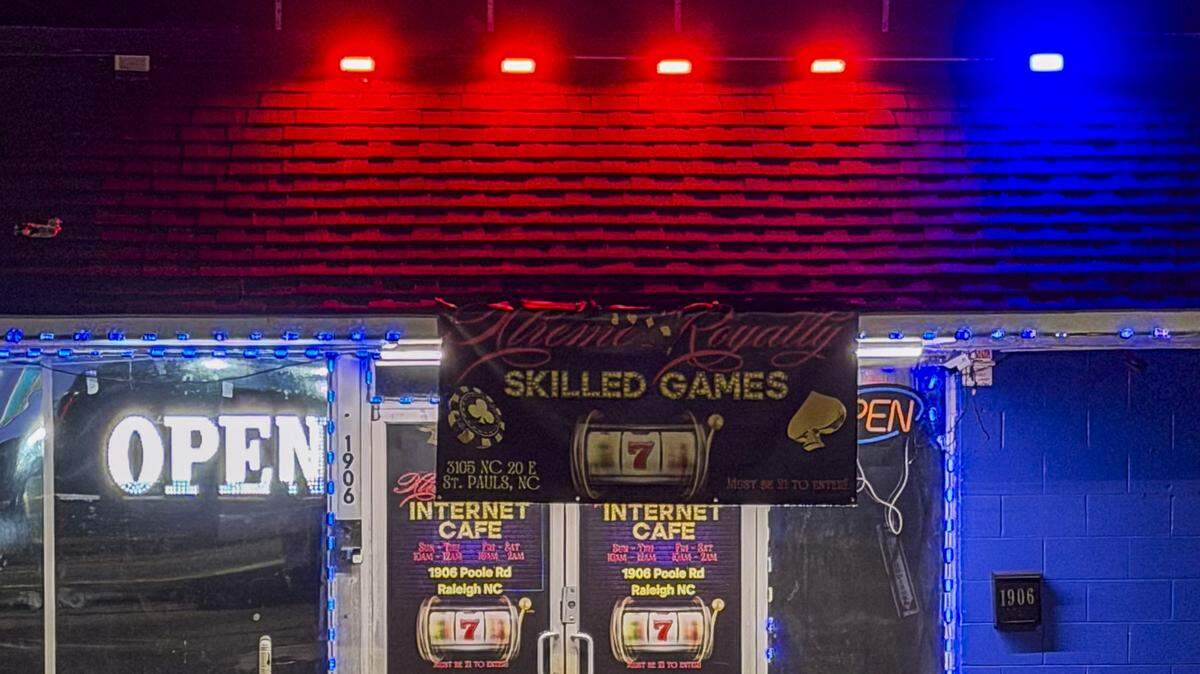
The News & Observer visited a dozen area electronic gaming businesses and found their continued, unregulated existence is due less to any legal loopholes and more to authorities in Raleigh, Durham and Cary choosing not to close them.
Expand All
.jpg)
.jpg)
As long as North Carolina has had gambling laws, gaming operators have tried to circumvent them.
State legislators banned slot machines in 1937, and the following year, lobbyists championed a new amusement game invented by a Forsyth County slot machine distributor named T.R. Styers. His machine featured an electronic roulette board, swapped coin slots for buttons, and replaced monetary payouts with prizes.
Distributors insisted Styers’ creation was a skill-based game, highlighting that players needed to put a ball into a “skill hole” to get a score.
This emphasis on skill versus chance reignited decades later with the rise of digital gaming. South Carolina banned video poker machines in 1999, and North Carolina lawmakers, fearing these cabinets would be moved across the state border, soon prohibited any new video gaming machines, while allowing those already operating to remain.
In 2006, North Carolina repealed its grandfather clause and barred all video gaming machines. Manufacturers sued, claiming their products weren’t slot machines or video gaming machines. So the General Assembly soon broadened its ban to all “server-based electronic game promotions.”
Gaming businesses again responded. “The predominant business model came to involve operators selling a product — such as phone time, internet time or gift certificates to an online store — and providing customers with sweepstakes entries purportedly as a marketing tool or promotional incentive,” UNC School of Government professor Jeff Welty wrote in a blog post this past January on North Carolina sweepstakes law.
“The purported product often went unused,” Welty added.
North Carolina addressed this loophole in 2010 when then-Gov. Bev Perdue signed a ban on machines that reveal sweepstake outcomes “through the use of an entertaining display,” including randomized symbol matching on reels.
Some operators did not stop. And with the law set, many local officials stepped up their raids.
Raids are common. But rarely in Durham or Raleigh
North Carolina counties and cities appear to vary on their “appetite” for regulating video gaming operators, Welty writes.
Charges are bunched geographically, North Carolina Judicial Branch data shows, suggesting the role targeted raids play in regulation. In 2020, for example, Randolph and Onslow counties accounted for 47 of the state’s 53 total video gaming felony charges, the data shows.
In 2023, local officials filed 23 felony charges for possession of five or more video gaming machines and 11 misdemeanor video electronic gaming charges, according to data from the North Carolina Judicial Branch. Last year, officials in Harnett County, Rockingham County and the City of High Point all busted local gaming operations, with the Harnett County Narcotics Division seizing around 130 computers, 20 stand-up machines, and $50,000 from a business about 50 miles south of Raleigh.
In August, the Cumberland County Sheriff’s Office seized 16 gambling machines and even more computers during a gaming bust in Fayetteville.
“Illegal gambling poses significant threats to society and affects mental health, leading to increased violent crimes due to financial hardships,” Cumberland County Sheriff Johnathan Morgan said in a statement to The N&O.
In coastal Onslow, Sheriff Christopher Thomas estimated his office has shut down at least five gaming locations in the past decade. His department investigates based on complaints, he said, and enters businesses covertly.
“We go play the game in an undercover capacity, and make a determination if there is any payout of cash, which is really the main part,” Thomas said.
Triangle authorities have seldom conducted raids or made arrests. In 2013, the year North Carolina courts upheld the state’s gaming ban, the Durham County Sheriff’s Office raided two internet sweepstakes cafés and seized a combined 70 computers. The next year, Wake County indicted three for operating internet sweepstakes after an agent went into the businesses undercover.
“It is the law,” Wake County’s then-District Attorney Colon Willoughby said at the time. “The legislature decides what is and is not illegal.”
Since 2015, however, neither Durham nor Wake counties has issued a charge for electronic sweepstakes or video gaming, according to data from the North Carolina Judicial Branch.
The Raleigh Police Department defers to the North Carolina Alcohol Law Enforcement division to enforce gambling laws, spokesperson Lt. David Davis said. The Durham Police Department likewise said in an email it “does not enforce” laws regarding sweepstakes internet cafés “as it falls under the jurisdiction of the North Carolina Alcohol Law Enforcement.”
However, North Carolina counties and cities have enforced state laws to shut down local gambling businesses. In an email to The N&O, ALE Agent William Happoldt said “any department has authority to enforce the laws of our state.” He added his state division “has no authority to conduct inspections to ensure compliance of laws” unless businesses have alcohol or lottery permits.
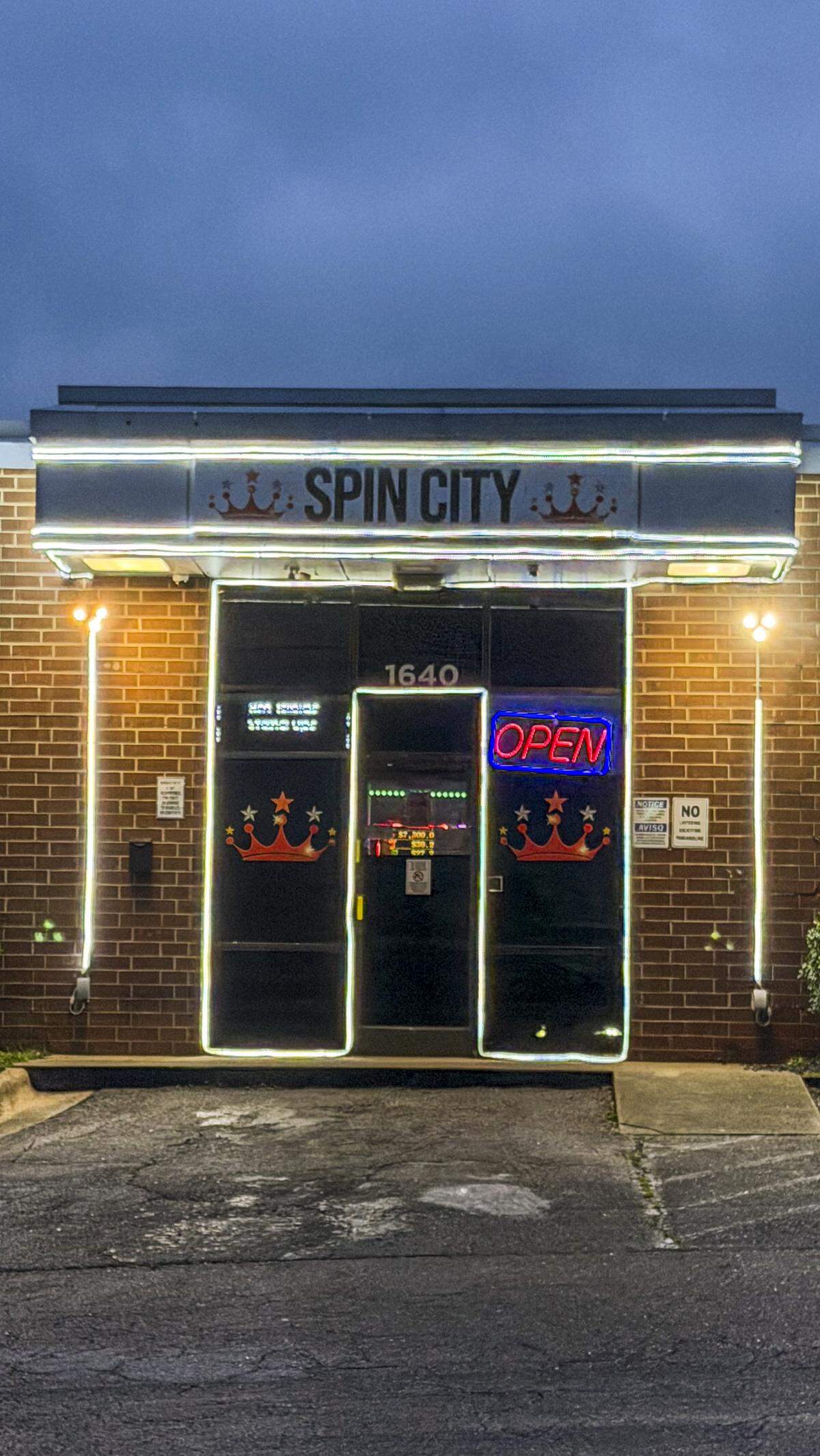
The Durham County Sheriff’s Office said it is aware of “entertainment businesses” that operate video gaming machines and will respond to “calls for services at these businesses when requested, and if there are visible violations of any North Carolina statute they are addressed.”
Wake County Sheriff’s Office spokesperson Rosalia Fodera said in an email that the department’s role “is to enforce criminal laws as set out in the NC General Statutes.”
“Therefore, the agency does not operate as a stand-alone regulatory agency in ensuring compliance among local businesses,” she said.
Neither Durham nor Wake made their sheriffs available for interviews about local electronic gaming enforcement.
Asked why illegal gaming halls persist in Durham, District Attorney Satana Deberry said in a phone interview that she didn’t know but noted that her office’s priority was “on the prosecution of violence and serious crime.”
Wake County District Attorney Lorrin Freeman shared this sentiment, saying in a phone call that local sheriff’s offices and police departments have a “limited number of agents.”
BEHIND THE STORY
MOREHow this story came about
In May, I met two friends for dinner at Himalayan Nepali Cuisine in Cary. Afterwards, we walked around the surrounding strip mall and saw a business with blacked out windows and single-word signage that simply read “Bingo.” Inside, it looked like a mini, 24-hours-a-day casino.
In an adjacent row of shops, we saw H&P Business Center which, despite its name, was clearly geared for gaming with slot machines and rows of sweepstakes computer terminals.
Knowing that gambling is illegal in North Carolina, my curiosity was piqued. I began researching the laws governing these establishments, spoke to law enforcement and visited a dozen area businesses. I played games in each of the storefronts I visited.
I didn’t identify myself as a reporter upfront. But after I began to form experiences that went into this package of stories, I called or revisited stores, identifying myself as a reporter, and asking for on-the-record interviews.
—Brian Gordon
If you or someone you know has a gambling problem, call the North Carolina Problem Gambling Helpline: 877-718-5543.
‘If it’s a law, then apply the law’
The barrier to opening an electronic gaming business is low, past and current operators say. Lease space, fill it with machines, hire a few employees, maybe a guard and attract regulars.
Some operators rent their machines in the beginning — with distributors taking a percentage of the revenue. Scott Beatty, who ran Barracuda Ventures in Catawba County, recalled his distributor’s cut being 20%. Eventually, successful “internet café” owners buy their machines outright.
“It’s different (distributors) out here that you can find,” said Donnie Williams, owner of Blue Dragon Sweepstakes in East Raleigh.
Williams worked at another area gaming establishment before opening Blue Dragon, a blue-walled building on Poole Road that is among at least six electronic gaming businesses within a one-mile radius. He said he considers the business to be an internet café, though acknowledged most people enter to play the slot machines, fish tables and sweepstakes computers that fill every part of the space.
He didn’t name his distributors but said those in the market for fish tables like Ocean Fish King and stand-up slot machines like Ultimate Fire Link have their choice of suppliers. “There’s quite a few of them right now,” Williams said. A recent eBay search for “Fire Link Slot Machine” returned 84 results and several third-party websites market machines.
Light & Wonder, the Las Vegas-based maker of Ultimate Fire Link, said in a statement that it “only supplies these devices to licensed customers in legal and regulated markets.”
“The unauthorized use or counterfeiting of any Light & Wonder product is illegal and a violation of state and federal law,” its spokesperson Andy Fouché wrote. “These activities may also violate criminal statutes.”
To his knowledge, Williams said, no law enforcement officers from the city, county or state have ever visited Blue Dragon as part of an investigation. “As long as those games are skill games, you’re pretty much fine,” he said.
One payout skills test at Blue Dragon asks players to stop an arrow within certain colored-areas of a spectrum. Whether this, or any test, demands enough dexterity to count as skills-based requires more nuance than one might think, says Neil Mulligan, a psychology professor who studies human memory at UNC-Chapel Hill.
Over the years, Mulligan has established himself as a go-to expert witness for gaming operators who sue local and state governments and need to establish the skills-based legality of their machines. “Two different people could look at the same exact game and say, ‘Oh, this is enough skill,’ or ‘This isn’t enough skill,’” he said. “The definition of ‘skill’ in the law is basically undefined.”
.jpg "H&P Business Center - 1401C SE Maynard Rd, Cary, NC 27511(3).jpg")
Asking players to identify the largest of three boxes or the bigger of two numbers likely doesn’t meet skill thresholds, Mulligan acknowledged, but other challenges might. And while traditional slot game strategy starts and ends with players pressing a button and perhaps nudging icons, fish table games — with their joystick maneuvers and moving animated targets — contain more opportunities for improvement, he says, which is a characteristic of skill-based contests.
In 2019, Mulligan’s report about the “fish” table game Ocean Fish King was used in a case brought by Beatty and a fellow Catawba County gaming operator after their respective city governments shut down their businesses. Mulligan testified that players “could develop a skill to memorize the game’s patterns over time,” and that the game rewarded those with superior dexterity.
Nonetheless, the North Carolina Court of Appeals upheld the lower court’s interpretation that Ocean Fish King is “predominately a game of chance.”
“Though players must have some measure of dexterity to use the joystick, a player cannot know beforehand how many hits are necessary to destroy fish and, thus, cannot strategically optimize a favorable return on credits,” the unanimous decision stated.
Beatty had already sold Barracuda Ventures by the time of this ruling. Now retired in the Blue Ridge foothills, he still believes fish table games are skill-based. He also described a second frustration, one perhaps felt by other North Carolina operators who had their illegal gaming business busted while similar ones — in neighboring towns and counties — continue uninterrupted.
“If it’s a law,” he said, “then apply the law.”
Next: Campaign donations, DAs, and the push to legalize more gambling in North Carolina
This story was originally published October 15, 2025 at 5:00 AM with the headline "Part 2: Gambling halls get raided across NC. Then why not in Raleigh or Durham?."