Inside the method — and madness — of Lenovo Center’s traffic cone maze
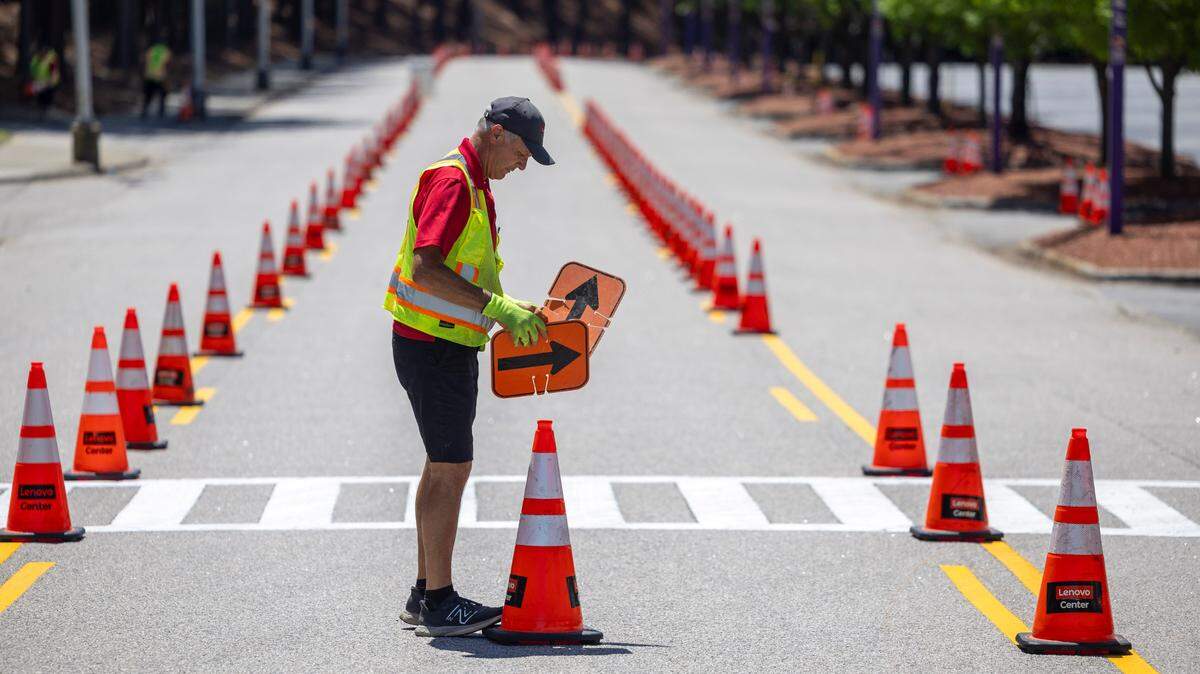
It may be the nicest day of the year so far, a sunny May afternoon with an erratic breeze, and Caleb Glover is glad to be working outside. He grabs a stack of traffic cones from the sidewalk that encircles the Lenovo Center, and drops them, one at a time, on dots marked in the main roadway.
The 28-year-old commutes from Castalia, near Rocky Mount, to work in the arena’s parking lots, but this is the best part of the job. No customers. No passes to scan. No adverse weather, not today. Just thousands of traffic cones that need to be placed in the correct spots before 12,000 Linkin Park fans show up that night. Glover came to a concert one night, applied for a job, and has been driving back and forth ever since.
“This is good duty,” Glover said. “It keeps you going when you get older. I don’t mind it. It gives me something to do.”
Michael Greenspon walks along with him as they work their way counterclockwise, starting at the east side of the property. In the parlance of the gig, they’re “dropping cones.” Hours later, they’ll go back and pick them up and stack them. And then do it all again for the next event. And again.
“It’s a very happy place to work,” Greenspon said. “People are coming to enjoy themselves. Really good vibes.”
Every person who has ever come to enjoy themselves at the arena — for hockey or basketball or a concert or a comedy show or even a COVID vaccination — has navigated some or all of the more than 2,000 safety orange, arena-branded traffic cones on their way in and out, as much a signature of the arena as anything else at this point.
The New York Public Library has its lions. Notre Dame has its gargoyles. The Capitol has its statues.
Lenovo has traffic cones. Lots of them. And those cones have to be set out before every event, then picked up afterwards, just as they have for more than 25 years. They have been stolen in batches by construction companies and churches, retrieved from parties by arena employees and laboriously relabeled over a three-day span when the naming rights flipped from PNC to Lenovo.
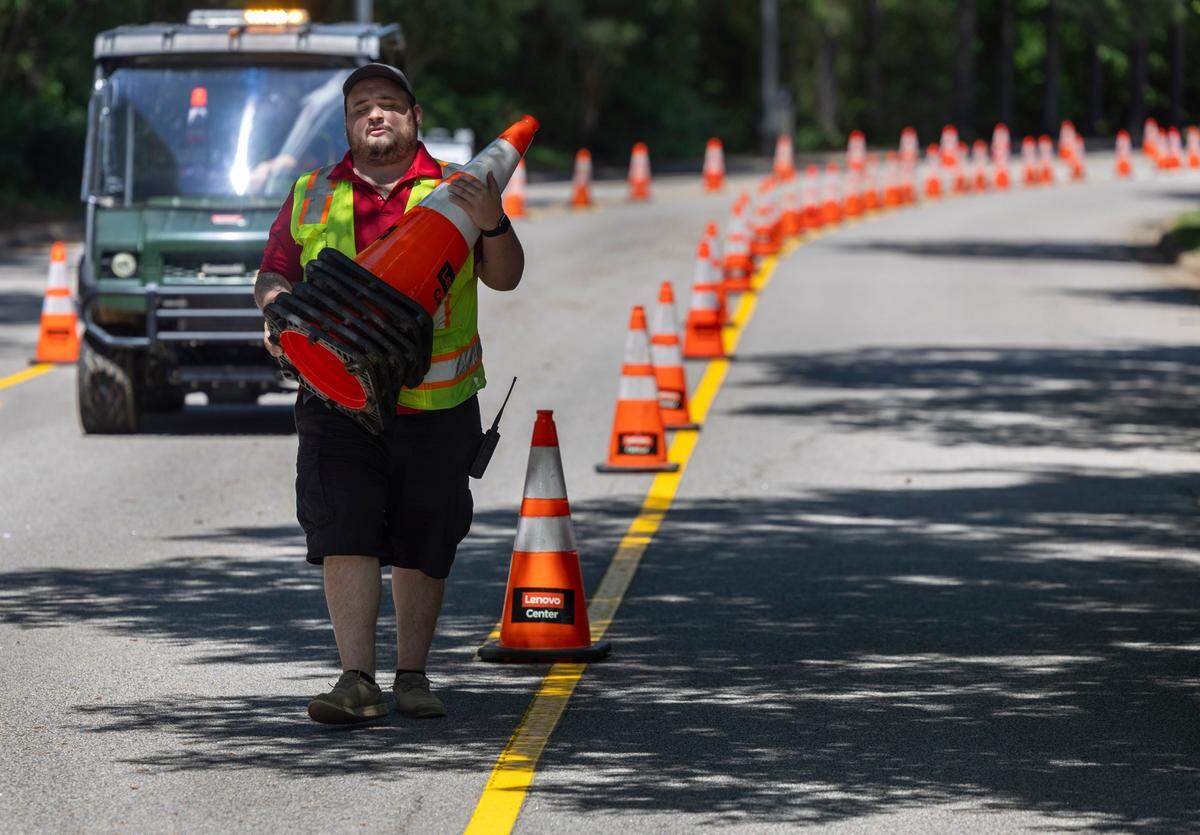
The cones, rudimentary as they are, create options: They are relocated mid-event to flip lanes from ingress to egress, or to adjust traffic flows away from full lots at the command of supervisors stationed on the arena roof with radios. The cones, and their constant presence, are a big reason why traffic now moves relatively smoothly in and out of the arena, unlike the opening-night disaster in 1999, or the epic traffic jam before the outdoor game at Carter-Finley Stadium in 2023, an error the NHL has pledged not to make again.
“One is for safety, two is for traffic control,” said Rob Seltzer, who started out as a cashier and became the arena’s director of parking in 2020. “The cones are great because they keep cars going in the direction we need them to go, but also keep them in lanes we need to keep them in so they don’t run into each other. It’s a great traffic control use. The police use them out on the roadways. We use them on the interior roadways around the arena. It just keeps traffic flowing so much better than if we didn’t have them.”
So there’s a method to it, but it’s also a little bit of madness.
“There’s a lot of cones around here,” Seltzer said. “That’s for sure.”
An orange solution to an access problem
When the arena opened in 1999 as the Entertainment and Sports Arena, the traffic backed up so severely, the building was half empty for the drop of the first puck. Some of that was collective inexperience; no one realized how long it would take to get into the arena and everyone showed up at the same time.
“It was fly by the seat of your pants for the opening,” said Jim Rutherford, the Hurricanes’ general manager at the time. “It could have been done a lot better. But it was difficult for the group anticipating how it was going to go.”
But that traffic jam was also structural; while it has a wide, three-lane roadway that circulates the arena, the arena was, confoundingly, built without direct access to Wade Avenue — there is only one small entrance from and exit to eastbound Wade that has only recently been utilized for arena events, although it has always been used for N.C. State football — which means instead of entering directly from a limited-access highway, every vehicle has to travel on what are essentially side streets: Edwards Mill, Trinity and Blue Ridge via Westchase.
By extension, that means lots don’t fill up at the same rate, and cars have to be redirected to open ones, sometimes all the way around the property. There’s also the matter of sorting out cars headed to VIP and premier parking from different entrances. Enter the traffic cones. Thousands of them.
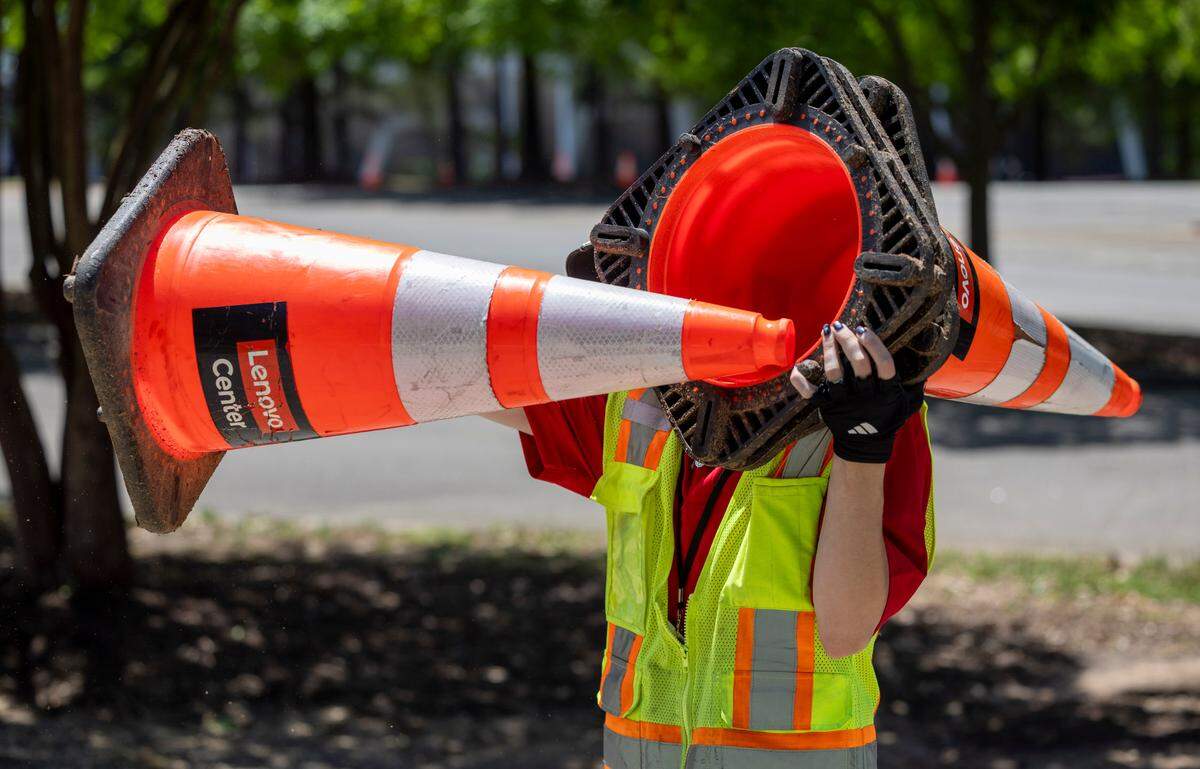
“We certainly didn’t anticipate those cones being all over the place,” said Bill Mullins, a charter member of the Centennial Authority, which built and now oversees the arena. “That just evolved through (the Hurricanes’) management and operation. They’re certainly unsightly and kind of a joke, but they seem to be necessary.”
Midway through that first season, Terry L. Putman Sr., a former highway patrolman, was promoted from assistant security chief to parking manager. As he tried to figure out better ways of getting patrons in and out, the answer was often “more cones.” About that same time, Larry Perkins arrived as the building’s assistant general manager, an expert in almost every aspect of arena operation. He also thought more cones would help. When the building got its first real name, the RBC Center, in 2002, they ordered even more cones with the new logo.
“We had a few cones for ESA. Who got the rights next? RBC,” Putman said. “So guess what? RBC cones. And when Larry Perkins came in, he came in from the Meadowlands. Up there, they would have cones like every 3 feet. You were building basically a funnel or a tunnel to get ‘em in or get ‘em out. Where every white line was, whatever it was, that’s what the state and city were saying we needed to do. Coming on the property, going off the property.”
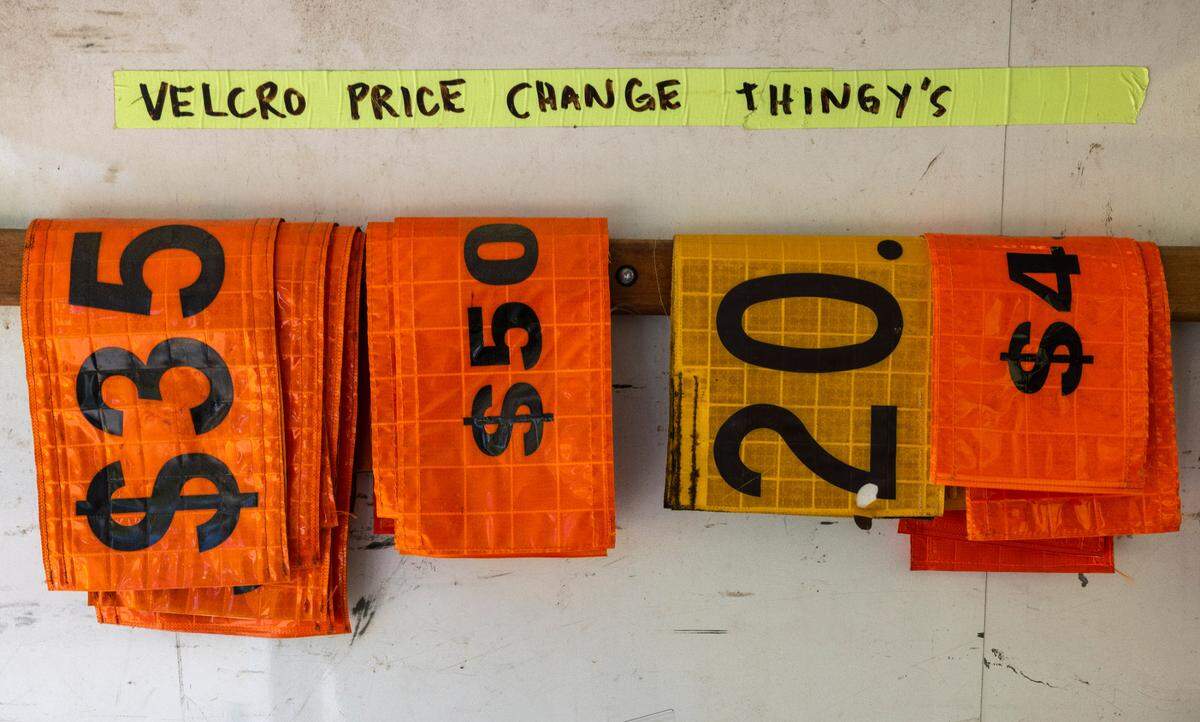
Putman bought the first 16-foot box trucks, of which the arena has two, that hold all the familiar signs: NO CASH, BAG POLICY, DO NOT CHANGE LANES etc. He ordered the custom trailers they pull, with low sides that allow employees to step on and off easily to grab and deposit cones. He left in 2003, and Perkins retired in 2022, but the procedure hasn’t changed much since. The cones get dropped. The cones get picked up. Repeat.
“When I get here, there’s a lot of times they’re just putting them out,” said Hurricanes coach Rod Brind’Amour, who’s been navigating them for 25 years.
On a good day, it takes six to eight people less than two hours. Some employees have been doing it so long, they know what needs to be done, down to the little jobs in corners of the lots, without being told.
Don Berryhill has been doing it for 17 years, and has spent a good chunk of that time figuring out how to sneak a concrete cone into a stack as a prank. On this day, he’s behind the wheel of a pickup truck pulling a trailer stacked with hundreds of cones. Along with Greg Lindley, he’s responsible for dropping piles of cones at the Edwards Mill entrance for the Raleigh Police Department to set out.
“We all piece together to help out,” Lindley said. “I kind of work with Don, usually. That’s my job. But we’ve all moved around enough to know what to do.”
After dropping 90 cones at the intersection, Lindley climbs on the trailer, dropping stack of five after stack of five along Edwards Mill, moving slowly toward Wade. At one point, Berryhill stops to retrieve a length of PVC pipe from the side of the road, throwing it on the trailer for personal use. Parking coordinator R.J. Arthur, watching from a four-wheeler, rolls his eyes: That’s Don.
“I had a stroke and my doctor said, ‘Get more exercise,’” Berryhill says from the front seat. “So here I am.”
If there’s an N.C. State football game, all the cones have to be picked up and stacked on the trailers, out of the way. A contractor handles Wolfpack football parking. Most of the time — like this week, when the arena has a comedy show, a hockey game, a concert, a hockey game and a concert on five straight nights — the arena staff just moves the cones from roadway to sidewalk between events.
Old traffic cones don’t die, they just fade
The cones sometimes escape to lives of their own. A cable contractor once grabbed about 75 and relabeled them; an arriving fan who had spotted them near his house told a parking attendant, and they were summarily retrieved. An arena security guard once reclaimed a purloined one at a party.
“The weirdest one I heard was 45 minutes away at a church,” said Arthur, who grew up in Holly Springs and went to N.C. State, a frequent fan before he became an employee. “They were using them for Sunday Mass.”
Even when they remain on property, they get run over by concert semi-trailers or dragged under cars. When replacements are needed, they’re ordered by the pallet in batches of 300. In September, before the new name was revealed, Seltzer and his team spent three full workdays slapping Lenovo Center stickers on PNC Arena cones.
“I think we ordered 600 new cones with the logo on them, and then we labeled another 1,500 cones that were still in great shape, so we didn’t want to get rid of them,” Seltzer said. “We basically brought in one section at a time. So we had someone to pick them up, somebody to put new labels on them and then another crew to put them back out.”
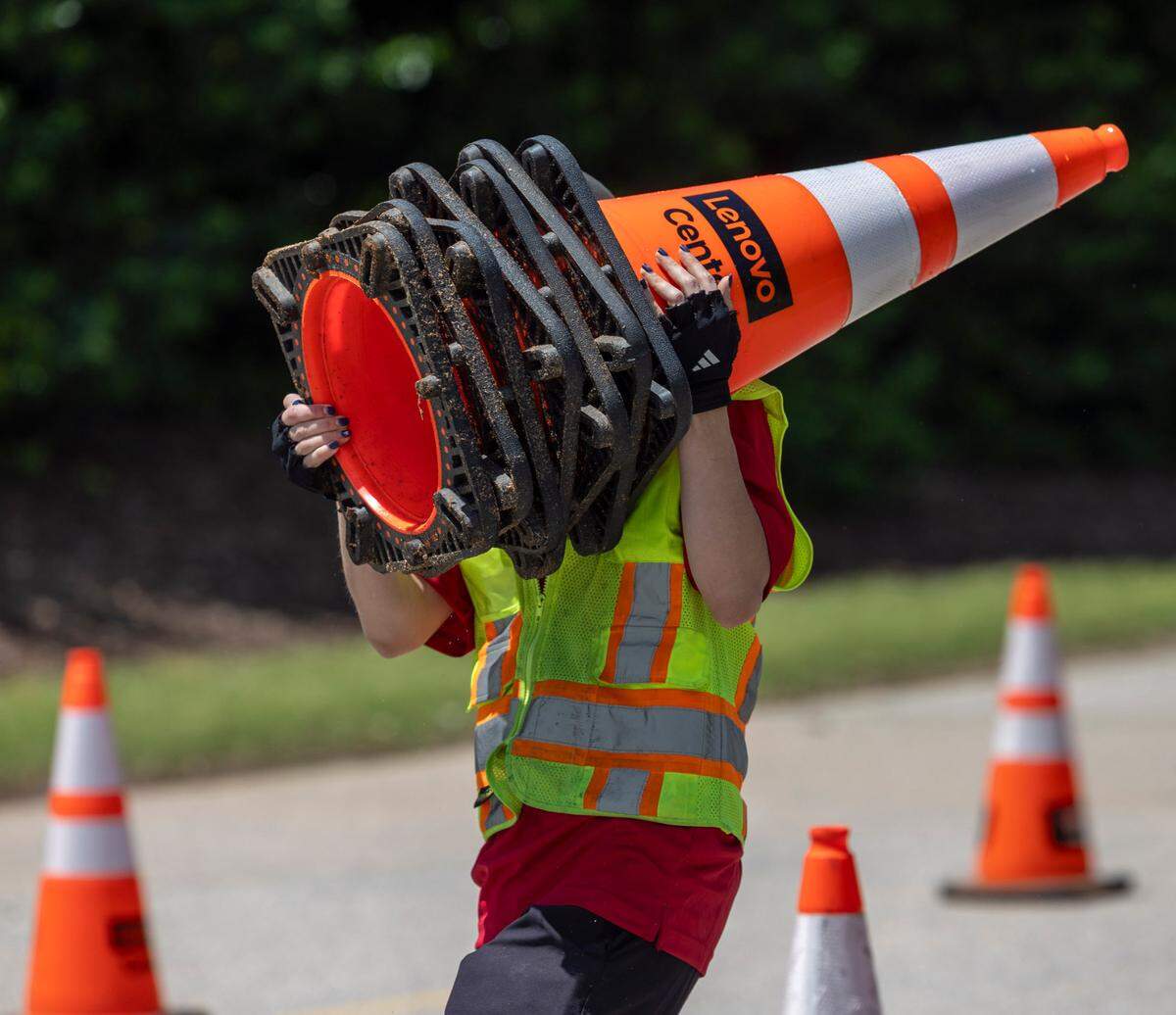
Other than the logo, not much has changed since the arena opened: The cones, the plan, the procedure. It has been refined, but the concepts remain the same.
“We’ve doubled the (Hurricanes’) fan base over the past couple years, doubled the cars, but we’re able to get the vehicles parked in the same amount of time,” Seltzer said. “A lot of it has to do with staffing and how we direct traffic.”
That’s all going to change soon, as the parking lots are redeveloped over the next 20 years into restaurants and hotels and housing, an entire post-urban core sprouting from what’s now just asphalt. Part of the agreement allowing Hurricanes owner Tom Dundon to develop the land calls for infrastructure upgrades to create better access for what’s going to be 365-day, 24-hour traffic regardless of arena events, but that’s going to require the cooperation of the DOT and could take a decade or more.
Imminently, a pair of parking decks will be constructed to the southeast of the arena in the first phase, creating hassles (lost spots, construction traffic) and opportunities (new traffic flows).
“A little bit of both,” Seltzer said. “Obviously there’s going to be some headaches and traffic issues every time there’s any kind of construction. But I’m definitely looking forward to the future when those decks are in place, and I think it’s going to give us a little better traffic control.”
For now, those lots remain open, and on this day, they’re prepared in less than two hours for the 12,000 concert-goers they’re expecting. Cones are dropped, signs are placed, chains are latched. The gate to Wade Avenue is unlocked and opened. There’s just a few minor tasks left to do before the lots officially open and the Linkin Park fans arrive.
Arthur, observing from his four-wheeler, watches Tim Layn put out a sign that says “DO NOT CHANGE LANES” on the access roadway from Edwards Mill. Almost immediately, an incoming car slows, then ducks between two cones within sight of the sign to veer into the far-right lane.
Arthur shakes his head. Nobody goes undefeated around here, not even the traffic cones.
Never miss a Luke DeCock column. Sign up at www.newsobserver.com/newsletters to have them delivered directly to your email inbox as soon as they post.
Luke DeCock’s Latest: Never miss a column on the Canes, ACC or other Triangle sports
This story was originally published May 9, 2025 at 5:30 AM with the headline "Inside the method — and madness — of Lenovo Center’s traffic cone maze."