Crypto ATMs draw scams that drain savings. Should the machines be banned in NC?
AI-generated summary reviewed by our newsroom.
- Crypto ATM scams have led to $389 million in stolen funds nationally.
- AARP North Carolina is lobbying lawmakers during the short session to act.
- Older victims often lost life savings when scams converted cash into untraceable crypto.
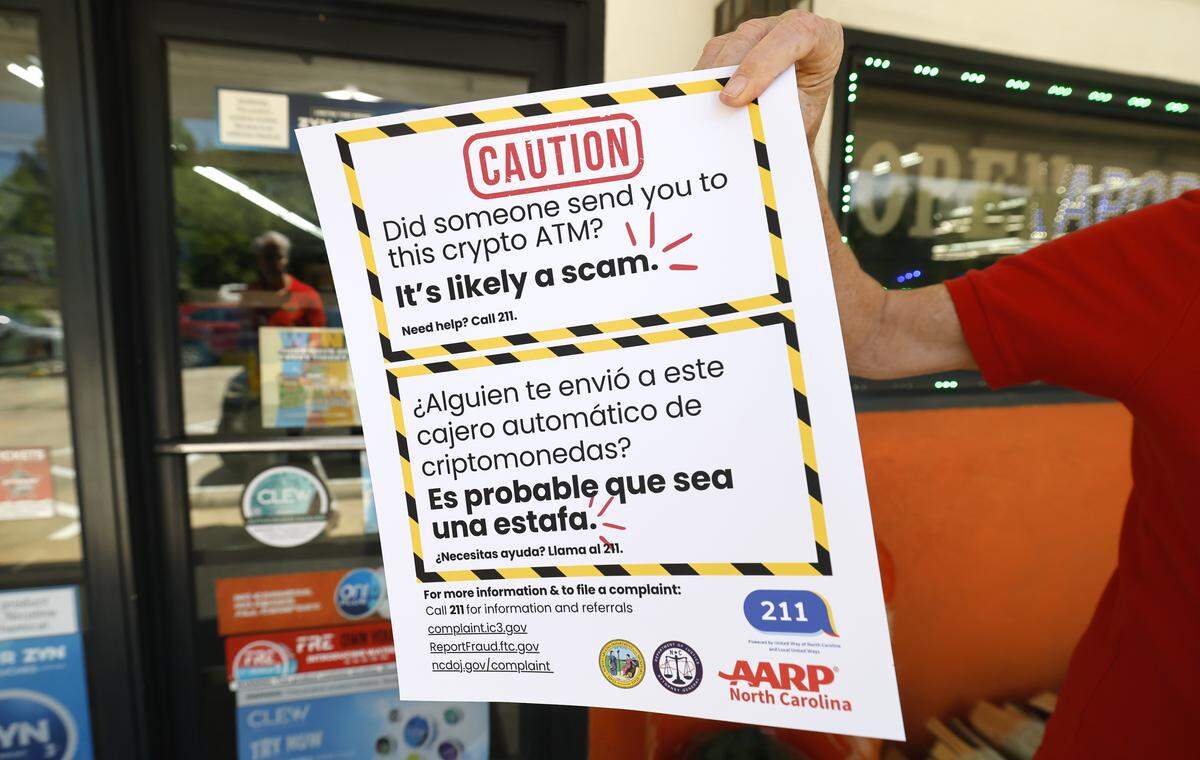
At a 76 gas station in Cary on a sunny Tuesday in May, a shop cashier held a sign with the word “Caution” printed in large red letters.
“Did someone send you to this crypto ATM? It’s likely a scam,” the sign read, followed by a translation in Spanish and phone numbers and links for help.
Members of AARP North Carolina had given him the sign, which was created for the N.C. Senior Consumer Fraud Task Force within the state’s Department of Justice.
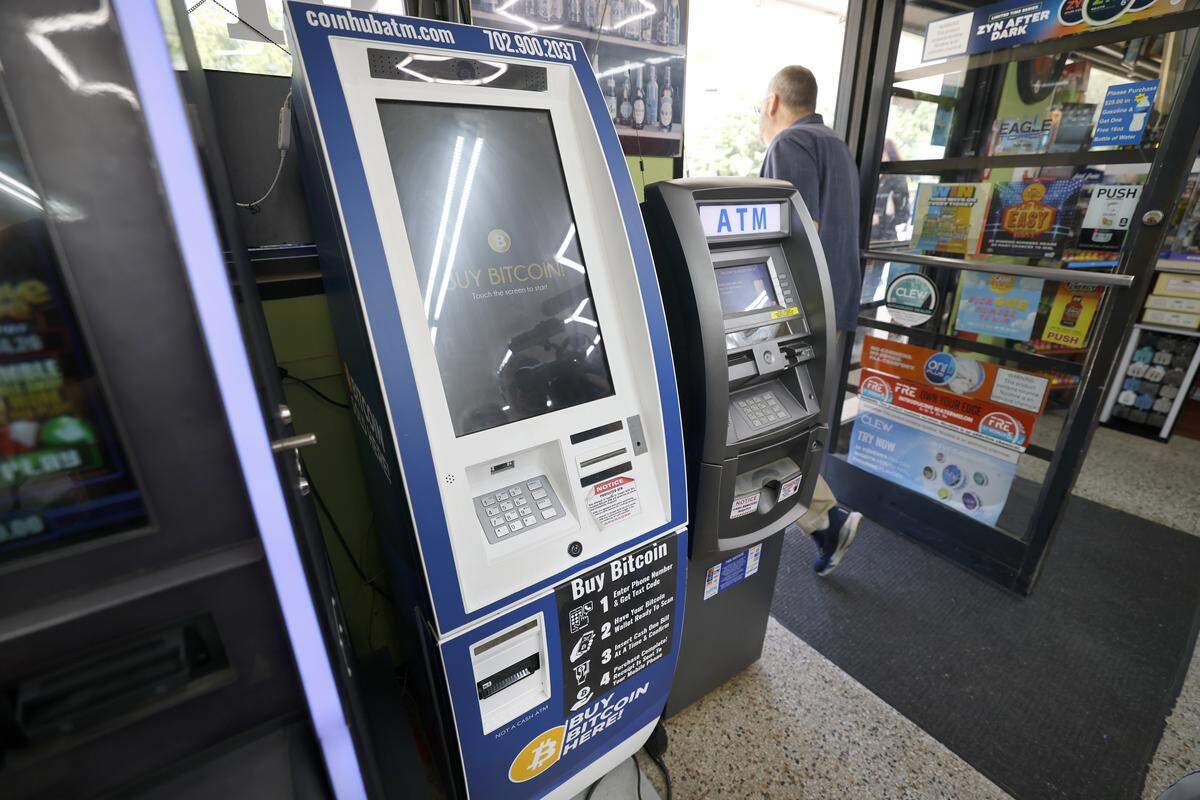
They asked the cashier whether he would place it near one of the store’s two cryptocurrency ATM machines, which sat next to an out-of-service gaming machine.
The shop was their first stop of the day, with six more planned as part of an effort to raise awareness about Bitcoin ATM scams.
The cashier was hesitant. He said he would think about it. Later that day, the group persuaded another gas station in Cary to post the sign.
Often inconspicuous — looking largely like a standard ATM — cryptocurrency machines have quietly spread across the Triangle and the country. Unlike traditional ATMs, they allow the purchase of digital currencies like Bitcoin and Ethereum. Businesses that host the ATMs can earn money through revenue-sharing or leasing arrangements.
With their spread, so has the fraud.
In 2025, the FBI’s Internet Crime Complaint Center received more than one million complaints totaling $20.8 billion in losses — a 26% jump from the year before. Cryptocurrency-related scams drove a disproportionate share of the damage: 18% of complaints but 54% of all losses, with the average loss over $60,000. Those over 60 accounted for just under 30% of crypto-related complaints but over 47% of losses.
Meanwhile, cryptocurrency ATM scams have led to $389 million in stolen funds, according to the FBI. And that’s just what’s been reported there.
AARP is pushing for legislative action in North Carolina to address the issue.
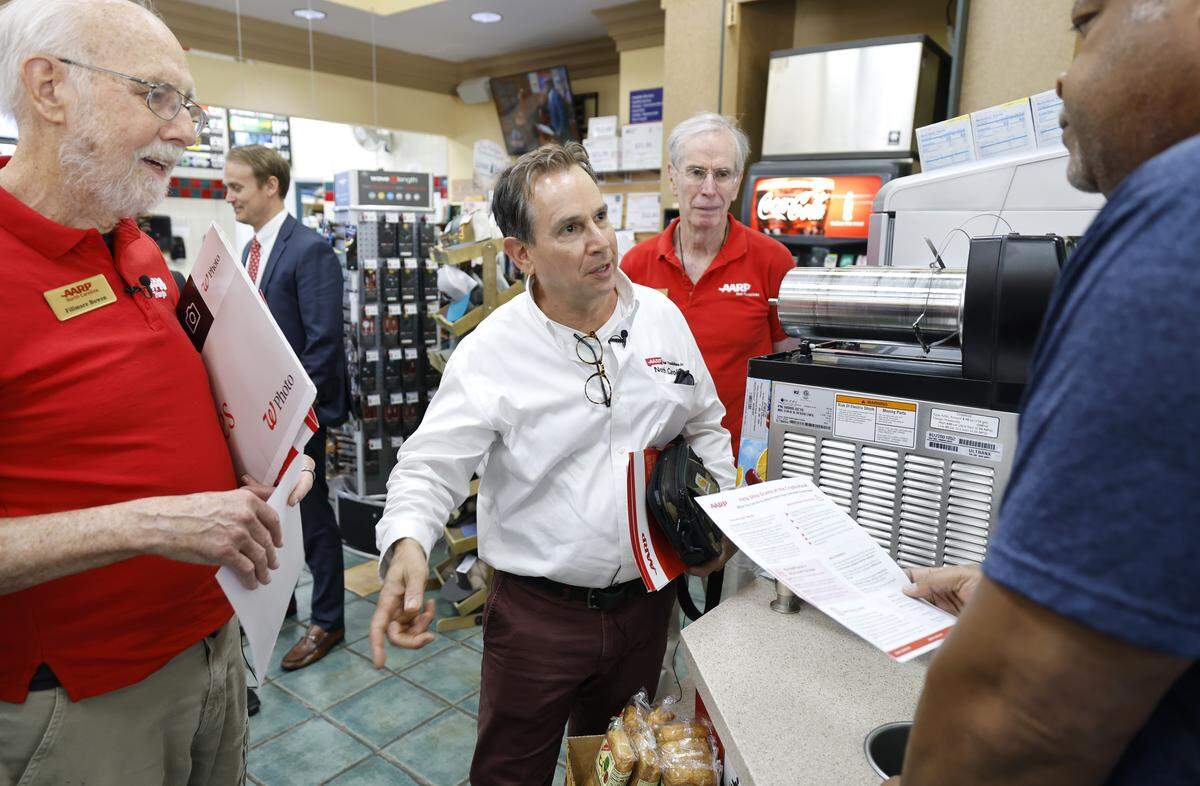
Chris Brandenburg, manager of federal and state advocacy for AARP North Carolina, said the organization has been having conversations with House and Senate lawmakers “who seem to understand the gravity of this issue.”
Thirty states, including most neighboring ones, have passed laws related to crypto kiosks, Brandenburg said. “I’m hopeful, cautiously optimistic, that we can get this done during the short session,” he said.
As for what the legislation could look like, Brandenburg said that in a “perfect world” it would include a full ban. If not, he said, alternatives could include safeguards such as transaction limits, recovery methods for victims of scams, and requirements for warning signage around the machines.
Education on scams
One victim of a crypto ATM scam, 71-year-old Dolores Miller, shared her story Tuesday.
The Silver Spring, Maryland, resident didn’t speak publicly at first about what she experienced, but that changed after she attended a senior center event where a video addressing scams made light of them. “It was really inappropriate stuff, and it was supposed to be funny, and people were laughing. And I was devastated,” she said. She later connected with a county police fraud unit volunteer and has since spoken at about 35 educational events in hopes of helping others avoid similar schemes.
The scam began in October 2024 when she was buying bird seed at a store and her phone rang. The call came from a private number. She initially ignored it, but after multiple rings, she picked up.
The caller told her that he was with law enforcement and that there was a warrant for her arrest in connection to a murder case, for not responding to a subpoena. She told him she had not gotten any subpoena, and he said someone must be impersonating her and that she needed to go to the sheriff’s office to straighten it out.

She said that at that point, she was suspicious, but when she tried to hang up “he raised his voice.”
He sent a copy of the warrant and told her that she needed to pay a bond to show she had a required amount of money. As long as she kept the receipts, he told her, she would be refunded at the sheriff’s office. He told her to put it in a crypto machine. Until then, she had not heard of the crypto-machines and thought it was like a regular ATM.
“I was frightened; he told me not to tell anybody,” she said, adding that the scammer played both good cop and bad cop, guiding her calmly during the process of depositing the money in the Bitcoin ATM — but getting firm when she would push back. On the phone, she’d also hear him speaking with what seemed to be other officers. She made multiple trips back and forth to the Bitcoin machine at a grocery store.
In the end, she deposited about $10,000 that she had stored in a safe at home.
“It was taking that money out, I would start to cry, because it was hard-earned money that my husband and I had done extra jobs for over a period of years,” for retirement, she said.
“I was in a very heightened emotional state,” she said.
In these scams, victims are typically manipulated into depositing cash into a crypto ATM and sending it to a wallet controlled by scammers. The money, which can move almost instantly and does not go through traditional banking systems, is then converted into cryptocurrency and then often rapidly transferred across multiple wallets — many times overseas — making it difficult for investigators to trace or freeze.
In between trips to the ATM, she left a note for her husband telling him about the situation. He went to where she was and got her to hang up.
She said a security guard at the grocery store never intervened, despite her coming and going, crying, and having an anxiety attack.
“I just think if people who work in places where they have these machines, if they get some education as to what machines are used for, maybe it would have been like, ‘Wait a minute,’” she said.
Miller said she reached out to law enforcement, but nothing ever came of the case.
Investigator Bryan Williscroft with the Fuquay-Varina Police Department joined the AARP on Tuesday in its efforts to educate businesses.
He said what makes these cases difficult to trace is the technology that allows suspects to “make it impossible to catch up to them.”
Williscroft said attempts to seize the physical cash directly from crypto ATM operators fails because courts have viewed the transaction as a completed purchase.
“It’s a shame, but there really is like little to nothing we can do,” Williscroft said, adding that as a result, he has instead focused on persuading some crypto ATM companies to refund transaction fees tied to scams. Those fees can range from 15% to 30% and are returned by his department to victims when companies cooperate, he said.
Other crypto scams
Lori Flowers fell victim to a different kind of crypto scam.
The 58-year-old from Guilford County decided to share her story to help spread awareness and spark change. She said it’s also helped her process it. “The shame is the worst part,” she said.
She had more than $670,000 stolen, and because of owing hefty taxes on money she withdrew from her retirement savings, she said she had to file for Chapter 13 bankruptcy, which allows someone to keep property and pay debts over a few years.
She said she now makes a payment of almost $6,000 a month for 60 months.
“I’m super lucky that I’m still working,” she said, but the scam still “has changed my life, changed the lives of my kids,” she said.
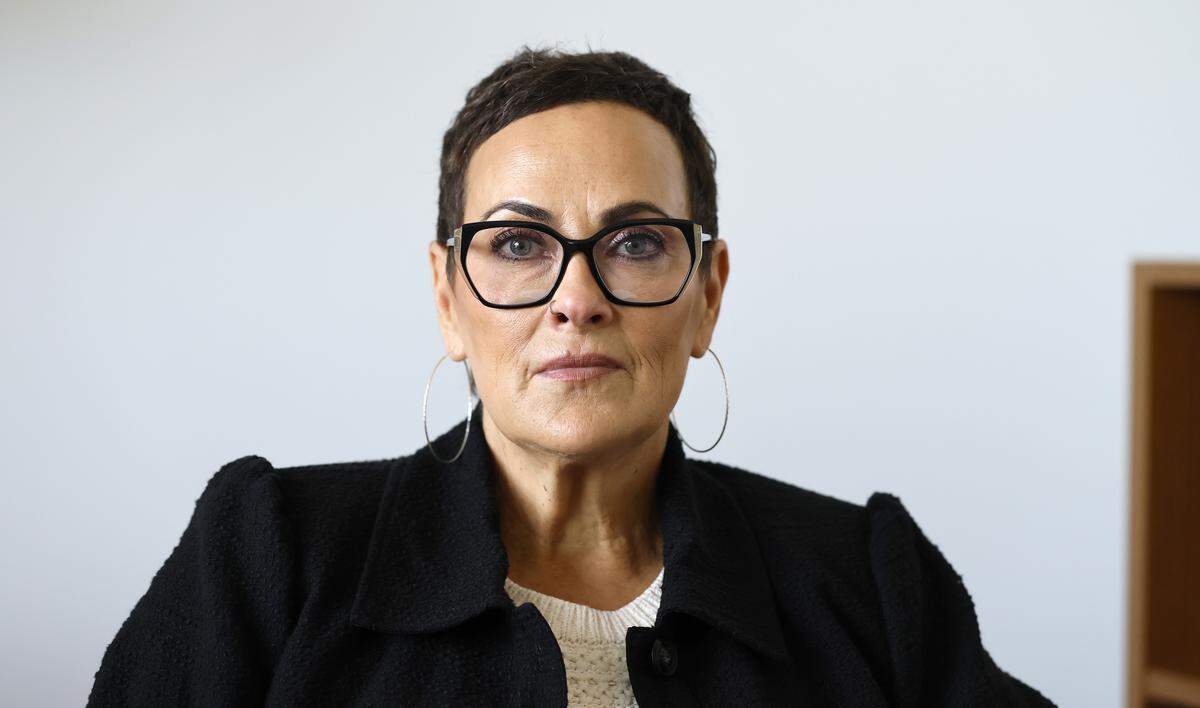
Flowers has also been advocating for federal tax reform, including in Congress, so that victims of scams don’t have to pay taxes on stolen money.
In her case, in early 2022, she received a LinkedIn message from a man asking about her community, including details about vaccination rates, claiming he planned to move to the area. Flowers works for a pharmaceutical company. They spoke on the phone twice a day for four months before the conversation turned to money.
“I think, from the outside, you think I didn’t know this person, but I arguably knew him better than a lot of other people I know,” she said.
Eventually, he asked Flowers to loan him money, claiming he was relocating to the U.S. to secure housing and help set up his company — saying he already had contracts and financing in place but was having trouble moving the funds over. He said it was short-term assistance, and Flowers checked with her financial planner to confirm that since the loan was expected to be paid back within 90 days, her retirement wouldn’t be taxed.
“There were contracts, there were conversations with his bank establishing his balance. All of those accounts were spoofed,” she said.
And so, she moved her retirement savings into crypto after the scammer created a situation where traditional banking “did not work.”
“It was six months into it when I realized that he was not going to keep that commitment,” she said.
“It doesn’t really matter the flavor of the scam, it is devastating,” she said, "and victims don’t need to feel shame. The light needs to be shone on the bad guys.”
Read News & Observer reporting on how to avoid cryptocurrency scams here.
This story was originally published May 18, 2026 at 6:00 AM with the headline "Crypto ATMs draw scams that drain savings. Should the machines be banned in NC?."