
In NC’s Supreme Court case, the least bad outcome is still really bad
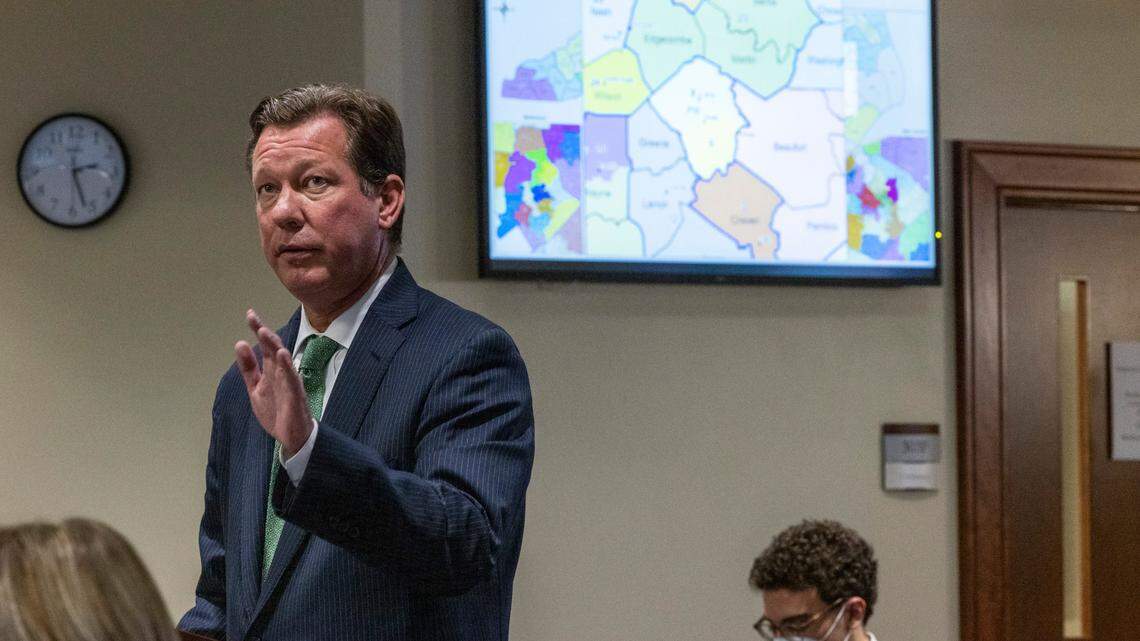
A legal case with potentially disastrous consequences for American democracy is headed to the U.S. Supreme Court this week, with oral arguments scheduled for Wednesday.
North Carolina Republicans want the Supreme Court to endorse a version of what’s referred to as the “independent state legislature theory,” an interpretation of the Constitution that suggests the state legislatures have near-complete power over federal elections.
The case has drawn national attention, largely due to the implications it could have for election administration across the country — certainly congressional redistricting, but perhaps also voter ID, mail-in voting procedures and more. At worst, some experts have feared, it could make it easier for state legislatures to overturn election results.
But Republicans say that people are exaggerating what Moore v. Harper will actually mean. It’s just about courts and maps, they say, dismissing concerns about the case’s repercussions as “hype and clickbait.”
Even if that’s true, Moore v. Harper still poses a threat. Even if Republican lawmakers aren’t explicitly asking the Supreme Court to write democracy’s obituary, what they are arguing for is ominous enough.
According to North Carolina legislators, the case is simply about whether state courts have the constitutional authority to intervene in the congressional redistricting process. Lawmakers argue the courts do not, and they want complete control over the process, essentially insulating the legislature against any and all gerrymandering lawsuits at the state level.
The case stems from a decision the North Carolina Supreme Court handed down earlier this year, in which it declared the state’s new electoral maps were unconstitutionally gerrymandered to favor Republicans. Those maps were all but guaranteed to give the GOP a supermajority in the state legislature and disproportionate representation in Congress.
Ultimately, the court imposed an interim congressional map for use in the 2022 election only. Now, for the next two years, North Carolina, a politically diverse purple state, will be represented in Congress by seven Democrats and seven Republicans.
“The question presented in this case, concerning whether or to what extent a State’s courts may seize on vague and abstract state constitutional language requiring ‘free’ or ‘fair’ elections to essentially create their own election code, could scarcely be more significant,” lawmakers wrote in their petition asking the court to take up the case.
Republicans are correct in saying that the case couldn’t be more significant. It is, fundamentally, about democracy: about checks and balances, about the fairness of elections.
Contrary to the GOP’s assertions, these concerns are not tall tales concocted by liberals. Experts, legal scholars and election officials from both political parties have filed briefs with the court urging justices to reject the legislature’s argument. The American Bar Association warned the court that the case could “cripple the rule of law. A group of former Republican officials said it could cause “unprecedented electoral disruption.”
In fact, the Supreme Court itself has rejected versions of the theory in the past, and centuries of precedent clearly supports the authority of state courts to act as a check on the legislature’s power regarding federal elections.
There’s plenty of the usual irony to be found in Republicans accusing state judges of “usurping” the will of the people, considering it’s coming from legislators who have habitually stifled the people’s voice to entrench themselves in power.
In reality, lawmakers are asking the Supreme Court to do exactly that: replace the will of the people with the will of the people in power.
If the court rules in the GOP’s favor, legislatures in both blue and red states could almost certainly gerrymander without state courts there to serve as a check on its power. Republicans argue that legislators will still have to answer to federal courts and Congress. But the Supreme Court ruled in 2019 that partisan gerrymandering questions are outside the scope of federal courts, and Congress is unlikely to be much of a check if its members hail from districts designed to favor the people who drew them.
Don’t be fooled by those who say this case isn’t as bad as it sounds. What is terrifying about Moore v Harper is not the damage that could be done in the worst-case scenario. It’s that even when taken at face value, it still is plenty dangerous to democracy.
Correction: An earlier version of this editorial provided an incorrect day for oral arguments for Moore v Harper. They will begin Wednesday.
BEHIND THE STORY
MOREWhat is the Editorial Board?
The Charlotte Observer and Raleigh News & Observer editorial boards combined in 2019 to provide fuller and more diverse North Carolina opinion content to our readers. The editorial board operates independently from the newsrooms in Charlotte and Raleigh and does not influence the work of the reporting and editing staffs. The combined board is led by N.C. Opinion Editor Peter St. Onge, who is joined in Raleigh by deputy Opinion editor Ned Barnett and in Charlotte by deputy Opinion editor Paige Masten. Board members also include Observer editor Rana Cash and News & Observer editor Nicole Stockdale. For questions about the board or our editorials, email pstonge@charlotteobserver.com.
This story was originally published December 5, 2022 at 4:00 AM with the headline "In NC’s Supreme Court case, the least bad outcome is still really bad."