
FAQ: Durham and Orange counties are planning for light rail. Here are the facts.
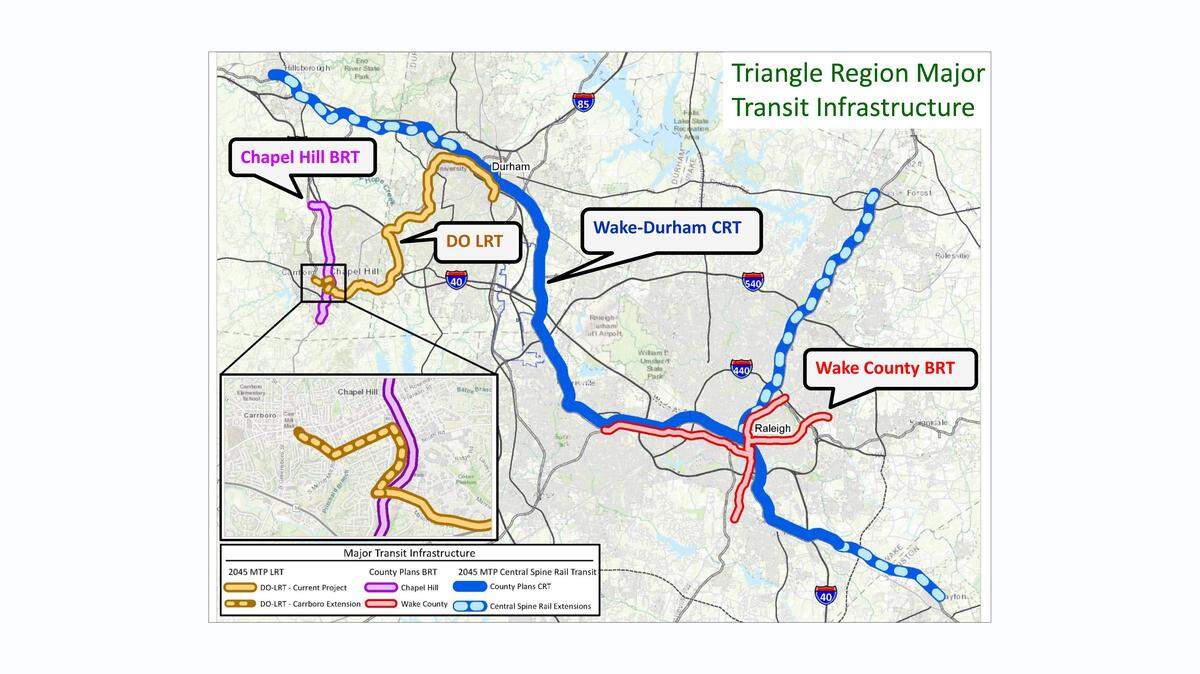
The Durham-Orange Light Rail Transit project continues to push through the changes on its track to secure nearly $1.5 billion in state and federal money.
The 17.7-mile system is part of each county’s transit plans and could cost $3.3 billion, including interest in short- and long-term loans. Local money and private donations would pay what the federal government does not.
The rail system could connect UNC Hospitals in Chapel Hill to Duke and N.C. Central universities in Durham, and points in between, with 19 stations surrounded by dense housing, retail and offices. Four stations would be in Orange County, two in the Chapel Hill portion of Durham County, and 13 others in Durham County.
Besides forming part of a Triangle transit network, the light-rail project was envisioned as a way to limit sprawl by concentrating dense economic and residential growth around its stations. Experts have said it won’t have a big effect on air pollution or congestion.
Why the route is where it is
The decision to run the rail line along N.C. 54 to just south of Interstate 40 and then east on U.S. 15-501 was a complicated one. Officials based it on the project’s cost, its expected ridership and its development potential.
U.S. 15-501 between Chapel Hill and Durham is congested and dense already, which created a challenge for siting the rail line, stations and new commercial and residential growth. Building it in the middle of the highway would have been expensive and created safety issues for people trying to board the trains, they said.
There has been significant growth along N.C. 54, too, but there’s still room for stations and development, officials said. That route also met a key goal: moving university and health care workers. Duke University, UNC-ChapelUNC-Chapel Hill and their health care systems are the counties’ top employers.
The light-rail line doesn't go to Research Triangle Park or Raleigh-Durham International Airport, but riders will be able to get there by transferring to a future commuter rail line between Durham and Raleigh or by taking a bus.
How the plan has changed
The original light-rail project was estimated at $1.8 billion — Durham and Orange counties would have split $450 million in costs — but the price grew when an extra stop was added at NCCU and for joint development projects around the light-rail stations.
Although a 19th station was added last year at the Durham Performing Arts Center in Durham County, it did not affect the cost.
The cost also increased when the governments agreed to use short- and long-term debt to cover a shortfall created when the state capped its share at 10 percent instead of 25 percent. The debt also will bridge the gap between when construction starts and when federal money could be available.
The debt, which added roughly $830 million in interest to the system's cost, is payable through 2062.
Where the money comes from
Local share: 40 percent of construction costs, plus interest on debt, or roughly $1.7 billion
Funding source: Half-cent sales tax — does not apply to food, gas, housing or medical care — car rental and vehicle registration fees
Private donations: A public-private Funding and Community Collaborative is seeking cash and land donations of at least $102 million
State share: Up to 10 percent, or $247 million.
Federal share: Up to 50 percent, or $1.23 billion
How the local share is divided
The cost-sharing agreement between Durham and Orange counties is based on the amount of light rail that will be built in each county. The agreement, which was re-negotiated in 2017, states that no other tax dollars will be used for the project.
Orange County: $316.6 million (16.5 percent of construction costs, 18.5 percent of interest)
Durham County: $1.5 billion (81.5 percent of construction costs and interest)
How operating costs will be paid
Durham has agreed to pay 80 percent to 81 percent of the operations and maintenance costs – about $26.2 million a year by 2045 – with Orange County picking up the rest, or roughly $6.2 million a year.
Light-rail fares would provide some operations and maintenance funding, but the transit sales tax, registration fees and car rental fees also could continue.
Where the project currently stands
The light-rail project is in the last phase — engineering — of the Federal Transit Administration's New Starts grant program.
GoTriangle, Orange and Durham officials are working with an FTA-appointed project management oversight contractor to complete the project’s design, schedule and costs, and confirm that state and local funding is available.
Half of the work has been completed, and a federal budget recommendation could be submitted to the FTA later this year. Local officials could learn whether the project gets federal funding by September 2019.
What happens if light rail is approved
Construction could begin in 2020, and the first $100 million federal installment could be included in the 2019-2020 federal budget.
The FTA would reimburse half of the money that GoTriangle has spent so far, including about $33 million for a required environmental impact study and nearly $115 million for engineering, program management and construction management consultant contracts.
What ifs
The project budget includes an amount equal to roughly 30 percent of the construction cost, or roughly $740 million, for unexpected expenses. Local officials also are looking for ways to cut costs.
The light-rail line won't be built without federal or state funding.
The Capital Area and the Durham-Chapel Hill-Carrboro metropolitan planning organizations recently removed other projects, including money for buses, bus routes and bus-rapid transit routes, from their priority lists to give light rail a better shot at full state funding.
Plan B
If there is no state or federal money, Durham, Orange and GoTriangle would meet within 15 business days to consider other solutions, including a search for other money; delaying, suspending or reducing the project; or stopping the project.
If the project stops, officials would meet within 20 business days to draft a new transit plan. If they can’t agree, it will go to mediation and then an arbitration hearing before three judges – one picked by each county and one picked jointly.
This story was originally published March 16, 2018 at 3:20 PM with the headline "FAQ: Durham and Orange counties are planning for light rail. Here are the facts.."