NC lawmakers vote to allow Duke Energy to charge customers in advance for new plants
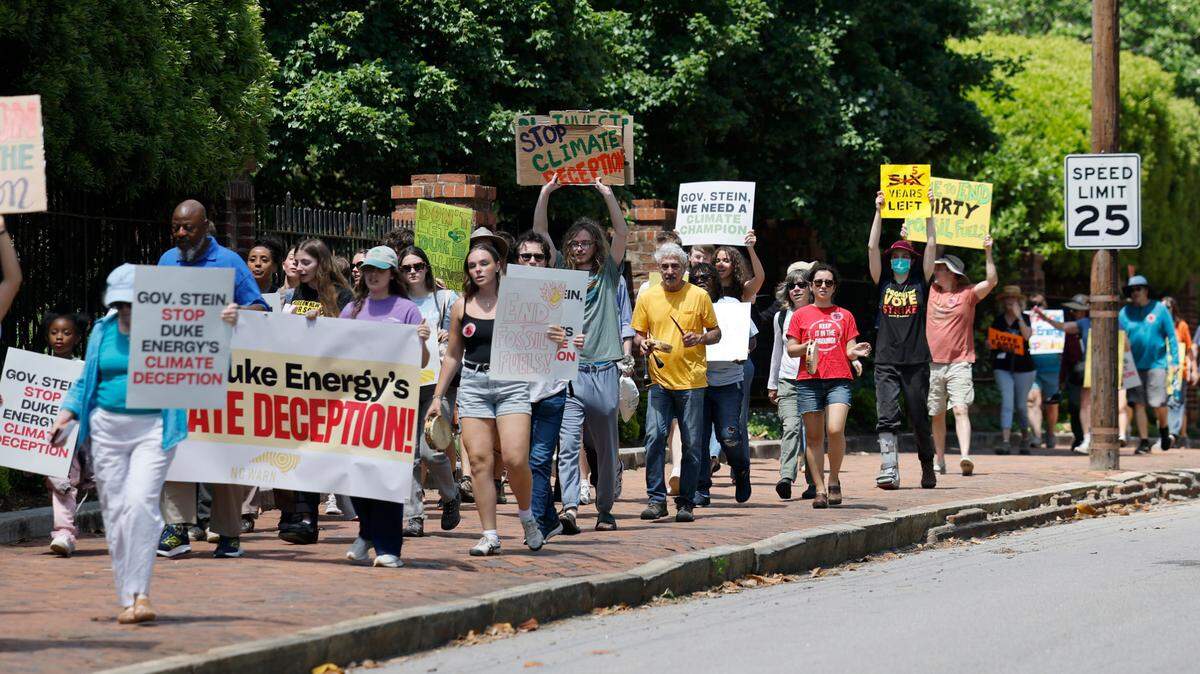
The N.C. General Assembly voted Tuesday to overturn Gov. Josh Stein’s veto of a bill that opponents say will cause Duke Energy’s residential electric rates to rise while committing the utility to an over-reliance on fossil fuels for generations.
The Senate vote was 30 to 18. The House voted 74 to 46, with three Democrats — Representatives Carla Cunningham, Nasif Majeed and Shelly Willingham — joining Republicans in favor of the override.
Duke Energy and some business interests supported the bill. Duke says the measure will result in lower costs for consumers in the long run, despite contradictory findings by researchers at N.C. State and Duke universities. The utility and other bill supporters say it will help ensure the state has reliable, affordable energy to meet the needs of a growing population and expanding industry, including data processing centers.
After the votes, a Duke Energy spokesman said, “We appreciate bipartisan efforts by policymakers to keep costs as low as possible for customers and enable the always-on energy resources like carbon-free nuclear power our communities need. We remain focused on working with all state leaders to support North Carolina’s continued success through smart investments and a reliable, affordable, and increasingly clean mix of energy resources.”
The bill, which moved quickly through the Republican-controlled legislature with help from some Democrats, was passed by the General Assembly in June. Stein vetoed it on July 2.
At that time, Stein said, “This bill not only makes everyone’s utility bills more expensive, but it also shifts the cost of electricity from large industrial users onto the backs of regular people — families will pay more so that industry pays less. Additionally, this bill walks back our state’s commitment to reduce carbon emissions, sending the wrong signal to businesses that want to be a part of our clean energy economy.
“My job is to do everything in my power to lower costs and grow the economy,” Stein said. “This bill fails that test.”
The 30-page bill includes provisions that:
- Allow Duke energy to charge rate-payers in advance for power plants before they’re built or brought online. This method of financing new construction, called Construction While in Progress, saves the utility interest that would be charged on money borrowed to build new plants. But in South Carolina and Georgia, it resulted in rate-payers footing the bills for plants that were never completed or were finished late and far over budget.
- Allow the utility to charge residential customers for a larger share of the cost of electricity Duke has to buy to meet excess demand. Currently, the formula is based in part on usage. Senate Bill 266 removes usage from the equation, and has residential customers paying for 49% of the cost, analysts have said, when they typically use about 40% of the electricity.
- Allow Duke Energy to miss a previously agreed-upon goal of reducing its carbon emissions. In 2021, Democrats and Republicans worked together to approve House Bill 951 that committed North Carolina to a 70% reduction in carbon dioxide emissions by public electric utilities from 2005 levels by the year 2030. Duke now says that goal is unachievable, though it says it still can meet a goal of carbon neutrality — meaning that for every ton of carbon dioxide its plants produce, an equivalent amount of emissions is prevented — by 2050.
SB 266 leaves the 2050 goal in place but drops the interim 70% reduction.
Environmental groups say the cumulative effects of the provisions will be to encourage Duke Energy to build more large, centralized power plants that use natural gas or nuclear fission to generate power as coal-burning plants are retired. Those groups want the state to move toward cleaner energy sources such as large-scale solar, saying it’s more reliable in the long term and will slow the effects of climate change.
Several groups had planned a protest Monday night near the legislative building in opposition to the bill, but canceled the event because of a severe heat warning, with temperatures in the 90s and heat indices over 100 degrees.
Margaret Lillard of the Sierra Club said the event’s cancellation because of excessive heat was “yet another vivid representation of the impact of climate change-driven weather extremes in North Carolina,” and only underscored the need to stop SB 266.
Mikaela Curry, manager of the Sierra Club’s “Beyond Coal” campaign, said, “I don’t understand why our lawmakers haven’t done a better job of protecting us. This bill locks us into a future that is not good for North Carolina families.”
This story was produced with financial support from the Hartfield Foundation and Green South Foundation, in partnership with Journalism Funding Partners, as part of an independent journalism fellowship program. The N&O maintains full editorial control of the work. If you would like to help support local journalism, please consider signing up for a digital subscription, which you can do here.
This story was originally published July 29, 2025 at 10:18 AM with the headline "NC lawmakers vote to allow Duke Energy to charge customers in advance for new plants."