
Missing in Western North Carolina since Helene: The sounds of freight trains
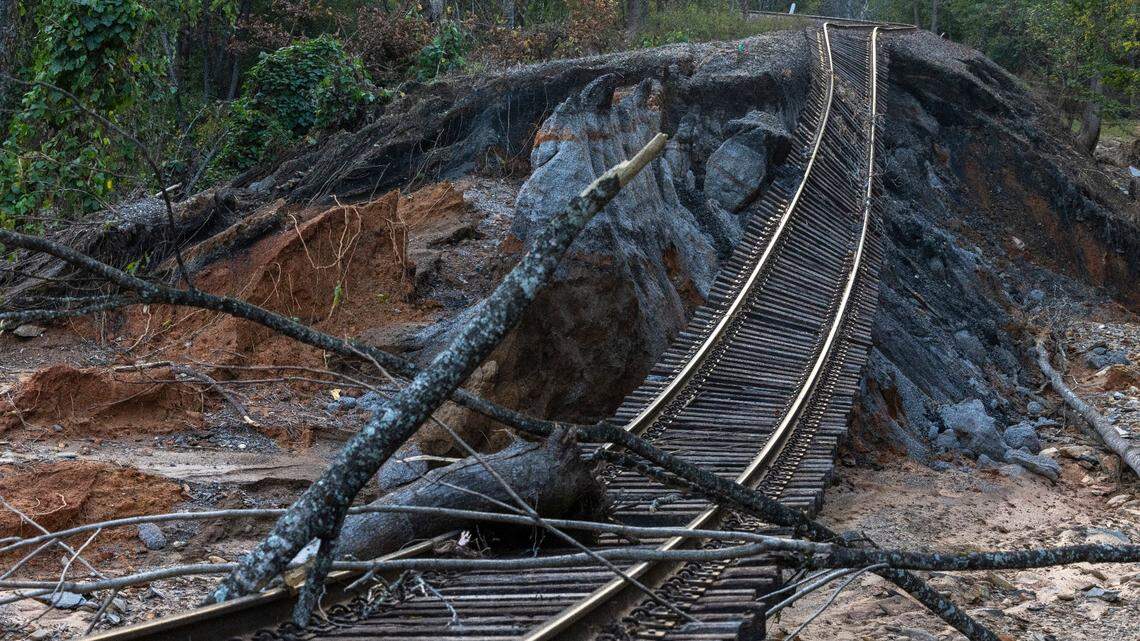
Before Helene, the towns and valleys of Western North Carolina echoed with the rumble and screech of trains that carried freight through the mountains and stopped at factories, mines and lumber yards in the region.
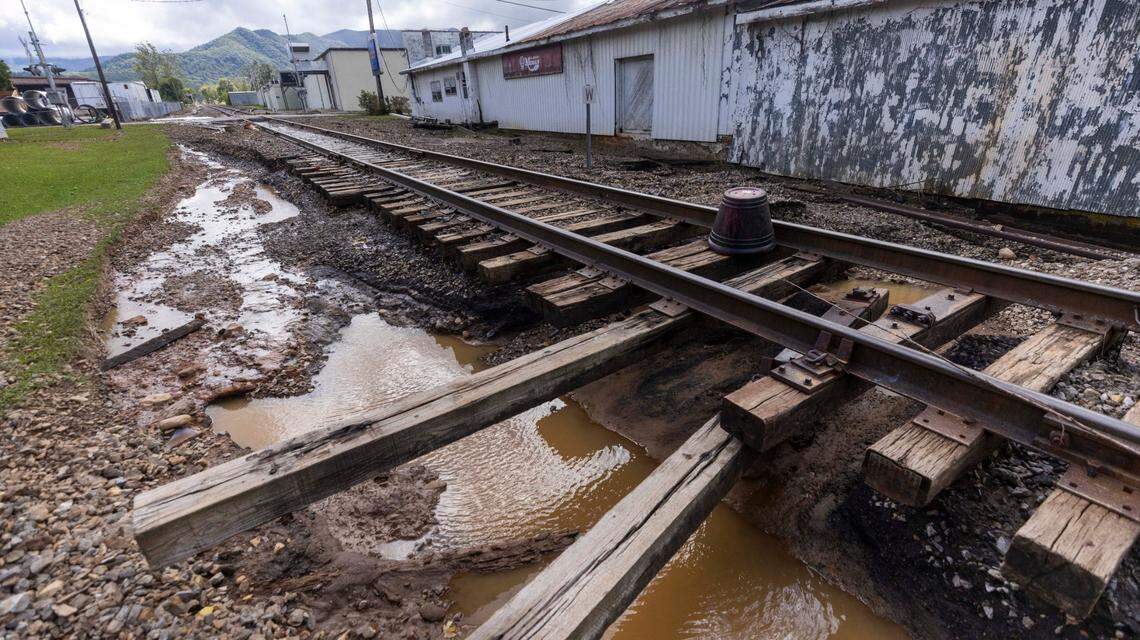
But the rail lines have been silent in many places since the storm triggered landslides and washed out tracks and bridges on Sept. 27. About 230 miles of railroad remain out of service, including key sections owned by the Southeast’s two long-distance carriers, CSX and Norfolk Southern.
Rebuilding the tracks and fully restoring freight rail service to the region will take months and perhaps longer in some areas.
In the mountains, railroads often follow the level terrain alongside rivers such as the Swannanoa, the French Broad and the North Toe. That made them vulnerable to the catastrophic flooding that also washed away roads, homes and businesses in the valleys.
Among the worst damage was along the North Toe and Nolichucky rivers from Spruce Pine northwest into Tennessee. For about 40 miles, CSX trains snaked through a steep, remote valley on tracks that don’t exist anymore, says Jason Orthner, director of the N.C. Department of Transportation’s Rail Division.
“Because it is such a narrow gorge, it washed out the railroad ties,” Orthner said. “So CSX is having to completely rebuild that portion of the railroad.”
The CSX Blue Ridge Subdivision, as the line is known, is a key link between the Southeast and Midwest but also serves businesses in the mountains. The railroad was able to restore limited service from Spruce Pine south toward Charlotte and South Carolina, allowing it to carry freight for two important customers, the Quartz Corp., which produces high-quality quartz for semiconductor chips near Spruce Pine, and Baxter Healthcare, which makes IV fluids near Marion.
Meanwhile, Norfolk Southern’s AS Line remains out of service from Old Fort through Asheville to Newport, Tennessee. The railroad said more than four miles of track were washed out and another 12 miles damaged by scour or slides.
%20(1).jpeg "Image (2) (1).jpeg")
Norfolk Southern says it hopes to restore the line from Newport through Asheville to near Black Mountain by the end of March. That would include its freight yard in Asheville, adjacent to the city’s devastated River Arts District.
But the company doesn’t know when it will be able to reopen the line between Black Mountain and Old Fort, where the tracks top the Eastern Continental Divide with a series of horseshoe turns through rugged terrain. This section of the AS Line connects Western North Carolina with the rest of the state, Orthner said, and is the route NCDOT is studying for possible future passenger trains between Salisbury and Asheville.
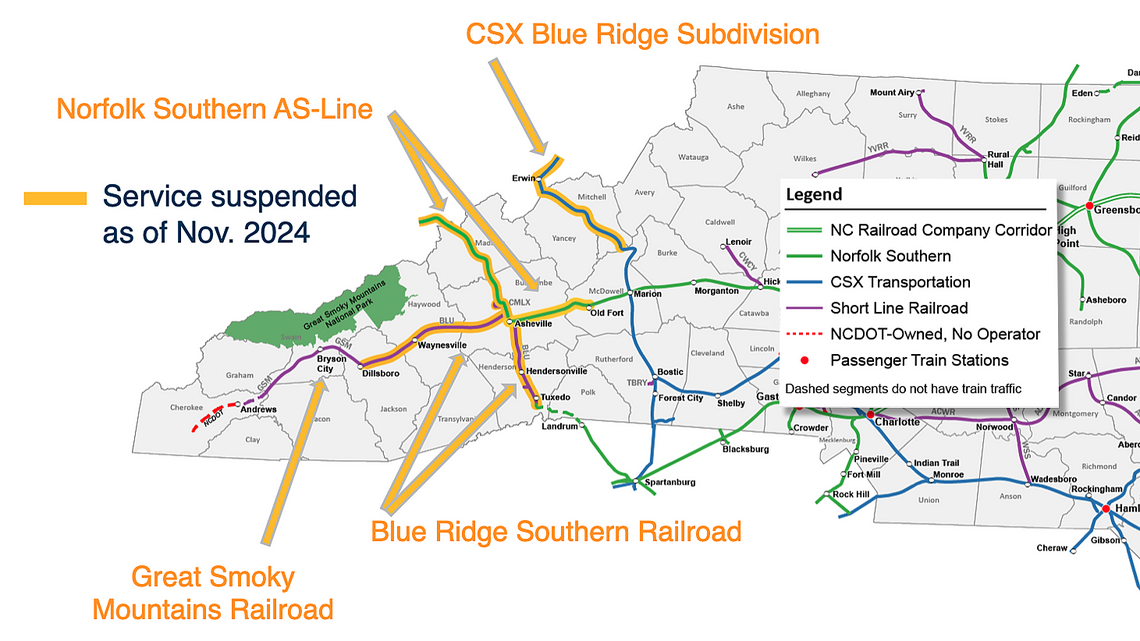
A third freight railroad was also heavily damaged by Helene. The Blue Ridge Southern Railroad serves businesses along routes through Hendersonville and Waynesville that connect to the outside world at Norfolk Southern’s yard in Asheville. The short-line railroad must rebuild about a mile of track spread over several locations, Orthner said.
“And importantly, they cannot provide service to their customers without Norfolk Southern establishing their connection in Asheville,” he said.
Providing help for rail-dependent businesses
Companies are having to adjust to the lack of rail service, primarily by sending and receiving goods by truck. Trucking is more expensive than rail, says Patrick Pierce, director of economic and business development for the North Carolina Railroad Co.
“From a cost standpoint, it’s three to four trucks per rail car,” Pierce said. “Those costs can become pretty significant over a long-term outage.”
The North Carolina Railroad, a private company wholly owned by the state, owns and manages a rail line that extends from Charlotte through the Triangle to Morehead City.
But it also has a mission of economic development, which is why, less than two weeks after Helene, it announced a $10 million grant fund to help rail-dependent businesses in the mountains. That money is going to help repair sidings and other infrastructure and help businesses retain employees who do rail-related work, such as load or unload train cars, said Trish Haver, the company’s chief operating officer.
“We’re helping to cover salaries and things like that, so that people don’t lose their jobs,” Haver said. “So that when rail comes back online, operations can resume as normal.”
CSX warned against ‘mining’ the Nolichucky River
The rail lines in the mountains are privately owned, and it’s up to the companies to rebuild them, with some assistance and oversight from the state and federal governments.
Some environmental groups felt there wasn’t enough oversight of CSX’s effort to rebuild its tracks along the Nolichucky River.
Two groups, American Rivers and American Whitewater, sued three federal agencies last month for allowing the company and its contractors to mine rock from the riverbed without required permits. Scooping rock from the river was “inflicting significant damage on the gorge, ruining its unmatched values, and increasing downstream risk from future floods,” the Southern Environmental Law Center wrote in a suit filed in federal court last month on behalf of the groups.
“We want CSX to be able to quickly rebuild its damaged rail lines,” Patrick Hunter, an attorney in SELC’s Asheville office, wrote in a statement. “But it needs to do so in a responsible way that follows the law and protects our communities.”
Since then, the U.S. Army Corps of Engineers has ordered CSX not to do any work in the river that would require a permit under federal law.
“This prohibition extends to any excavation or dredging of material from the Nolichucky River or its tributaries in both Tennessee and North Carolina, and any deposition of dredge or fill material into those waters,” the Corps wrote in a letter dated Dec. 2.
CSX has adjusted its operations following the Corps’ instructions, according to company spokeswoman Sheriee Bowman.
“While the directive has slowed certain operations,” Bowman wrote in an email, “CSX remains committed to safely and responsibly rebuilding the Blue Ridge Subdivision as quickly as possible.”
This story was originally published December 11, 2024 at 5:15 AM with the headline "Missing in Western North Carolina since Helene: The sounds of freight trains."
