Control of the NC Supreme Court is up for grabs. These issues are at stake.
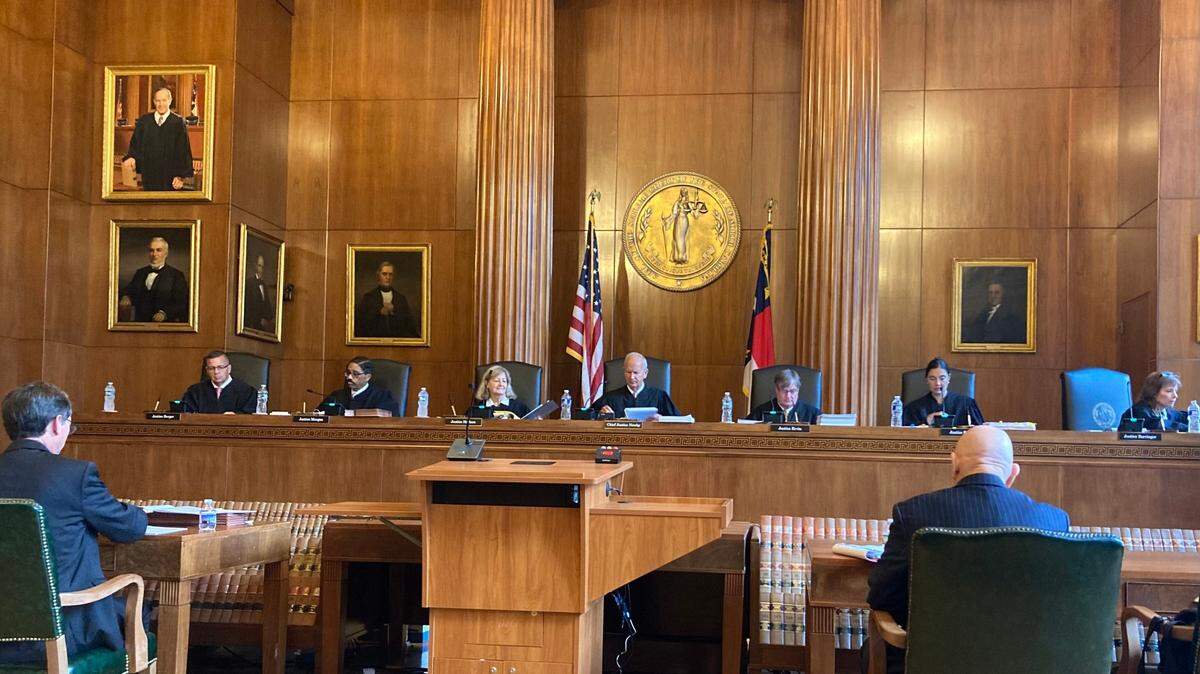
North Carolina voters will decide this November whether the state’s highest court should remain under Democratic control, or if Republicans should retake the majority for the first time in six years.
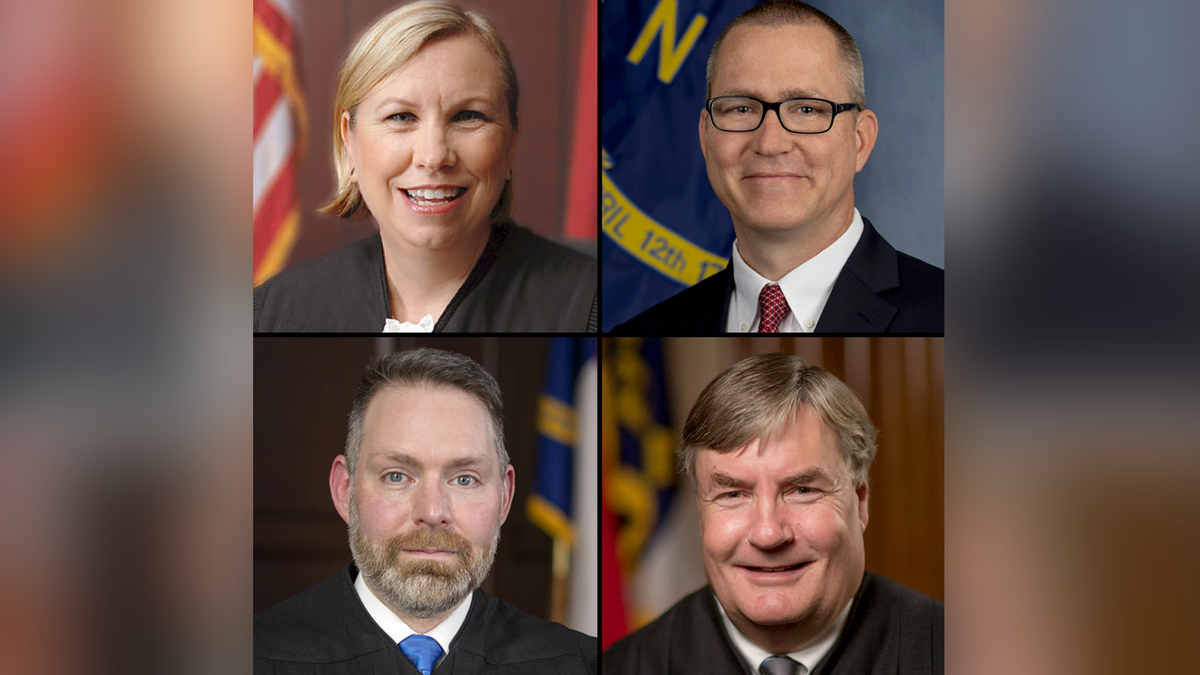
There are two races on the ballot this year, with Republican Trey Allen challenging Democratic incumbent Justice Sam Ervin IV and two N.C. Court of Appeals judges, Democrat Lucy Inman and Republican Richard Dietz, competing for an open seat.
Democrats will hold onto their 4-3 majority if they win both races. But if Republicans win one or both, the court will have a GOP majority starting in 2023.
The political stakes come at a time when the N.C. Supreme Court arguably has a higher profile than ever.
The other two branches of government are divided, with Republicans controlling the legislature while the executive is led by a Democrat, Gov. Roy Cooper. Their power struggles in recent years have frequently gone before the Supreme Court to referee, with a mixed record.
Cooper won his attempt to stop the legislature from taking away his influence over election rules, for instance. But the governor lost his attempts to take more control over state spending, and to stop the legislature from denying his nominees for cabinet jobs, a new power the legislature used last year to shoot down Cooper’s pick for the state’s top environmental regulator.
The court has also taken up other big political cases in recent years, ranging from education spending to voter ID, redistricting, Confederate statue removal and whether a gerrymandered legislature can claim to actually represent the people of the state.
The court also tackles plenty of cases related to business disputes, parental rights, HOA squabbles and numerous appeals of criminal convictions. The court frequently tackles death penalty cases, Fourth Amendment questions, lawsuits involving racial bias on juries and other criminal justice topics.
The next big issues?
If the legislature passes new laws in the next few years on various hot-button issues they’ve recently debated, lawsuits could very well follow — and those could then end up in front of the Supreme Court, as so many other political lawsuits have in recent years.
Some of those issues could include:
▪ Medical marijuana legalization
▪ Harsher penalties for protesters
▪ Limits to what teachers are allowed to say about racism and LGBT people.
▪ Changes to health care policy being discussed alongside Medicaid expansion
Politics and the court
Cooper may not have won all of his cases against the legislature before the Democratic-controlled court, but overall, recent rulings in political lawsuits have tended to come down along partisan lines.
People shouldn’t be surprised when judges, elected in political campaigns, rule in favor of their political party, one longtime expert on state politics said in an interview.
“We have this expectation that judges should be fair and nonpartisan,” said Michael Bitzer, a political science professor at Catawba College. “But to expect no party politics, when we’re looking at the kind of cases that our appellate courts deal with, is not based in reality.”
Bitzer said the hot-button issue this year is abortion. The U.S. Supreme Court overturned Roe v. Wade in this summer’s Dobbs decision. Bitzer said if Republicans win a supermajority in the legislature, they can pass whatever new abortion restrictions the N.C. Supreme Court will allow.
It would be “political malfeasance” for Democrats not to focus on that message in their ads for the Supreme Court, he said.
“Because any new challenges will have to be at the state level, not the federal level,” Bitzer said. “With Dobbs, the (U.S.) Supreme Court basically said, ‘We’re out of this game, we’re going to let states decide.’”
In mid-October, the ACLU announced it would be spending over $1 million on voter outreach and ads in the two Supreme Court races, focused on “the right to access abortion care.”
A former Democratic campaign consultant who is now a Duke University professor, Mac McCorkle, said normally this year would’ve been tough for Democrats, since midterm elections tend to go against whichever party controls the White House. But nationwide backlash to the Dobbs decision has hurt Republicans — to the point where in the U.S. Senate race, polls have shown Democrat Cheri Beasley and Republican Ted Budd essentially tied.
Yet while most people tend to vote straight-party tickets, McCorkle said, voters do lean a little more conservative in judicial races.
“My sense is Beasley is competitive, and other Democrats are maybe a step behind Beasley,” he said. “So something needs to happen for the Democrats in the statewide judicial races.”
Court can influence elections
For both political parties, control of the court is important because of redistricting. The justices have the final say on whether to strike down political districts legislators draw as unconstitutional gerrymandering — or to let the maps stand.
The Supreme Court ruled this year that partisan gerrymandering can violate the state constitution. The legislature’s original maps would’ve likely led to Republicans winning 10 of the 14 U.S. House seats even if Democrats won the statewide vote, evidence in the case showed. The court ruled 4-3 that the maps were so skewed toward one party they violated the constitution’s guarantee of free elections.
All the Republican justices on the court dissented from that ruling, echoing criticisms GOP lawmakers also made.
That worries Democrats like McCorkle, concerned about their party’s future in elections if a new Republican majority on the court reverses its stance on gerrymandering.
“You never know, but the state oversight over gerrymandering would likely go away,” he said. “So Republicans in the legislature could come in and draw much more aggressive maps.”
One of the lead Republican redistricting chairmen, Sen. Warren Daniel of Morganton, said in an interview this summer that the court has no business interjecting itself into the mapmaking process. Recent rulings like the one this year harm the court’s reputation, he said, adding that he believes the solution is to elect more Republicans to the court.
“There’s just been this trend, over the last few years, that judges are starting to get into the role of legislators and perceive themselves as super-legislators,” Daniel said. “I think that’s really the underlying problem.”
A former Republican N.C. Supreme Court justice, Bob Orr, told The N&O in an interview last year about the 2022 judicial elections that campaign spending — and political pressure — skyrocketed after gerrymandering lawsuits picked up in the 1990s and 2000s.
In recent years, North Carolina has been home to numerous redistricting lawsuits, and also some of the nation’s most expensive Supreme Court races.
“I’ve told folks if you reform redistricting, you’ll also do a lot to take politics out of the court,” Orr said.
Richard Dietz vs. Lucy Inman
One seat is open after Democratic Justice Robin Hudson chose not to seek reelection. Even if she had run and won, she would’ve quickly been forced to step down, due to the court’s mandatory retirement age of 72.
Seeking to replace her:
▪ Dietz is a Republican who has been on the appeals court since 2014. He was the first in his family to go to college and after law school worked in both Japan and Washington, D.C., for several years. He later moved to North Carolina for a job in the appellate division of international law firm Kilpatrick Townsend & Stockton, where he once helped argue a case in front of the U.S. Supreme Court before becoming a judge himself.
In that case, Dietz helped represent a former police officer accused of making an illegal straw purchase of a gun for a relative, the Triad Business Journal reported in 2013. The court ruled 5-4 against the officer.
He was appointed to a seat on the Court of Appeals by Republican Gov. Pat McCrory.
▪ Inman is a Democrat who has served on the appeals court since 2015. She is a member of Raleigh’s prominent Daniels family, who owned The N&O from 1894 until 1995. She worked as a reporter before law school and later clerked for Jim Exum, then the chief justice of the Supreme Court.
Inman worked in private practice in both Raleigh and Los Angeles for 18 years, before becoming a trial court judge in 2010, appointed to an opening by Democratic Gov. Bev Perdue.
In 2020, Inman’s son William Warden pleaded guilty to threatening a Cary synagogue in 2018, when he was 20 years old. The FBI said he claimed to be part of a right-wing hate group, The N&O reported, noting that his family said he had “struggled with bipolar disorder and schizophrenia all his life.” Inman and her husband apologized to the local Jewish community after the arrest, writing that “our son has been exploited by people whose agenda is completely opposed to the inclusive values we espouse and live.”
Sam Ervin IV vs. Trey Allen
In the other race:
▪ Ervin is the grandson of the U.S. senator of the same name from Morganton, who led hearings that took down both Joseph McCarthy and Richard Nixon. He still lives in Morganton, where he practiced law for 18 years before getting involved in politics in the early 2000s. He served on the N.C. Utilities Commission, which regulates energy companies, for eight years before winning an election for a seat on the N.C. Court of Appeals in 2008.
Ervin first ran for Supreme Court in 2012, losing to Republican incumbent Paul Newby, who is now the chief justice. He ran again in 2014 and won, and has served on the Supreme Court ever since. This is his first shot at reelection, since terms on the court are eight years long.
▪ Allen, a Robeson County native who began his legal career in the Marines, is the top lawyer for the North Carolina courts system. Newby ousted several top court system employees after he became chief justice last year, and he replaced one of them, the general counsel, with Allen, who was a law clerk for Newby early in his career.
Allen was previously a lawyer for several years at Raleigh law firm Tharrington Smith, and he taught at UNC-Chapel Hill from 2013 until last year.
Allen has never worked as a judge, but that isn’t a requirement to serve on the state’s highest court. Three of the court’s seven current justices — Newby, Anita Earls and Tamara Barringer — had no judicial experience prior to joining the Supreme Court.
For more North Carolina government and politics news, subscribe to the Under the Dome politics newsletter from The News & Observer and the NC Insider and follow our weekly Under the Dome podcast at campsite.bio/underthedome or wherever you get your podcasts.
This story was originally published October 16, 2022 at 6:00 AM with the headline "Control of the NC Supreme Court is up for grabs. These issues are at stake.."