North Carolina’s 2022 primary election is in flux. Your guide to the uncertainties.
READ MORE
Are you ready to vote?
The finer details of North Carolina’s 2022 primary election switch up as quickly as the weather. The final results will influence which party controls Congress and the legislature in coming years. This special N&O report breaks down what you need to know about the changing, confusing election.
Expand All
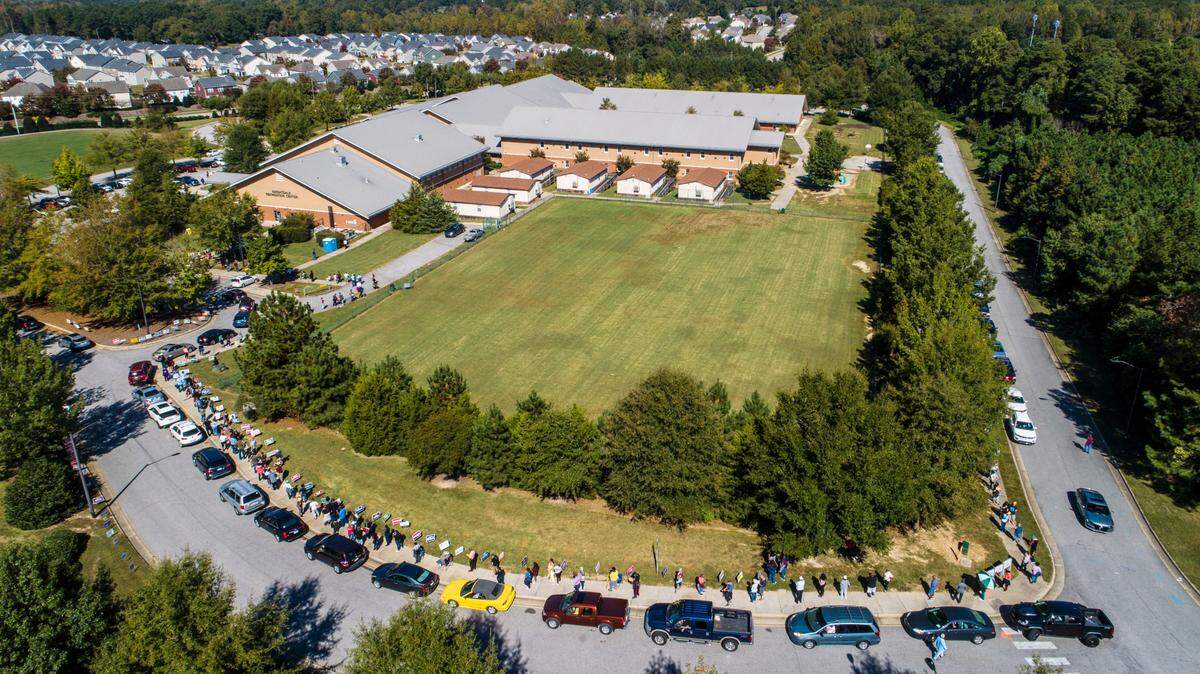
At this moment, North Carolina’s 2022 primary election, which will set the playing field for Democrats and Republicans vying for control of both chambers of Congress and the state legislature, will take place in May.
That could change in the coming days, and it’s just one part of the 2022 primary that is still in flux.
The dates when candidates will be able to file for election remain in limbo. It’s unclear if state legislative and congressional districts drawn by North Carolina’s Republican-controlled legislature will remain intact. The state elections board is delaying a challenge to one high-profile candidate’s eligibility for office.
Whether the primary election ends up in May or June, political maps are redrawn, or U.S. Rep. Madison Cawthorn can run for reelection, the primary’s results will influence which party makes gains in the general election, and ultimately, what happens in our state and country in the coming years.
“I think we underestimate the importance of the primary elections, and I think voters need to be, you know, paying attention to this stage,” said Kerry Haynie, chair of political science at Duke University. “It really sets up how competitive the general election will be.”
Despite fierce fights between Democrats and Republicans over these details, whether the date of the primary is moved will ultimately have a small impact on voters.
“Since we’ve been in the pandemic, elections have been confusing already,” Haynie said. “Voters are in a position now to expect any and everything and know that you have to be ready to pivot.”
Here’s what you need to know about the primary election.
Why should I care about this year’s primary election?
When an incumbent runs for reelection, they rarely face a competitive primary, and the outcome often isn’t in question.
That is not the case in 2022.
Multiple members of Congress aren’t running for reelection, so their seats are up for grabs. Plus the state’s new congressional map, if it stands, has several incumbent-free districts. All in all, 2022 could be one of the most important primary elections for years to come since there are rarely so many opportunities for newcomers to go to Congress.
North Carolina’s map for the U.S. House of Representatives, as currently drawn, has 10 seats that are all-but-guaranteed to elect a Republican, three seats that are all-but-guaranteed to elect a Democrat, and one competitive seat.
So 13 of the 14 people who will represent North Carolina in the U.S. House are likely going to be decided in the primary election, not the general election in November. And even in that one competitive seat, the primaries will be important. Both Republicans and Democrats will have competitive races since the incumbent, Democratic Rep. G.K. Butterfield, is not running for reelection.
In North Carolina, people can vote in the primary of the party they’re a member of. If they’re registered as unaffiliated, they can choose which party’s primary they want to participate in when they get to their polling place.
How do I register to vote, or update my new address?
There’s still plenty of time to either update your information if you’ve moved or want to switch parties, or register for the first time. For now, with the primary on May 17, the deadline to register to vote is April 22.
And that only applies to people who plan to vote on Election Day itself, or by mail. People who miss the April 22 deadline can still go during early voting to a polling place and register to vote in person at the same time they cast their ballot.
To find more information, including how to register, go to www.ncsbe.gov/registering. To find information about your local polling places, dates of early voting and other election details, search online for your county’s board of elections website.
So the date of the primary still isn’t set in stone? Why?
The state Supreme Court delayed the primary in December, moving it from March 8 to May 17 to allow time for legal challenges to the Republican-drawn districts to play out. Republicans then passed a bill last week that would further delay the primary until June 7. The bill received no support from Democrats in either chamber, signaling Democratic Gov. Roy Cooper is unlikely to sign the measure into the law.
Why did Republicans want to move it?
Republicans have cited a variety of reasons to justify moving the primary, including alleviating voter confusion and giving candidates more time to decide whether they’ll file if new maps are drawn.
Moving the election to June gives candidates time to know “what a district actually looks like” before declaring a run for it, Sen. Ralph Hise, a Republican from Spruce Pine, told The News & Observer Friday. And it gives “voters a longer time period to get to know the candidates running before the primary election,” Hise said.
Republicans would also benefit from moving the primary date back because doing so could give lawmakers more time to redraw the maps themselves, rather than an outside expert brought in by the majority-Democrat state Supreme Court.
Why don’t Democrats want to move it?
Democrats could have a better chance of the maps being redrawn in their favor if the court handles it.
Many Democrats said last week that the legislature should let the process play out in court.
“I worry that that may appear, to those looking in from the outside, of us jumping in on another branch,” said Rep. Robert Reives, a Democrat from Chatham County.
When will we know if it’s going to be moved or not?
Cooper has 10 days from when the bill passed the legislature to sign it into law, so we should know by the end of this week when the primary date will be. The legislature could try and override the governor’s veto, if that happens, but they’re unlikely to gain enough support from Democrats to be successful.
Would moving the primary to June actually matter?
Not really, no. Experts say that moving the date from May to June will only minimally affect turnout, and is unlikely to confuse voters.
“It’s a net-zero effect,” said Meredith College political science professor Whitney Manzo. “The turnout for primary elections is already very small. It was going to be small if it’s held in May, and it’s going to be small if it’s held in June.”
Since the bill Republicans passed also moves the filing date back further, the legislation could, however, benefit candidates who need time if new maps are drawn to decide whether they’re going to run.
Races to watch as this plays out
At the top of the ballot, North Carolina has a wide-open race for U.S. Senate since Republican Richard Burr is not seeking reelection. The Republican primary is already shaping up as a slugfest between former Gov. Pat McCrory and U.S. Rep. Ted Budd. On the Democratic side, former N.C. Supreme Court Chief Justice Cheri Beasley is thought to be the frontrunner, although she is expected to have several challengers.
And that’s not all.
Since North Carolina’s U.S. House delegation will likely be mainly determined in the primary elections, people who want a say in who represents them in Congress shouldn’t skip the primaries. Here are some of the most important House primaries to keep an eye on, assuming districts are unchanged.
▪ NC-02: The only tossup district out of all 14 statewide, and one with a retiring incumbent, the 2nd Congressional District will be a prime focus of local and national political groups on both sides of the aisle. Covering half the state’s border with Virginia, plus Rocky Mount, Wilson and Goldsboro, both Republican and Democratic voters should expect multiple candidates competing for the party nomination in this northeastern district.
▪ NC-04: Other than the 2nd, this district — covering areas south of Raleigh including Fayetteville and Smithfield — is the most likely to be competitive in November. It’s drawn to favor a Republican candidate but, unlike most of the other Republican districts in the state, could hypothetically be won by a Democrat in a strong year. And it has no incumbent. So expect to see at least a crowded Republican primary, and maybe a competitive Democratic primary, too.
▪ NC-06: The biggest election in the Triangle will be the Democratic primary for this seat, as numerous contenders line up to replace retiring Rep. David Price in this heavily liberal district that covers Durham, Chapel Hill, Cary and Apex. Whoever wins is almost certain to also win the general election in November. Voters will have a broad group of candidates to pick from, from Raleigh-born celebrity singer Clay Aiken to Durham County Commissioner Nida Allam, state Sens. Wiley Nickel and Valerie Foushee, and others.
▪ NC-07: Aspiring GOP politicians are eyeing this district in the middle of the state, which stretches from Fuquay-Varina and Holly Springs to the west through Pittsboro, Sanford, Burlington, Asheboro, Lexington and some of the Greensboro suburbs. It has no incumbent, and whoever wins the Republican primary is likely to win the general election. Far-right Republican Rep. Madison Cawthorn has endorsed fellow millennial Bo Hines for the seat, but there have been rumors for months that Greensboro preacher Mark Walker — who used to represent parts of the area in Congress — may drop out of the U.S. Senate primary and run in this district instead.
▪ NC-12: Every Republican in North Carolina’s U.S. House delegation attempted to overturn the 2020 election results in at least one state Democratic President Joe Biden won — except for Rep. Patrick McHenry. He represents this district, which now stretches from the Charlotte suburbs north to Winston-Salem. McHenry has held high-level party roles in the past, but will he face a competitive primary challenge because of that vote?
▪ NC-13: Will Cawthorn face a more mainstream Republican challenger? North Carolina’s most controversial and well-known Republican is planning not to run for reelection in his western district. Instead, he will run for this district, which includes the northern Charlotte suburbs as well as outlying counties to the west. Local and national media will be watching how it plays out — if he’s allowed to run at all. Some voters are asking the state to ban Cawthorn from the election, saying that he helped plan the Jan. 6, 2021, attack on Congress and should be banned under the 14th Amendment. It says no one who aids an insurrection against the government can hold office.
▪ NC-14: Who replaces Cawthorn? With his departure to run for the other seat, his old seat is up for grabs. Whoever wins the Republican primary will be the heavy favorite to win the general election in November.
Other races on the ballot in the upcoming primary
▪ Every state legislative race. All 120 seats in the state House and 50 seats in the Senate are up for grabs in November.
▪ State Supreme Court. Two judges on the court, both Democrats, have terms expiring. If Republicans flip just one of those seats, they’ll take back the majority.
What about municipal elections? Will they be affected if the primary is moved back?
Yes. Municipal elections will be held on the same day the primary is held for statewide races.
Most towns around the state already held their city council elections in 2021, but some like Raleigh and Cary pushed theirs back until 2022. The election dates will be different depending on the town, since some have primaries and some don’t. The dates could also still change if the legislature moves the primary to June. To keep up with the latest changes, check your county’s board of elections website for information on what elections are happening in your area and when.
What else will change if the primary is moved to June?
Runoffs. The primary runoff election, for local elections, would move from July 5 to July 26. (A runoff election would be held in the event that no candidate breaks 30% of the vote and the second-place finisher asks for one. It would then feature only the top two vote-getters from the first primary).
But, it gets even more complicated. For federal elections, the primary runoff election would move from July 26 (for a May primary) to Aug. 16 (for a June primary). And it’s likely that if there are any federal runoffs, then the non-federal runoffs would also happen on this date rather than the earlier date.
Got all that?
For more North Carolina government and politics news, listen to the Under the Dome politics podcast from The News & Observer and the NC Insider. You can find it at link.chtbl.com/underthedomenc or wherever you get your podcasts.
This story was originally published January 26, 2022 at 6:00 AM with the headline "North Carolina’s 2022 primary election is in flux. Your guide to the uncertainties.."