Viking-age hoard found in Scotland a decade ago had indecipherable runes — until now
Ten years ago in Kirkcudbrightshire, Scotland, metal detectorists stumbled upon pieces of silver and gold.
Researchers excavated the pieces and as they dug deeper into the pile, they found more than 10 pounds of artifacts carefully buried in a hoard. The pieces dated to around 900 A.D. or the Viking Age.
The hoard “was buried in four distinct parcels” that kept the contents inside incredibly well preserved, according to a Feb. 7 news release from National Museums Scotland.
“The top layer was a parcel of silver bullion and a rare Anglo-Saxon cross, separated from a lower layer of three parts: firstly, another parcel of silver bullion wrapped in leather and twice as big as the one above; secondly, a cluster of four elaborately decorated silver ‘ribbon’ arm-rings bound together and concealing in their midst a small wooden box containing three items of gold; and thirdly, a lidded, silver gilt vessel wrapped in layers of textile and packed with carefully wrapped objects that appear to have been curated like relics or heirlooms,” according to the release.
Much of the hoard has been well-studied in the decade since its discovery, but one piece has remained a mystery.
.jpg "The Galloway Hoard © National Museums Scotland (2).jpg")
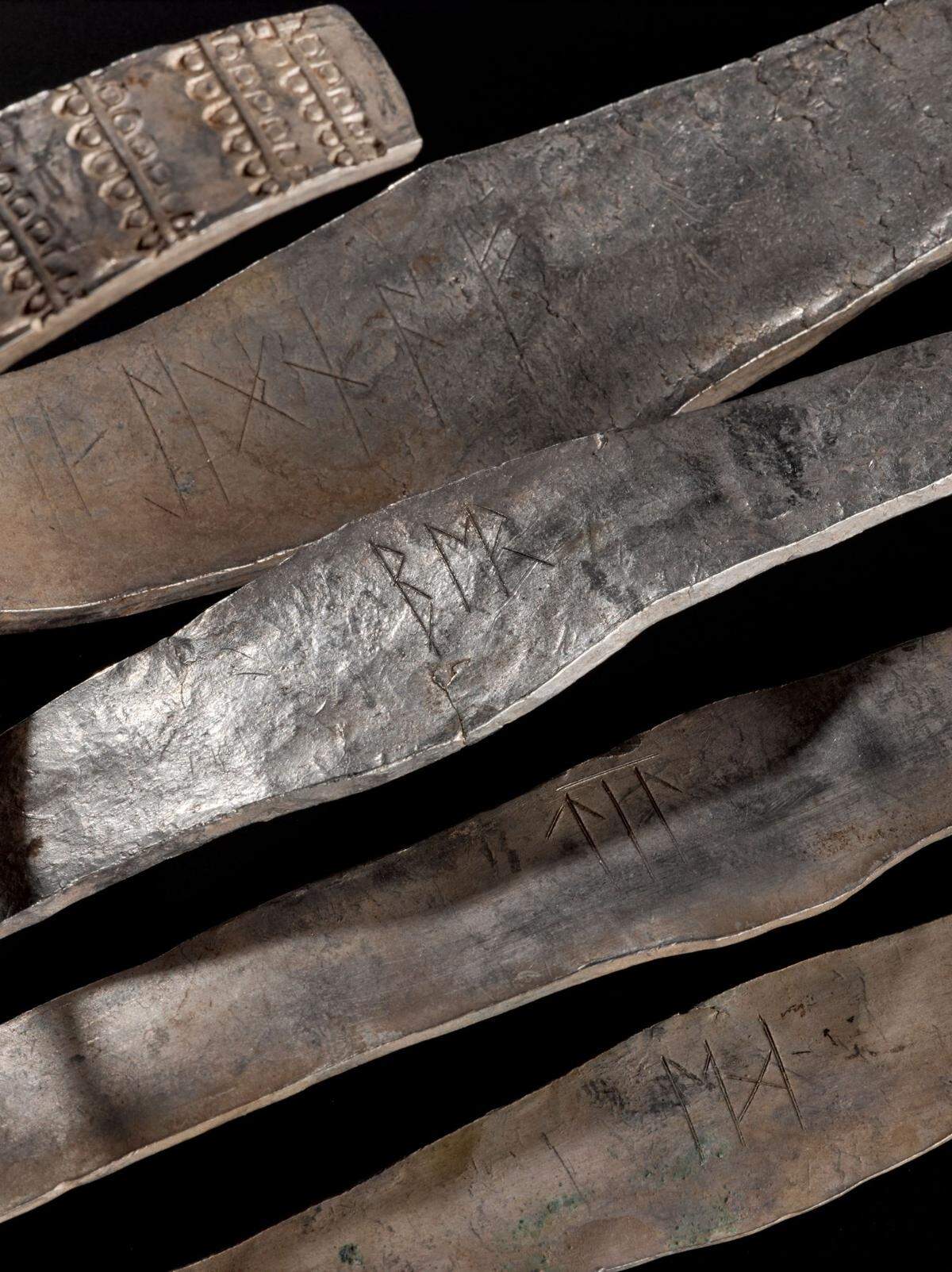
Of the four arm bands found with the hoard, three of them are inscribed with Anglo-Saxon runes with Old English name elements, officials said. These runes likely correspond with the names of the owners of the bands.
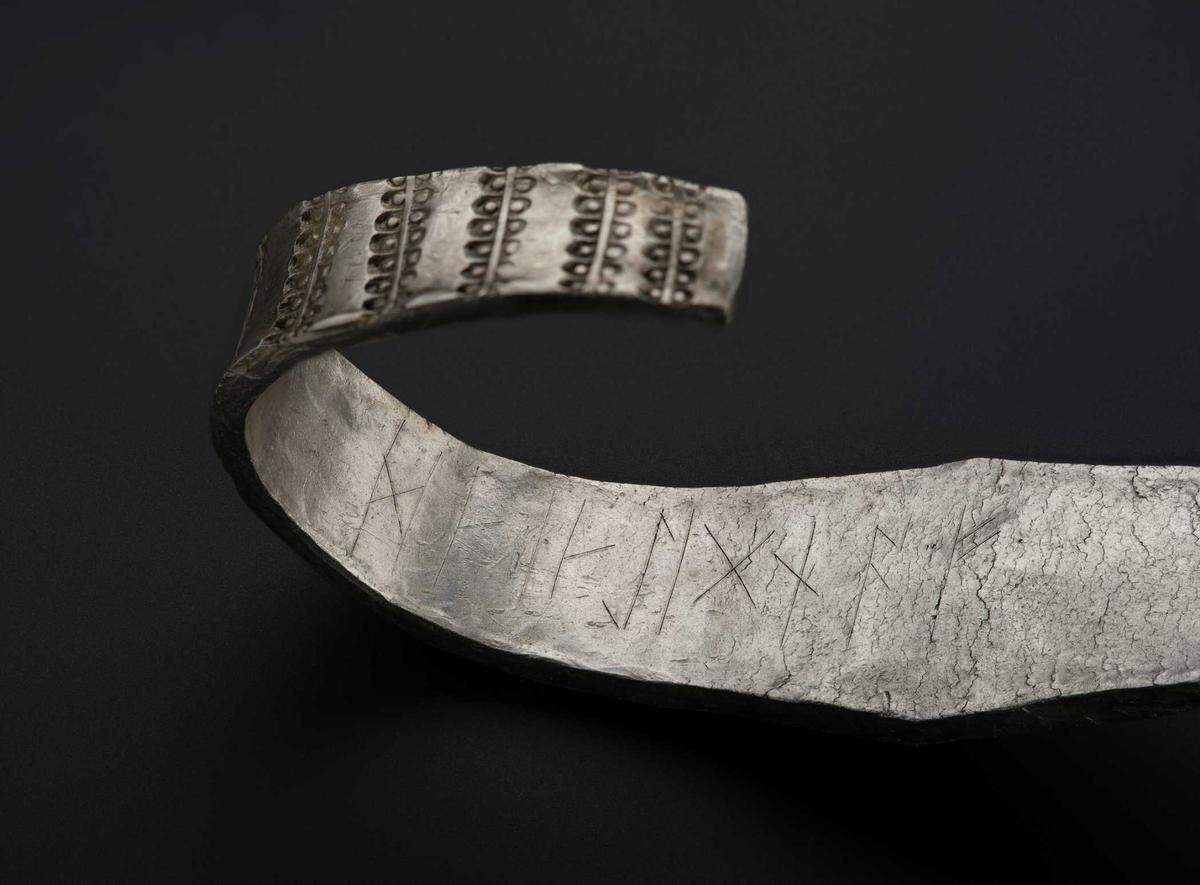
But one band, the longest set of runes, was indecipherable and “confounded” experts, according to the release.
Now, historians have cracked the code.
“Carved inside the curved half of the arm-ring the runes read: DIS IS ЇIGNA ˑFˑ. The main issue was the word ‘ ЇIGNAF’, which did not correspond to any language spoken in early medieval Britain or Ireland. The discovery that the final rune, F, was marked out with puncts, or dots, to either side, indicating it could be understood as the name of the F-rune itself ‘feoh’ [wealth or property] unlocked the new translation. ‘ ЇIGNA’ could then be interpreted as the Old English word ‘higna’ [community] with the first letter spelled in an unusual but comprehensible way,” officials said.
This meant the general translation of the rune was not a single person’s name, but instead said “this is the community’s wealth/property,” according to the release.
“The idea that the wealth this hoard represents would be communally held is fascinating,” Martin Goldberg, from National Museums Scotland, said in the release. “It does still leave us with unanswered questions around the circumstances in which a community’s wealth would come to be buried, and also which particular community.”
Goldberg said the presence of the pectoral cross and a jar that appears to be made for a bishop suggests it could have been a religious community.
“This is a difficult and unusual inscription, and the proposed translation is challenging. There are a number of things which are technically ‘wrong’ when we compare it with what we know about ‘correct’ runic writing,” David Parsons, a runologist from the University of Wales, said in the release. “However, if we think about both spoken and written English today, there are a huge range of regional and idiomatic variations and, if we allow for this, then it becomes possible to accept this as a plausible reading.”
The Galloway Hoard is considered the “richest collection” of Viking-age artifacts ever found in Britain or Ireland, according to the museums, and teaches historians about Anglo-Saxon kingdoms.
Some items in the hoard originated in Asia, and expose trade and connections at the time political entities in the modern-day United Kingdom were forming, and the presence of Viking raids, the museums say.
“It has been fascinating to see the succession of significant discoveries over the life of the Unwrapping the Galloway Hoard project, from the exotic origins of some of its star pieces to the presence of named individuals and now this latest exciting discovery,” Christopher Smith, executive director of the UKRI Arts and Humanities Research Council, said in the release.
The hoard set off on an international tour beginning Feb. 8 in Adelaide, Australia, museum officials said.
Kirkcudbrightshire is on the southwestern coast of Scotland.
This story was originally published February 11, 2025 at 1:48 PM with the headline "Viking-age hoard found in Scotland a decade ago had indecipherable runes — until now."