‘Sword tail’ creature — hundreds of millions of years old — is new species in Germany

Today, the wandering albatross holds the title of largest flying creature on the planet.
The Antarctic traveler can reach wingspans of more than 12 feet across. But, they are dwarfed by their prehistoric ancestors.
Long before feathered animals ruled the sky, flying reptiles called pterosaurs were the commanders of the air.
Pterosaurs ranged in size from small birds to 33-foot-wingspan beasts, and these two mismatched branches were separated by millions of years.
Now, researchers examining pterosaur fossils discovered in Germany have identified an entirely new species — and possibly the missing evolutionary link.
The fossils were discovered in the “visitor’s section” of a quarry in Bavaria in 2015 in a layer of rock that dates to the upper Jurassic period, according to a study published Nov. 18 in the peer-reviewed journal Current Biology.
The bones were exceptionally preserved, researchers said, despite them being anywhere from 145 million to 163.5 million years old.
This wasn’t the only thing that caught paleontologists’ attention.
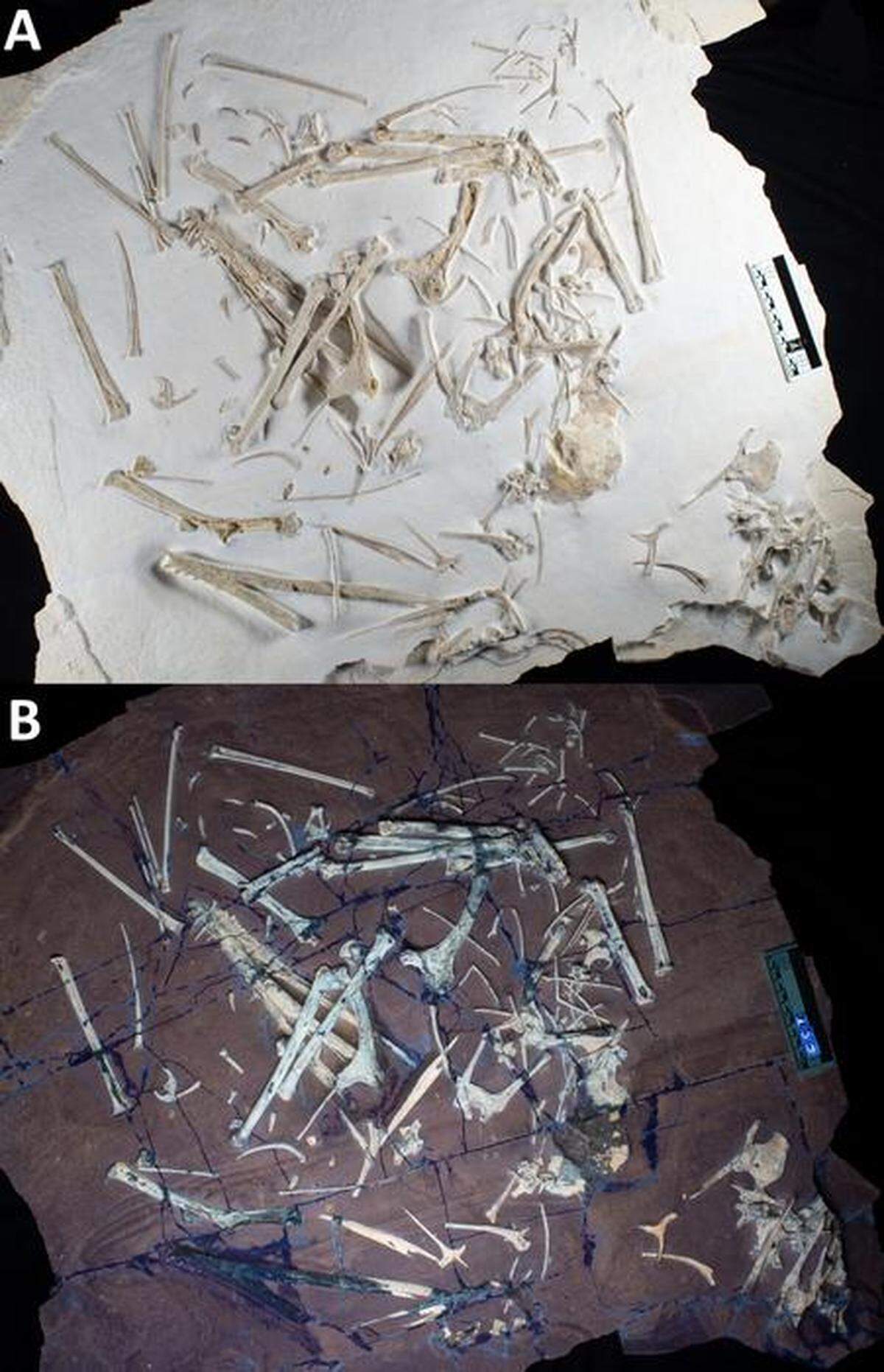
“The specimen is complete with nearly every single bone preserved and unusually, it is preserved in three dimensions, where most pterosaurs tend to be crushed flat,” researchers said in a Nov. 18 news release from Queen Mary University of London.
The pterosaur had a wingspan just over 6 feet wide, similar in size to the golden eagle, researchers said.
In order to fly, the bones of pterosaurs had to be relatively light and fragile, like today’s birds, and so the fossils are often poorly preserved compared to dinosaurs that lived during the same time period.
The bones found in Germany were so well preserved that researchers could see distinct morphological features that helped them identify the animal as a new species.
The pterosaur had a “very unusual short, but stiff and pointed tail,” researchers said, unique to the species. They named the species Skiphosoura bavarica, translating to “sword tail from Bavaria,” according to the study.
“For two hundred years, paleontologists split the pterosaurs into two major groups, the early non-pterodactyloids and the later and much larger pterodactyloids,” researchers said.
At some point, the groups split when pterosaurs started to develop larger heads and necks before the rest of their bodies enlarged, according to the study. When this happened, however, has remained a mystery.
“Skiphosoura reveals these changes. Evolutionarily it sits between these earlier darwinopterans and the pterodactyloids. It retains a very pterodactyloid-like head and neck, but also shows a longer wrist, and a shorter toe and tail than earlier darwinopterans but these are not as extreme as those seen in the pterodactyloids,” researchers said.
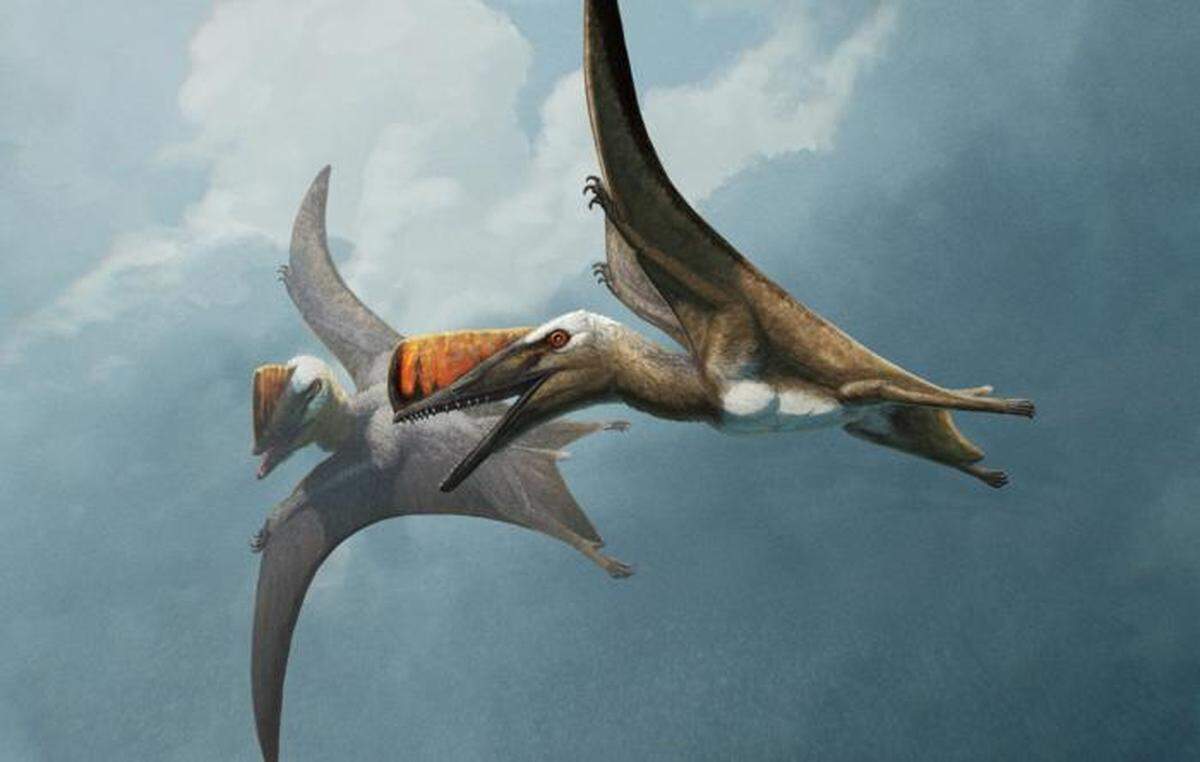
Paleontologists can now track a lineage of pterosaurs as their heads and necks got bigger, their wrists elongated, and their toes and tail shrank, closing the evolutionary gap that has eluded them for centuries.
“This is an incredible find. It really helps us to piece together how these amazing flying animals lived and evolved. Hopefully this study will be the basis for more work in the future on this important evolutionary transition,” David Hone, a researcher with Queen Mary University of London and lead author of the study, said in the release.
Pterosaurs were not dinosaurs, but rather a relative evolved from a different branch of the reptile family tree, according to the American Museum of Natural History.
They dominated the sky for more than 150 million years, throughout the “age of dinosaurs,” the AMNH says.
They used their wings to fly above the surface and search for fish and small animals below, reaching down with hooked claws and sharp teeth to catch a meal, according to the Orlando Science Center.
The new species was discovered in the district of Eichstätt, in Bavaria, southern Germany, about a 70-mile drive north from Munich.
The research team includes David Hone, Adam Fitch, Stefan Selzer, René Lauer and Bruce Lauer.
This story was originally published November 22, 2024 at 1:28 PM with the headline "‘Sword tail’ creature — hundreds of millions of years old — is new species in Germany."