
Winged reptile so small it could perch on your shoulder identified from AZ fossil
A fossil from a seagull-sized winged reptile that lived millions of years ago was found in Arizona, and the creature has now been identified as a new species.
The new type of pterosaur, named Eotephradactylus mcintireae, was identified by a Smithsonian-led research team, according to a July 7 news release from the institution.
It’s known as the “ash-winged dawn goddess.”
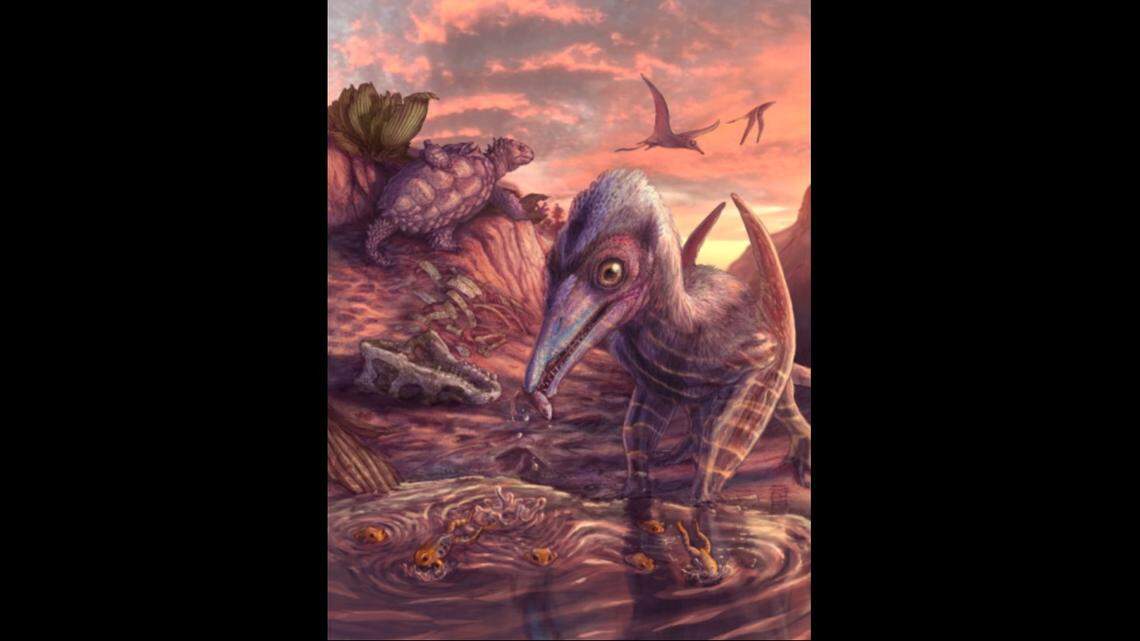
The creature “would have been small enough to comfortably perch on a person’s shoulder,” per Smithsonian officials.
It also had “a long jaw with several types of teeth for different purposes,” including curved fangs for grabbing prey and blade-like teeth for slicing it up, paleontologist Ben Kligman said in a July 8 email to McClatchy News.
He said the pterosaur likely feasted on “primitive fish related to living gar.”
Researchers — including Kligman, a postdoctoral fellow at the Smithsonian’s National Museum of Natural History — documented the new species in a study published July 7 in the peer-reviewed journal PNAS, or Proceedings of the National Academy of Sciences.
First occurrence
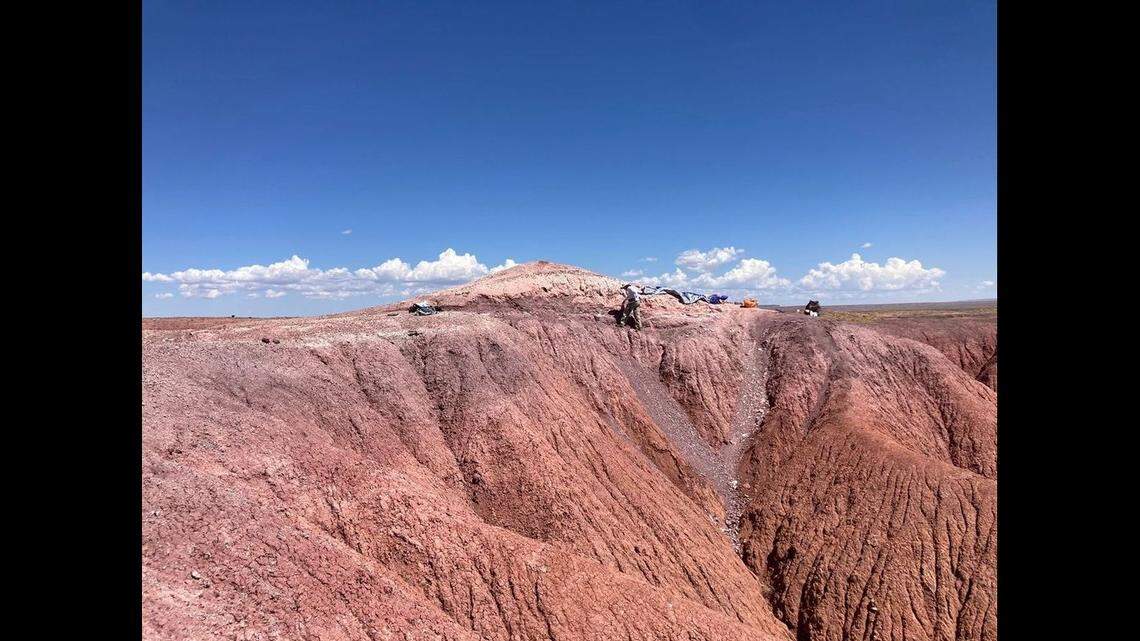
The pterosaur’s jawbone with teeth came from a remote area in northeastern Arizona’s Petrified Forest National Park, Smithsonian officials said.
The site also contained numerous other fossils from different creatures, including “an ancient turtle with spike-like armor,” according to Smithsonian officials.
“These fossils, which date back to the late Triassic period around 209 million years ago, preserve a snapshot of a dynamic ecosystem where older groups of animals, including giant amphibians and armored crocodile relatives, lived alongside evolutionary upstarts like frogs, turtles and pterosaurs,” Smithsonian officials said.
Kligman noted in his email that “the presence of the pterosaur Eotephradactylus living and interacting in a community alongside groups like frogs, lizard relatives, and turtles is the first occurrence of this community type in the fossil record.”

Those groups were found living together in later eras, he said, but not before a massive extinction event that killed about three-quarters of species on the planet about 201 million years ago.
That “means that the assembly of modern vertebrate communities was not the direct result of the end-Triassic extinction, and had been taking place well before it,” he said.
Stands out
During Eotephradactylus mcintireae’s time, the fossil site area “was positioned in the middle of Pangaea and sat just above the equator,” according to Smithsonian officials, who noted that “the semi-arid environment was crisscrossed by small river channels and likely prone to seasonal floods” that sent ash and sediment into the channels.
The creatures found in the site were likely buried in such a flood, Smithsonian officials said.
The site was discovered several years ago, and the pterosaur jaw fossil was eventually uncovered by Suzanne McIntire, a longtime volunteer in the Smithsonian’s FossiLab, Smithsonian officials said. The new species was named partly for her.
The ash-winged dawn goddess is the oldest-known pterosaur in North America, according to Smithsonian officials.
Kligman said “a big part of why (it) stands out is that it was found fossilized in sediments deposited in a river. Most early pterosaurs are found in oceanic sediments. We hope that our (study’s) recognition of pterosaurs from new environments of the Pangaean continent will help future researchers in the search for more of these rare fossils.”
Kay Behrensmeyer from the Smithsonian and Robin Whatley from Columbia College Chicago were study co-leads. Other authors were Jahandar Ramezani, Adam D. Marsh, Tyler R. Lyson, Adam J. Fitch and William G. Parker.
This story was originally published July 9, 2025 at 10:15 AM with the headline "Winged reptile so small it could perch on your shoulder identified from AZ fossil."
.JPG)