
163-million-year-old ‘fish lizard’ fossil discovered by boater in Utah along shoreline
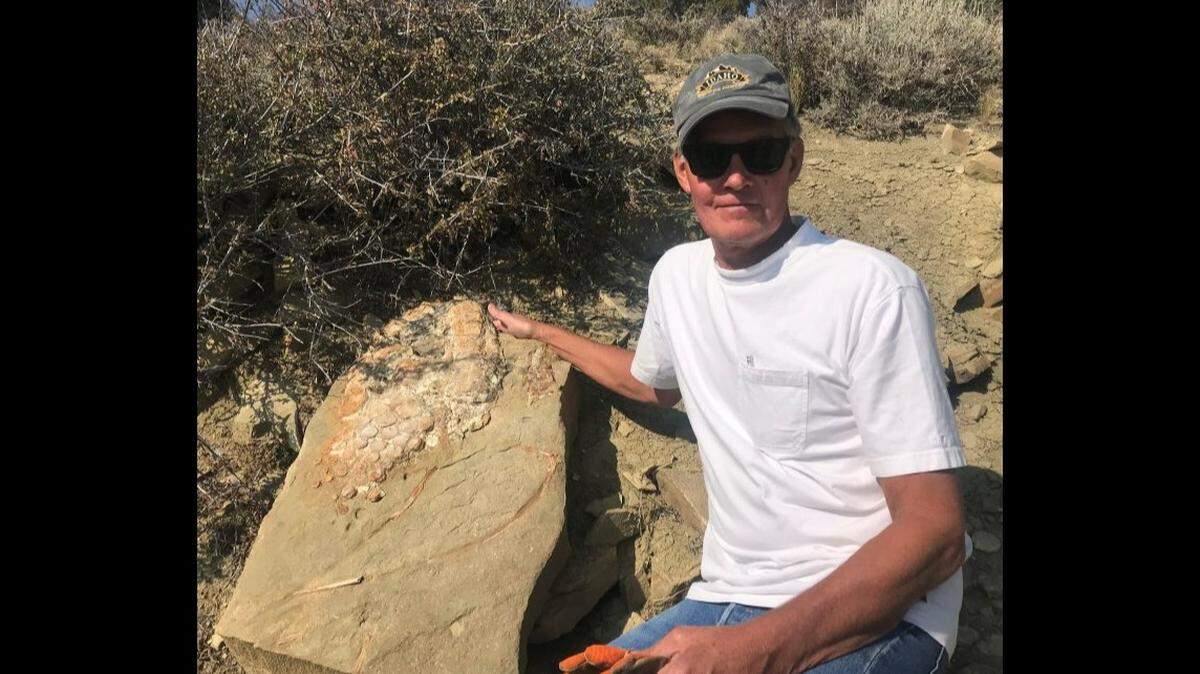
A boat trip on Utah’s Flaming Gorge Reservoir turned into quite the adventure for Alan Dailey.
Dailey saw there were bones sticking out from a 400-pound sandstone block about 50 to 80 feet away from the shoreline, KSL reported. The bones discovered in May turned out to belong to one of the most well-preserved ichthyosaur fossils ever found in the state.
Dailey took some photos of the fossil and sent them to paleontologists, along with the fossil’s location, according to an Oct. 5 statement from Utah State Parks. From there, scientists were able to examine the specimen up close.
Crews discovered that the specimen had a “nearly complete and articulated forefin,” as well as 10 ribs and 19 vertebrae, the statement said. Previous ichthyosaur fossils “have mostly consisted of isolated vertebrae,” Utah State Parks said.
“It is not often you see an entire fin laid out in the rock like that — so it is fun to be able to imagine a fast-swimming ichthyosaur chasing prey through the warm seawater in our region so long ago,” John Foster, a team member of the Utah Field House of Natural History, said in the release.
Ichthyosaurs were “dolphin-to-whale-sized marine reptiles that existed for almost 130 million years,” the release said. This particular ichthyosaur likely lived in an inland seaway in the reservoir area during the Late Jurassic epoch, or around 163.5 to 145.5 million years ago.
The dinosaur’s name comes from the ancient Greek for “fish lizard.” The ichthyosaur discovered at the reservoir was roughly dolphin-sized and shares several characteristics with dolphins, including “conical teeth, a streamlined body, compact fins, and a tail built for speed,” the release said.
“The ichthyosaurs looked more or less like a reptilian dolphin,” Foster told KSL. “They had the same short torpedo-shaped body, dorsal fins, pectoral and pelvic ends, a long snout with conical teeth for eating fish. The main difference was their tail was vertical rather than flat like a dolphin’s is, and that just has to do with the different ways that mammals move compared to reptiles.”
Extracting the fossil from the sandstone wasn’t easy -- a team including Dailey, paleontologists and volunteers from the Utah Field House of Natural History, two U.S. Forest Service representatives and a Utah State Parks ranger first had to get the sandstone block into a boat for transport, the news release said. Then, a forklift operator had to lift the block from the boat so it could be transported to the Utah Field House of Natural History, where it will go on display after lab workers clear more of the rock covering the bones to better expose the fossil.
That process will also allow scientists to determine what type of ichthyosaur the fossil came from, the statement said.
“By [Dailey] doing the right thing and reporting the fossil, an important, partially articulated ichthyosaur will now be available for marine reptile specialists to study,” Steve Sroka, park manager of the Utah Field House of Natural History State Park Museum, said in the release.
This story was originally published October 7, 2021 at 8:10 PM with the headline "163-million-year-old ‘fish lizard’ fossil discovered by boater in Utah along shoreline."