Know when you can (and can’t) pass a stopped school bus on NC roads
It’s back-to-school time in North Carolina.
That means school buses are back on the roads, toting kids to and from class each morning and afternoon, and all drivers must be vigilant to respect the safety of everyone onboard.
The rules about when it is and isn’t safe to pass a stopped school bus — and when you’re required to stop for them in North Carolina — may seem straightforward: always stop, never pass.
But the rules largely depend on how many lanes a road has, as well as which direction you’re traveling in relation to the bus when it stops to drop off or pick up a student.
To make sure everyone stays safe on the roads this school year, we’ve compiled some bus safety rules using information from the N.C. Department of Public Safety (NCDPS) and the N.C. Department of Transportation (NCDOT).
Here’s what to know.
When are you required to stop your car for a school bus in NC?
When a school bus stops for passengers in North Carolina — that is, to drop off or pick up passengers, and when the bus’s stop sign arm is used — whether you’re required to stop depends largely on how many lanes a road has.
Use the following guidance to know when to stop:
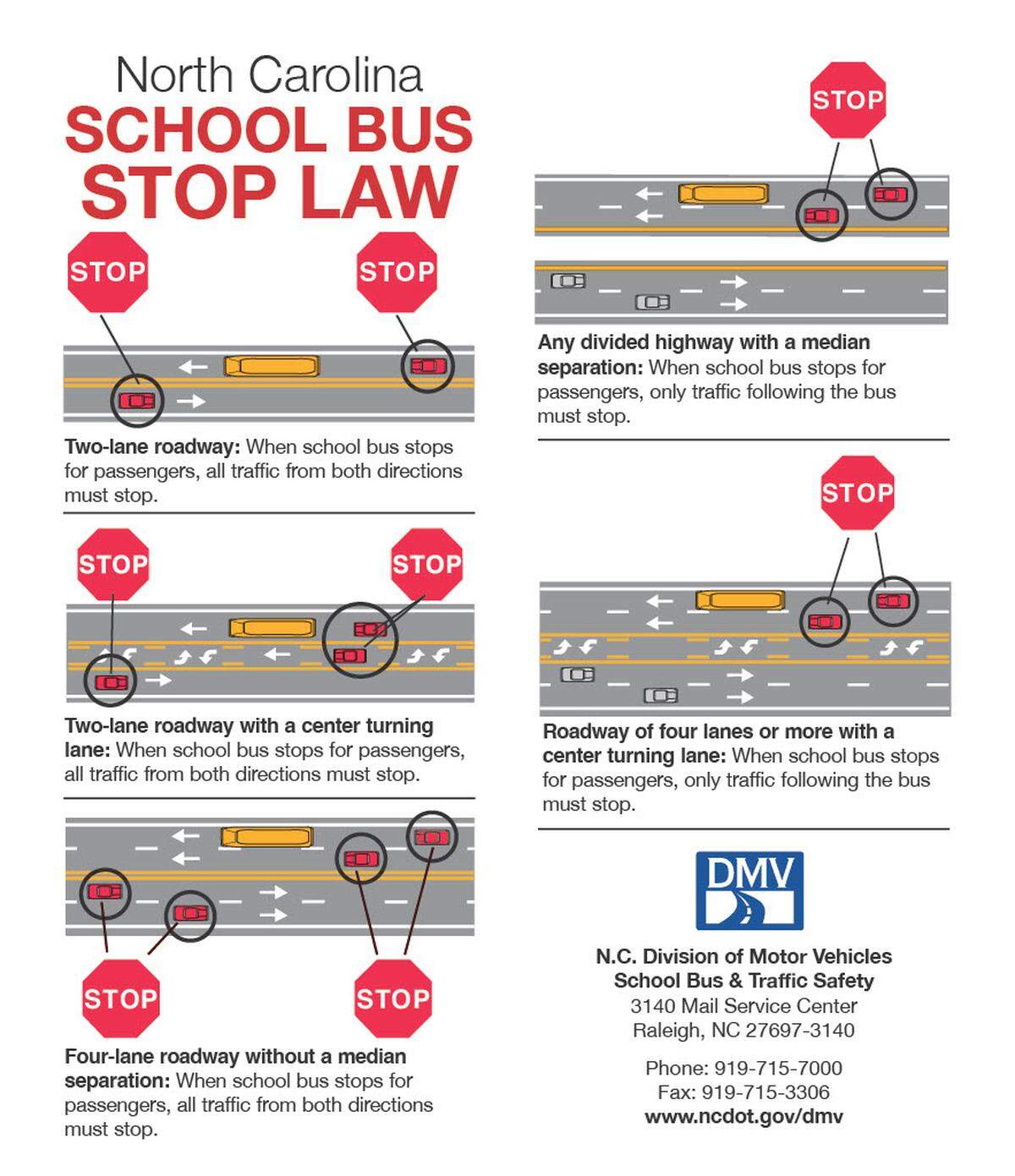
▪ If you’re on a simple two-lane road — just two lanes divided by yellow lines, with no median or center turning lanes — you must stop for a bus regardless of which direction you’re traveling. If you’re behind the bus, you must stop when the bus stops, and you cannot pass the bus. If you’re traveling the opposite direction of the bus, you must also stop for the bus.
▪ If you’re on a two-lane road with a center turning lane, you must stop for a bus regardless of which direction you’re traveling. This means you must stop whether you’re traveling behind the bus or in the opposite direction of the bus.
▪ If you’re on a four-lane road — two lanes on either side of the yellow lines, with no median or center turning lane — you must stop for a bus regardless of which direction you’re traveling or which lane you’re in. Whether you’re directly behind the bus, in the next lane directly over from the bus or traveling in the opposite direction in the other two lanes, you must stop.
▪ If you’re on any divided highway with a median, you are only required to stop if you are traveling in the same direction as the bus. If you are on the other side of the median from the bus, you do not have to stop.
▪ If you’re on a road with four or more lanes and a center turning lane, you are only required to stop if you are traveling in the same direction as the bus. If you are on the other side of the turning lane from the bus, traveling in the other direction, you do not have to stop.
Need some extra explanation about these rules? Take a look at NCDOT’s visual infographic that breaks down the rules.
What do the flashing signals on NC school buses mean?
School buses also have a system of flashing light signals that inform drivers of their actions.
NCDOT breaks down the meaning of these flashing lights:
▪ Yellow flashing lights mean the bus is about to stop and pick up or drop off students. If you see these lights, you should slow down and prepare to stop your vehicle.
▪ Red flashing lights and an extended stop sign from the bus mean the bus has stopped and students are getting on or off the bus. If required under the rules detailed above, “drivers must stop their cars and wait until the red lights stop flashing, the extended stop-arm is withdrawn and the bus begins moving before they can start driving again.”
More North Carolina bus safety tips for drivers
In addition to knowing when to stop for a bus, there are additional steps and precautions drivers can take to prioritize the safety of students on buses.
NCDOT recommends drivers take the following precautions:
▪ When you’re backing out of a driveway or garage, keep an eye out for children who may be walking or biking to school or to their bus stop.
▪ If you’re driving in a neighborhood with a school zone, you should also keep an eye out for children who may be commuting to or from school. Watch for children in the streets, especially if there are no sidewalks.
▪ Watch for children playing or congregating near bus stops.
▪ Stay alert. “Children arriving late for the bus may dart into the street without looking for traffic,” NCDOT says.
North Carolina bus safety tips for students
Children and students can also take steps to stay safe while they’re waiting for the bus and getting on or off the bus.
NCDOT recommends students take the following precautions:
▪ Arrive early to the bus stop to avoid unsafe situations. “Children arriving late for the bus may dart into the street without looking for traffic,” NCDOT says.
▪ Walk, don’t run, to the bus stop.
▪ Stand at least six feet away from the curb while you wait for the bus. Stay out of the street.
▪ Wait until the school bus stops completely before getting on or off the bus.
▪ Use the handrail inside the bus when you’re entering or exiting the bus to keep yourself steady.
▪ Listen to directions from your bus driver.
▪ Look both ways before you cross the street, either before you get on or after you get off the bus.
▪ Never walk behind a school bus. When you get off the bus, if you need to cross the street, walk in front of the bus to get to your destination.
▪ Do not run or play at the bus stop.
▪ Do not run in the aisle of the bus. Stay in your seat until it’s time to get off the bus.
Additional North Carolina bus safety information
Want more information about bus safety and rules in North Carolina? Try the following resources:
▪ N.C. School Bus Safety — ncbussafety.org
▪ N.C. Department of Transportation — ncdot.gov/initiatives-policies/safety/driving-safety/Pages/school-bus-safety.aspx
▪ N.C. Department of Public Safety — ncdps.gov/blog/2019/10/25/north-carolina-school-bus-stop-law---what-do
This story was originally published August 23, 2022 at 4:40 PM with the headline "Know when you can (and can’t) pass a stopped school bus on NC roads."