Get ready for snow. Farmers’ Almanac has predictions for NC winter weather
After a brutally hot summers, some North Carolinians actually look forward to the cooler weather the winter season brings.
But just how cold will it get in North Carolina this winter? Can we expect a snowy winter wonderland, or will we be bringing out the flip flops in January?
To get some possible answers to those questions, we consulted the Farmers’ Almanac, which has been providing “an extended weather forecast that helps people plan ahead” each year since 1818. The Almanac released its 2022-2023 winter weather forecast last week, with physical copies hitting store shelves Aug. 15.
NOTE: We’ve also updated this story to include predictions from the Old Farmer’s Almanac, another popular publication that makes long-term predictions about weather. The Old Farmer’s Almanac released its winter weather predictions on Aug. 30.
Here’s what the almanacs are predicting in North Carolina and the Southeast for this winter.
Overall winter predictions from the Farmers’ Almanac
Overall for the U.S., the Farmers’ Almanac is predicting a winter season “filled plenty of shaking, shivering and shoveling.”
▪ The 2022-2023 winter season will bring “plenty of snow, rain and mush,” the Almanac’s website says.
▪ “Frigid temperatures should flow into many areas nationwide,” the Almanac’s website says, with some spots in the country likely experiencing record-breaking cold temperatures — as low as 40 degrees below zero.
▪ The Almanac predicts there will be “quite a few significant winter weather disturbances nationwide” this winter, with heavy snow possible in early- to mid-January, depending on the exact location.
But most places can expect the “first bite” of winter weather to arrive earlier than usual — possibly even making for a white Christmas for some.
▪ “December 2022 looks stormy and cold nationwide with an active storm pattern developing and hanging around for most of the season over the eastern half of the country,” the Almanac’s website says.
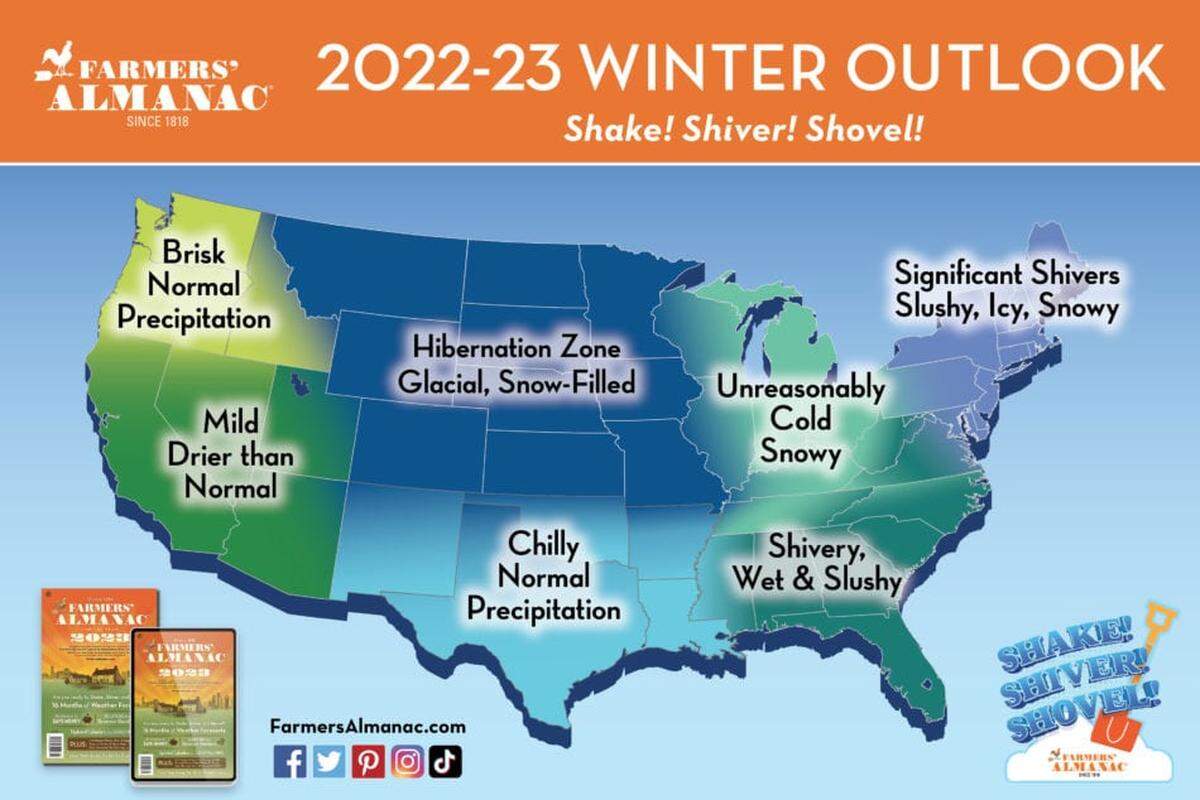
Farmers’ Almanac predictions for NC’s winter weather
Closer to home, North Carolina appears to be in for either a “shivery, wet and slushy” winter or an “unreasonably cold” and “snowy” one, according to a map illustration from the Almanac.
▪ The Almanac says the winter season will be “be dominated by an active storm track in the eastern half of the country” that extends across West Virginia and Virginia — but according to the map on the Almanac’s website, North Carolina seems to be just south of that system.
▪ Instead, the Almanac says, much of the Southeast “will see frequent storms bringing cold rains and a wintry mix of wet snow, sleet, ice, freezing rain — as well as chilly temperatures.”
January 2023 will bring “some shivers” to the Southeast, the Almanac says.
▪ The Almanac says the “eastern two-thirds of the country” — likely including North Carolina — can expect “bouts of heavy rain and snow” during the week of Jan. 16-23 of next year.
▪ However, by February, “near-normal winter season temperatures” will return to the region.
▪ The Almanac predicts a “lion-like end of March” with varied conditions across the U.S., from “heavy snows to torrents of rain to gusty thunderstorms.”
Overall winter predictions from the Old Farmer’s Almanac
The Old Farmer’s Almanac has dubbed the upcoming winter season “A Tale of Two Winters.”
The almanac is predicting the season’s wintry conditions will “will split the country in two” — meaning half of the country is likely to get “very cold” weather, while the other half will experience more “mild” weather.
▪ The almanac is predicting the western half of the country will experience the more “mild” conditions.
▪ The eastern part of the country is set to experience the “very cold” weather, the almanac predicts.
“Depending on where you live, this will be the best of winters or memorable for all the wrong reasons,” Old Farmer’s Almanac editor Janice Stillman said on the almanac’s website. “One half of the country will deal with bone-chilling cold and loads of snow, while the other half may feel like winter never really arrives.”
Still, whether you’re set for “very cold” or “mild” conditions, the almanac is predicting “that most of the U.S. will be colder than normal this winter.”
Old Farmer’s Almanac predictions for NC’s winter weather
The Old Farmer’s Almanac is predicting below-normal winter temperatures for the Southeast and Appalachian regions, which include all of North Carolina.
▪ The almanac predicts the coldest periods for the Southeast region will be “early December, early and late January, and mid-February.” In the Appalachian region, the coldest periods will be “early December, late January, and mid- to late February.”
▪ The almanac says precipitation will be below normal in the Southeast, but near-normal in the Appalachian region.
▪ Snowfall will be above normal for both regions. The best chances for snow will be in early and late January, as well as in February, the almanac says.
Difference between Farmers’ Almanac and Old Farmer’s Almanac
While the Farmers’ Almanac and the Old Farmer’s Almanac have similar names and serve similar purposes, they are different publications.
Both almanacs tout an accuracy of about 80%.
▪ The Old Farmer’s Almanac is, in fact, older than the Farmers’ Almanac. The Old Farmer’s Almanac was first published in 1792 and, according to its website, it is the oldest almanac in America.
A new edition of the Old Farmer’s Almanac is released every September, and includes information about when to plant crops, the moon’s phases, weather forecasts and more, such as trivia and humor. The almanac’s website (almanac.com) also contains much of the same information.
Each edition of the publication “calculates the tides and times for fishermen, travelers, sailors, bookkeepers, beekeepers, gardeners, prognosticators, pollsters, politician, cooks, and really anyone who walks this Earth, including farmers,” the Old Farmer’s Almanac website reads.
The almanac makes its long-range weather forecasts “from a secret formula that was devised by the founder of this Almanac, Robert B. Thomas, in 1792,” the almanac’s website reads.
▪ The Farmers’ Almanac is a little newer than the Old Farmer’s Almanac, first beginning publication in 1818.
Similar to the Old Farmer’s Almanac, the Farmers’ Almanac provides long-range weather predictions, plus “informative articles, helpful planning calendars, and information on everything from the best days to garden and fish, quit a bad habit, plus natural home remedies.”
The almanac is published in print annually, and is also updated online at farmersalmanac.com.
The Farmers’ Almanac makes its annual predictions using a “set of rules” developed by astronomer David Young, the almanac’s first editor. The predictions are made two years in advance and are not changed or updated once an edition is published.
“The formula takes into consideration things like sunspot activity, tidal action of the Moon, the position of the planets, and a variety of other factors,” the almanac’s website reads.
More information from the Farmers’ Almanac & Old Farmer’s Almanac
Want more information on the Farmers’ Almanac’s predictions for this winter? Read their full predictions online at farmersalmanac.com/extended-forecast.
More information about the Old Farmer’s Almanac’s predictions can be found at almanac.com/winter-extended-forecast-farmers-almanac.
This story was originally published August 22, 2022 at 2:00 PM with the headline "Get ready for snow. Farmers’ Almanac has predictions for NC winter weather."