EPA employees in RTP brace for changes under Trump, including where they’ll work
Update: On Jan. 24, Acting EPA Administrator James Payne informed agency employees that all workers on telework and remote work agreements must report to their worksites full-time “not later than February 24, 2025,” according to an internal agency email reviewed by The News & Observer. This rule, Payne wrote, was made to comply with President Donald Trump’s Return to In-Person Work executive action.
On Jan. 20, his first day in office, President Donald Trump signed an executive action calling for federal employees to be back in the office.
“Heads of all departments and agencies in the executive branch of Government shall, as soon as practicable, take all necessary steps to terminate remote work arrangements and require employees to return to work in-person at their respective duty stations on a full-time basis,” the order read. “Provided that the department and agency heads shall make exemptions they deem necessary.”
According to the Congressional Research Service, North Carolina is home to roughly 51,000 civilian federal employees. One of the state’s biggest federal sites is in Research Triangle Park, where more than 2,000 workers and contractors report to the 509-acre campus of the U.S. Environmental Protection Agency.
Since the pandemic, many Triangle-area EPA employees have routinely worked from home. While some have job duties that can only be completed on site, eligible staff were, under a previous agency rule, allowed to telework up to eight days each 10-day pay period.
“Everybody’s curious what’s going to happen,” said a local EPA employee who was not authorized to speak to the media. “Do we have to go into work now? Managers have told us to just wait for an official email. I assume it’s going to take a while for them to figure out.”
According to an August report from the Office of Management and Budget, of all federal employees eligible for telework (not counting fully remote staff) about 61% of work hours were already in person. However, the EPA had the lowest percentage of in-person work hours among all agencies at just under 36%.
Where EPA employees work is just one change their agency faces under the new administration. On Jan. 20, Trump signed a separate executive action directing the EPA to consider not using the “social cost of carbon” — a calculation that measures the economic costs per ton of carbon dioxide — when making regulatory decisions. The same action also requires the EPA to submit a review of its 2009 findings on greenhouse gases emissions under the Clean Air Act.
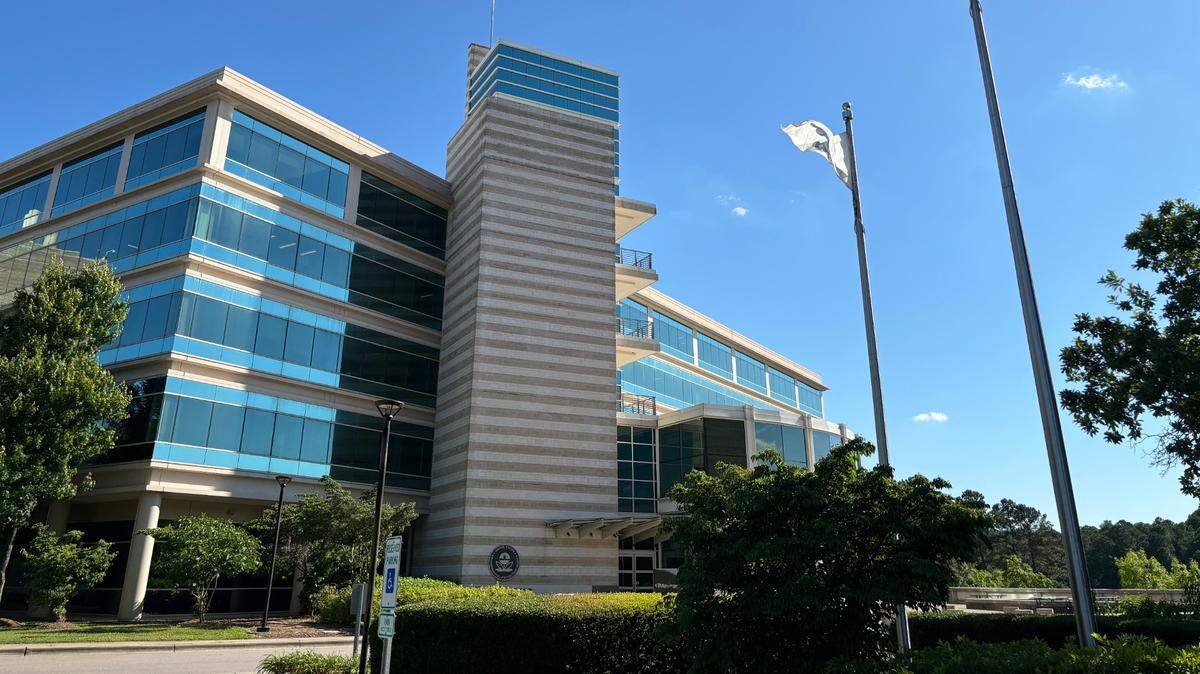
.jpg "IMG_5455 (1).jpg")
Opened in 2001, the EPA site in Research Triangle Park is the agency’s largest physical campus. Its focus is air quality research and regulations. Across a warren of offices and labs, workers identify contaminants, test permissible levels, and recommend standards. The EPA shares the land with the National Institute of Environmental Health Sciences.
In a statement to The News & Observer, EPA spokesperson Molly Vaseliou said the agency “is working to diligently implement President Trump’s executive orders.”
“President Trump was elected with a mandate from the American people to do just this,” the statement read.
Telework as a recruitment tool
In June, the EPA ratified a new union contract with the American Federation of Government Employees. The agreement praises telework for allowing the agency to perform most operations remotely “without interruption” during the COVID-19 pandemic. In contrast to remote work, telework is specific to employees who live in the same area as their base office.
The union contract described both telework and remote work as tools “to enhance talent recruitment and retention, and advancing diversity, equity, inclusion, and accessibility in the EPA workforce.”
Telework arrangements are not guaranteed, though management must provide “sufficient notice” before ending it. The contact says proper notice is typically six weeks.
“As written, the return to worksite directive does not violate any collective bargaining agreements, so hybrid telework schedules detailed in those contracts remain legally binding,” said Tim Kauffman, a spokesperson for the American Federation of Government Employees.
If federal policies were to ever contradict contracts, Kauffman advised that employees comply with the new directives while the union explored filing grievances.
NC Reality Check is an N&O series holding those in power accountable and shining a light on public issues that affect the Triangle or North Carolina. Have a suggestion for a future story? Email realitycheck@newsobserver.com
This story was originally published January 23, 2025 at 1:32 PM with the headline "EPA employees in RTP brace for changes under Trump, including where they’ll work."