Farewell to a fish called Muddy, and a logo that upended minor-league baseball
AI-generated summary reviewed by our newsroom.
- Carolina Mudcats conclude 35 seasons in Zebulon with a final homestand this week
- Team’s 1990s catfish logo sparked national merchandising success and recognition
- Franchise plans relocation to Wilson, ending a unique era in eastern Wake County
Not many fans walk through the home-plate entrance to Five County Stadium, which is not the most convenient entry from the gravel parking lots. They’re mostly regulars, along with employees and suite guests, and Ann Ray knows almost all of them.
She has spent two decades checking tickets and chatting and holding court in the shadowy underneath of the stadium’s giant upper concourse, and when the Carolina Mudcats pack up and move to Wilson this winter, she won’t be going with them.
Ray, who lives just west of the stadium, will miss the baseball, of course. But that’s not what she’ll miss the most.
“The people,” Ray said. “Then again, there’s not as many as I used to know. A lot of the original season-ticket holders were older, and so many of them have died, probably. But I still enjoy it.”
This week, the Mudcats will host their final homestand in Zebulon at the conclusion of their 35th and last season there, the end of an improbable era of minor-league baseball in eastern Wake County that began in 1991 when businessman Steve Bryant decided Raleigh needed a team of its own and this was as close as he could get. There was always something a little off about the Mudcats, who carved out a place among old tobacco fields at an otherwise empty crossroads in the middle of nowhere, became a model minor-league franchise and then slowly withered on the stalk.
Long before IronPigs and Trash Pandas, the Mudcats hit the merchandising jackpot with their catfish logo. In the early ‘90s, their hats were the hottest things going. In 1990, during their sole season as the Columbus Mudcats before moving from Georgia, they sold more than $200,000 worth of merchandise. Jimmy Carter, George W. Bush and Muhammad Ali were all spotted in the hats. The artist, Frank Harrod, received $500 for his work. The Mudcats made millions.
The realization that a clever nickname and logo could move units to people who would never, ever see a game sparked the minor-league logo revolution that brought us Swamp Rabbits and Isotopes. On HBO’s “Last Week Tonight,” John Oliver recently rebranded the Erie SeaWolves into the Erie Moon Mammoths. The trend that started with the Mudcats extended beyond baseball to hockey and soccer and any other sport that had a jersey worth embroidering. The Mudcats swam so the Biscuits could bake.
“It all happened because the Mudcats sold so much stuff,” said ESPN’s Ryan McGee, who wrote a book about his own minor-league experiences in Asheville at the same time the Mudcats were thriving.
At a crossroads
That was a long time ago now. As things wind down in Zebulon, the team store behind home plate looks like a K-Mart in mid-liquidation, with barren shelves and empty hangers dangling from racks. What’s a catfish compared to a raccoon or a sock puppet?
The Mudcats were modern when it was cool to be retro and slowly turned retro just as it became cool to be modern. Five County Stadium, with its five-row lower deck and massive, overhanging upper concourse built in 1999 — it looks as much like an old NASCAR short track as a baseball stadium from the parking lots — was part of the orphan generation of big, symmetrical, vertical baseball parks designed just before Camden Yards opened and hit reverse on the direction of stadium design.
But it served its purpose well enough, and even if it was too big some nights, and most nights now, it overflowed on the Fourth of July or when a rehabbing major-leaguer (or NBA legend) came to town.
Bryant’s original vision for a minor-league team was in Raleigh, but he ended up exactly 35 miles from home plate in Durham, at the very edge of the Bulls’ territory — a distance the Bulls’ then-owner, Miles Wolff, had successfully lobbied to expand expressly to keep Bryant’s new team out of Raleigh itself.
For a while, the Mudcats were the hottest thing going, outdrawing the Bulls (at the old Durham Athletic Park) and serving as the venue for Michael Jordan’s homecoming during his baseball sabbatical. They played in the Class AA Southern League, and some of the best young talent in baseball spent at least part of a summer in Zebulon en route to the major leagues: Juan Pierre, Matt Holliday, Miguel Cabrera, Dontrelle Willis.
But even as US Foods moved in across the street from right field and subdivisions slowly spread across the old farmland, even after construction of the Highway 64 bypass in 2005 to speed the drive from Raleigh proper — which the team branded the “Mudcats Expressway” — the Mudcats never seemed to gain the same traction with the newcomers and transplants that they did with the locals when they first arrived. The Bulls, meanwhile, built a new ballpark in the new Camden Yards tradition, moved up to AAA in 1998 and never looked back.
In 2012, the Mudcats dropped from AA to A ball and went through four affiliations in seven years before landing with the Brewers, who bought the team from Bryant in 2017. And while the Mudcats seemed frozen in time, the baseball world kept spinning. Since the 2021 consolidation of minor-league baseball under MLB’s umbrella, parent clubs and private equity have scooped up dozens of franchises, betting on concerts and real-estate development to make their money back.
When Five County Stadium needed at least $15 million in renovations to meet the new standards imposed by MLB, the Brewers certainly weren’t going to foot the bill. When Wake County balked, Wilson stepped in. To anchor a $300 million multi-use development, the city agreed to build a $70 million stadium for the Wilson Warbirds, an improbably anodyne name when Whirligigs was right there, but one that exemplifies the swing of minor-league baseball from characteristically clever to commensurately corporate.
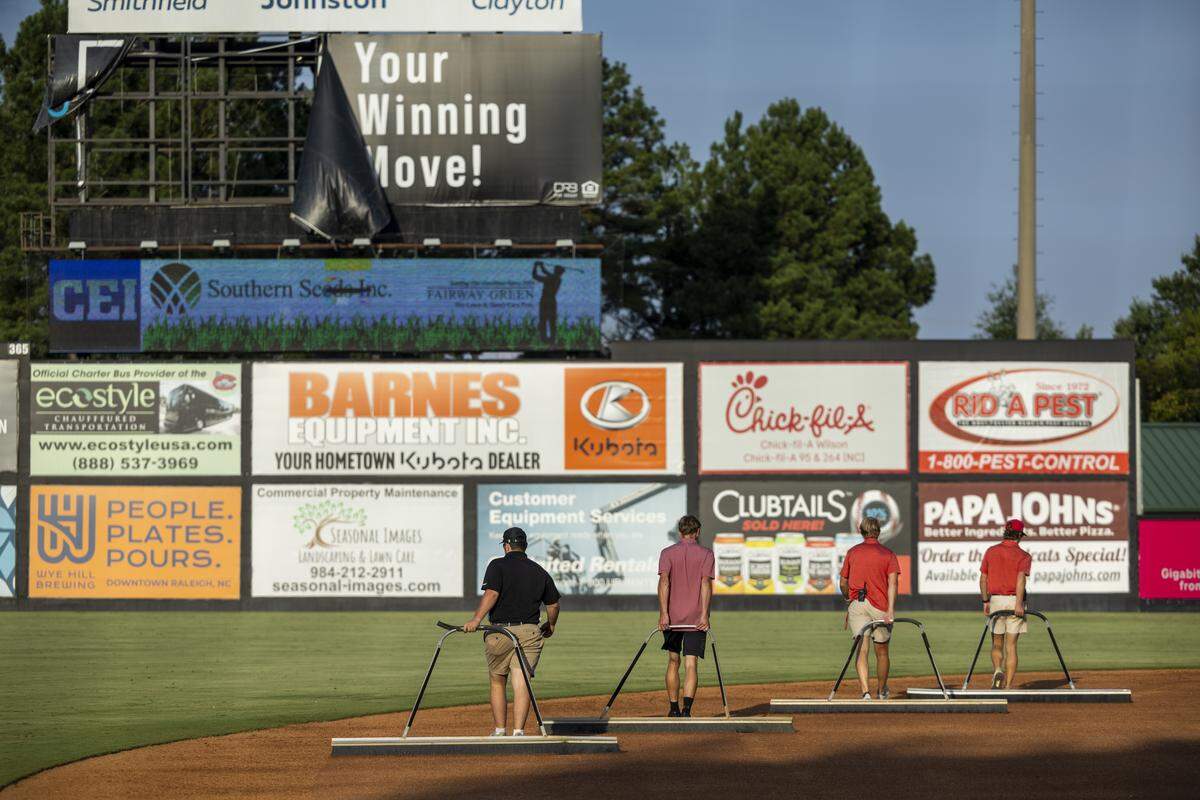
So while Wake County figures out the future of Five County Stadium without a tenant, the Mudcats’ future was long ago settled. The flapping, torn tarp over a storm-damaged advertisement on the center-field scoreboard is as much a commentary on their fate as it is the futility of fixing it. The franchise isn’t going far, Wilson being one of the eponymous five counties (Franklin, Johnston, Nash, Wake), but like the tobacco that once grew in the fields the team eventually came to occupy, the Mudcats are all but history.
A Mudcats childhood
Will Privette knows those fields well. Most of them, as far as the eye can see from the top row above home plate, once belonged to his family. Privette is more famous as an N.C. State basketball fan — as a student, C.J. Leslie saved him from being trampled during a court-storming after Privette fell out of his wheelchair, which earned them a hashtag (#RollPack) and an appearance on CBS News — but baseball was his first love, and he was born to it.
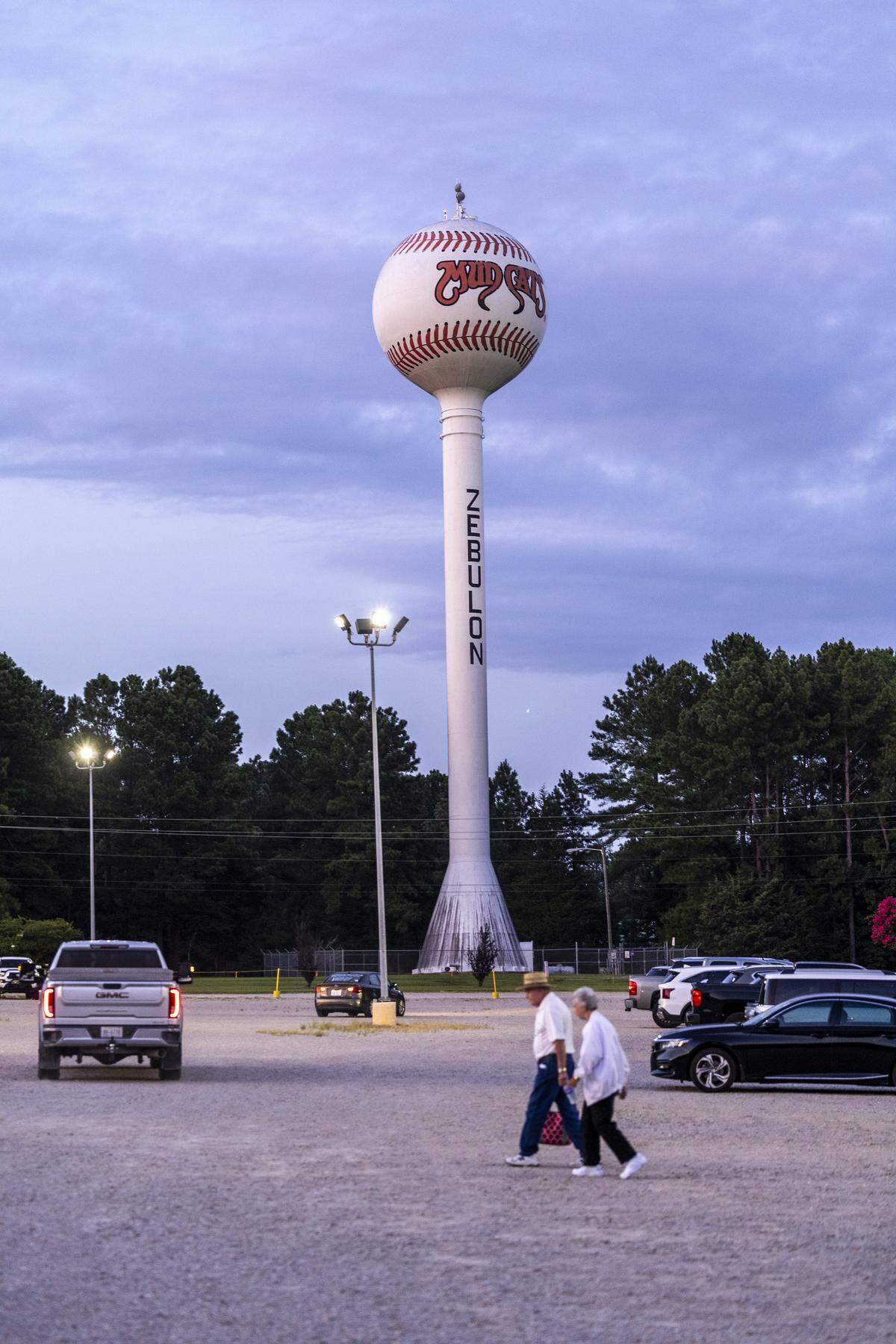
As part of the deal for the land where the stadium and its parking lots now sit, Privette’s parents asked for, and received, two perpetual season tickets for every member of the family. When Privette was born a few years later, they got another one for him when they sold a little more land to the team so it could build its famous baseball-branded water tower across Old Highway 264 to the north.
Privette grew up going to Mudcats games, threw out the first pitch when the Pittsburgh Pirates played an exhibition and partied with the team to celebrate championships as a teenager. One of his older sisters married a Mudcat. At one point, in middle school, he missed one home game in four seasons. He spent so much time around the ballpark as a kid, the home clubhouse was named for him when he graduated from State in 2013.
“For a lot of kids, it was their first job — working in concessions, being a bat boy,” Privette said. “That’s their first job in high school. It’s taking away kind of a rite of passage for people who grew up in Zebulon.”
Later, after college, Privette spent four years as a video assistant for the Mudcats’ parent clubs, charting pitches, working the radar gun and recording pitchers for the player-development staff. His love of the Mudcats made him want to work in baseball, and the Mudcats gave him the chance.
“My childhood was there,” Privette said. “I’ve slept in that stadium.”
On a steamy night in July, Privette — now in software sales — joined a dozen longtime former members of the Mudcats’ game-production staff for a reunion organized by Hayes Permar, the former local sports radio host, bon vivant and seven-summer Mudcats PA announcer who now owns the Rialto Theatre in Five Points. The team reserved a suite for “Hayes Permar and Acquaintances.” Which, as anyone who knows Permar knows, contains multitudes.
A life lesson
By the time Permar started with the Mudcats in 2015, there was a bit of an anything-goes atmosphere in the production booth, a crew of college and post-college kids running cameras and sound and promotions on a shoestring budget. Permar was famous not only for his on-the-edge verbiage but the giant fishing net he’d wield through the window, trying to catch T-shirts shot from a cannon. (His successor, on this night, missed.) Their antics made them the self-proclaimed “Most Interesting Team in Baseball.”
It’s not a stretch to say his time in the PA booth changed the direction of Permar’s life. Behind the mic, his mind used to wander to wondering what it would cost to buy the Mudcats, whether he could put a group of investors together to buy the team and run it all the weird ways he and his crew would do it.
The sale of the team to the Brewers jolted him out of that reverie, but there was a what-if that never went away. When the opportunity arose to buy the Rialto in 2023, an institution of similar personal meaning, he jumped at it.
Permar’s group spent the evening sharing inside jokes and reminiscing about the stuff they got away with and the disasters they narrowly avoided. The Mudcats had five video cameras; they used to tell newcomers to go run “Camera 6” … on top of the water tower. For all that, it was an incredible place to learn on the job.
Evan Moesta started out as a camera operator in 2016 and by the time COVID hit was doing everything from production to promotions, before he left for a job with the Minnesota Timberwolves. He’s back in the Triangle now, working at Capitol Broadcasting, but he still curates and maintains the lengthy Google doc of all the weird stuff that happened with the Mudcats, fodder for a potential book or movie.
“Every baseball season, the itch comes back,” Moesta said, as the PA blared and the video board flashed and the game went on behind him.
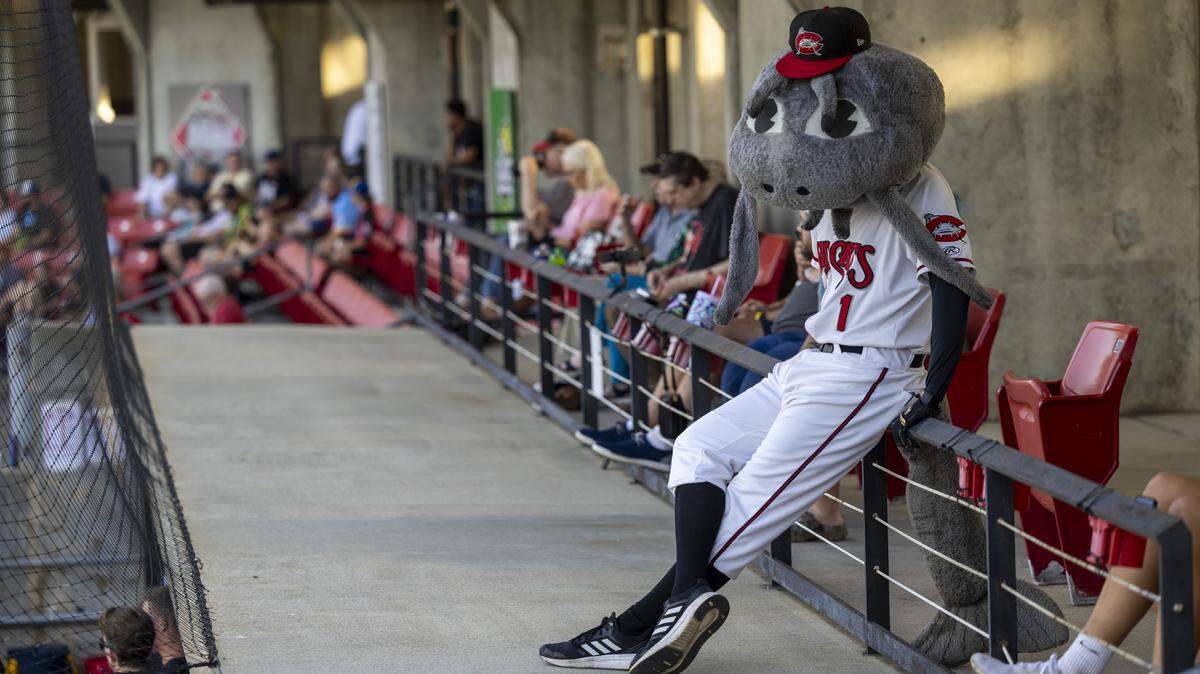
At one point, Permar heckled an opposing player for his bright yellow battling gloves, clearly audible from the top of the upper deck amid the few hundred fans in attendance. At another, they got “Happy Birthday Claeb” on the scoreboard, recreating a famous typo. The Muddy and Mini-Muddy mascots even stopped by the suite for photos, as did current general manager David Lawrence, who will make the move to Wilson with the team.
The festivities passed quickly. The Mudcats ripped through a 2-0 win in less than 90 minutes, darkness barely falling by the end. There’s one six-game homestand left, against the Delmarva Shorebirds, starting Tuesday and finishing with three nights of fireworks Friday, Saturday and Sunday. The Brewers’ top prospects — Jesus Made and Luis Pena — have already been promoted, after drawing big crowds of autograph seekers to Mudcats games both home and away.
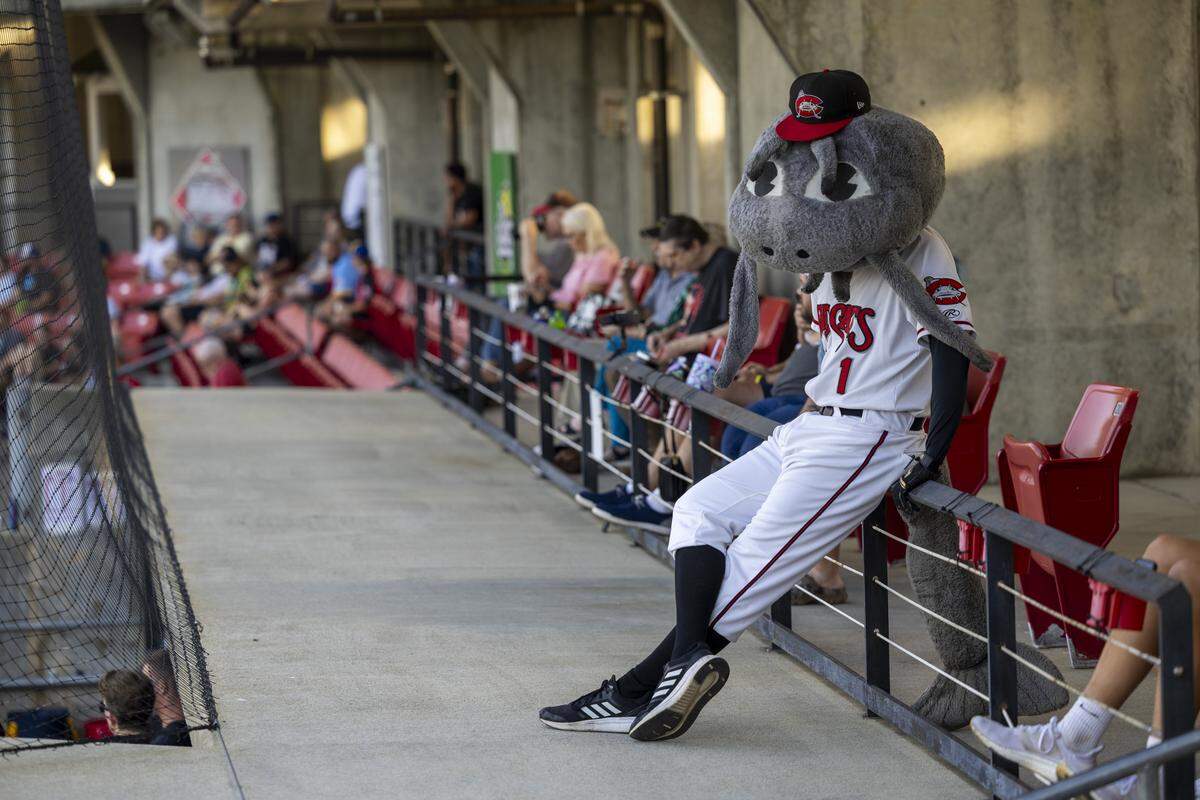
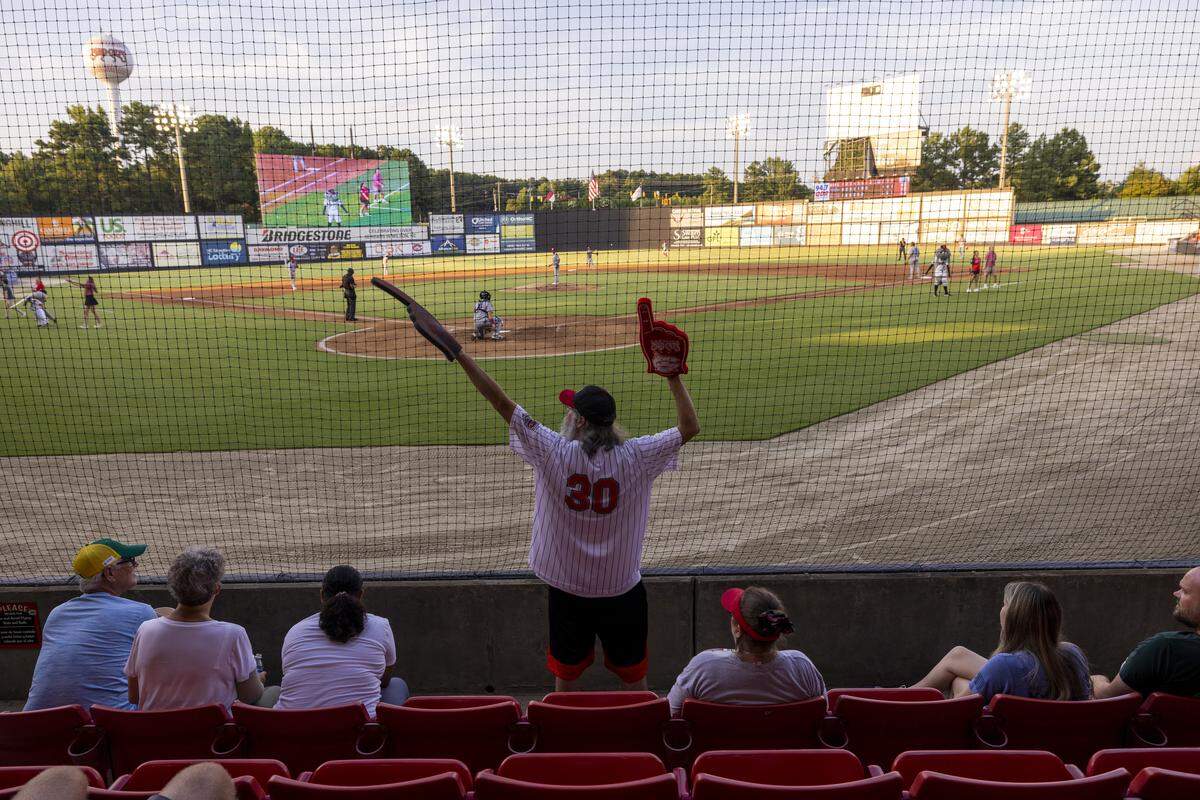
As one man’s crazy baseball vision expires, the Mudcats have become quintessentially minor league — the way it used to be, before the Mudcats existed, the very thing private equity is bound to erase everywhere: regulars in the stands who all know each other, the sun setting behind home plate over a vista of small-town Americana, a skeleton staff holding things together, cheap beer, wide-eyed players who all look like overgrown kids.
The Mudcats were once so far ahead of their time, only to fall so far behind. Raleigh and eastern Wake County, will move relentlessly on without them, propelled by the same economic forces that made baseball possible here in the first place. The Mudcats will move to Wilson, and their name and famous logo will be no more, but they managed to change minor-league baseball forever.
Never miss a Luke DeCock column. Sign up at www.newsobserver.com/newsletters to have them delivered directly to your email inbox as soon as they post.
This story was originally published August 24, 2025 at 5:30 AM with the headline "Farewell to a fish called Muddy, and a logo that upended minor-league baseball."