In Ivan Ryabkin, Hurricanes drafted the ultimate NHL risk-reward prospect
AI-generated summary reviewed by our newsroom.
- Hurricanes drafted Ivan Ryabkin 62nd overall despite major behavioral risks
- Ryabkin combines elite offensive talent with inconsistent effort and discipline
- Team sees long-term upside if development staff can reshape fitness and attitude
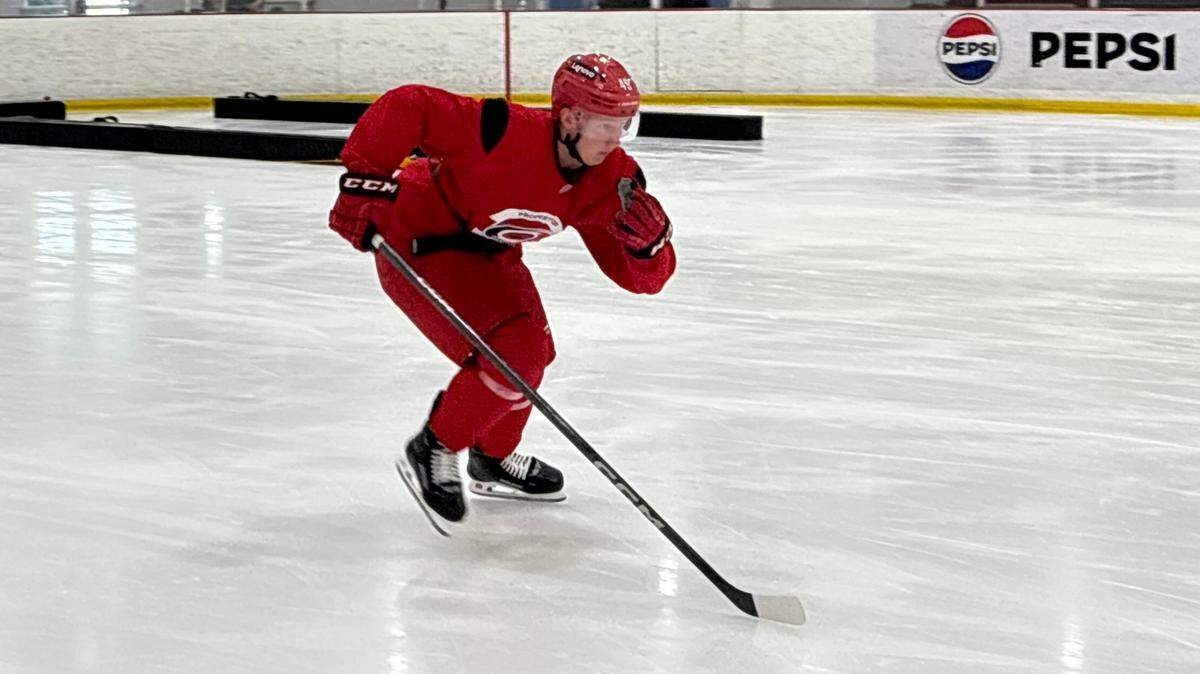
There wasn’t much to distinguish Ivan Ryabkin from the other six Russians in his little group at Invisalign Arena on Monday, the first day of the Carolina Hurricanes’ prospect development camp.
They all went through the same on-ice testing, skating with a leash attached to their waist to measure speed and power, getting timed in stop-and-start drills. But none was drafted as high as the second round, as Ryabkin was Saturday. And none was a top-10 prospect to start the season, as Ryabkin was.
The whispers about Ryabkin started long before the draft: Elite talent, terrible attitude. The Russian center might have been the biggest risk-reward pick in the entire draft, with more red flags than a short-track race.
Some teams wouldn’t have drafted him with the last pick. The Hurricanes bought a lottery ticket at No. 62. It may be years before they know if their numbers hit.
“An unbelievable goal-scorer with bite to his game,” Hurricanes associate general manager and scouting director Darren Yorke said Saturday, after the second day of the draft. “He drives to the net, he can hit you, he can take hits, he can score off the wrist shot, score off the one-timer, he can make plays in tight. He’s somebody we didn’t expect to slip where he did and we’re pretty happy we were able to get him there in the second round.”
That’s all true. But there’s a reason 27 other teams passed on him — and the did Hurricanes twice —and he was still sitting there with the Hurricanes’ third pick, late in the second round. Or reasons.
Ryabkin started the season No. 5 in TSN’s draft rankings and finished it No. 41. He bounced through four teams this season, leaving Russia to play for Muskegon in the USHL, where he helped the Lumberjacks to a championship as a point-per-game player despite an attitude and body language that made scouts cringe while noting a distaste for defense so acute it was hard to tell whether he was a bad skater or just not trying very hard.
He’s relentlessly physical, somewhere on the spectrum between mean and dirty, but with a penchant for taking selfish penalties that would make Andrei Svechnikov blush. He showed up at the draft combine 10 pounds heavier than his listed playing weight with a BMI just a shade below “obese” at 5-foot-11, 209 pounds.
And both his workouts and interviews at the combine left teams so turned off that some left him off their lists entirely — a strong statement in a league that would draft Darth Vader Jr. if he was a right-shot D who could skate and move the puck.
But: This is a player that was in the top 10 of at least one mock draft. There is zero doubt about his raw talent. As a 16-year-old, he put up better numbers in Russia’s junior league than Matvei Michkov or Nikita Kucherov did at that age. He can pass and he can score, with superstar potential, and there are precious few players with his skill level who play with the edge he does.
It’s the ultimate risk-reward pick. If this works out, the Hurricanes may have gotten the steal of the draft. If it doesn’t? So what. At 62, where maybe a third of draftees are going to end up in the NHL and even fewer are going to be impact players, there’s not that much to lose.
This isn’t like taking Pavel Brendl fourth overall only to find out he had the motor of a go-kart in the body of a Formula 1 car. (That was the New York Rangers, not the Hurricanes, who took a brief, lamentable chance on Brendl after he washed out with the Rangers and Philadelphia Flyers.) The Hurricanes were willing to take a small risk other teams were not. But someone would have drafted him, eventually.
“I can’t speak to what other teams have,” Yorke said. “The results speak for themselves on what he’s been able to accomplish. This is a player we didn’t expect to be where he was.”
If they can get his head screwed on right, if they can make him into a player his teammates actually like, if they can channel his aggression in a positive direction, if strength coach Bill Burniston can get him in shape and committed to his fitness, they have a potential top-six center who plays bigger than his size. (His height, anyway.)
That’s putting a lot of weight on the Hurricanes’ culture, but they also have a great deal of confidence in their ability to not only indoctrinate them on their philosophy, from Rod Brind’Amour down, but work with players on their fitness.
“We’ve had plenty of those guys,” Burniston said Monday while observing the groups go through testing. “Scotty Morrow, for one. That kid transformed his body last year, worked his tail off, did everything we asked him to do. His body comp changed, his lean muscle. Jackson Blake. There’s just a ton of them. Seth Jarvis, not last year, but a couple years ago. We try to meet them where they are and not have a bias.”
Drafting 18-year-olds is by nature a speculative industry. Sometimes you have to take a shot, even on a player other teams wouldn’t touch. For a franchise desperate for star power, it’s a gamble worth taking.
Never miss a Luke DeCock column. Sign up at www.newsobserver.com/newsletters to have them delivered directly to your email inbox as soon as they post.
Luke DeCock’s Latest: Never miss a column on the Canes, ACC or other Triangle sports
This story was originally published July 1, 2025 at 5:00 AM with the headline "In Ivan Ryabkin, Hurricanes drafted the ultimate NHL risk-reward prospect."