Bad blood may not carry over, but Canes and Caps have reasons to hate each other
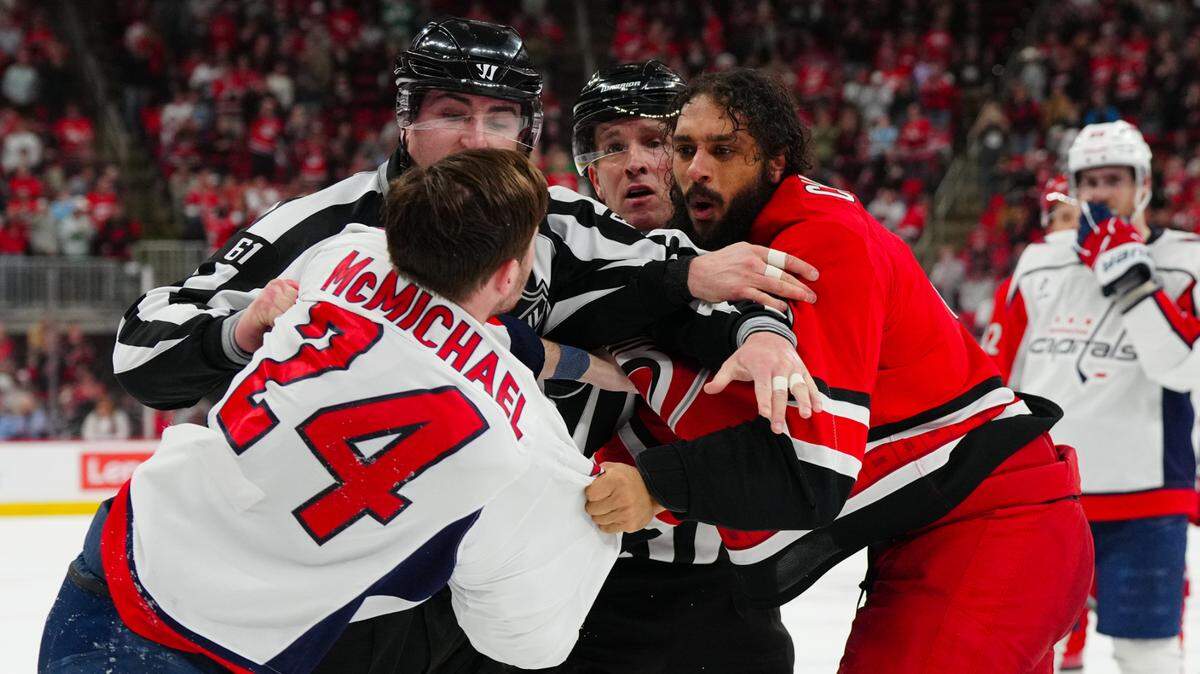
The Washington Capitals all but put a bounty on Jalen Chatfield’s head before their final meeting with the Carolina Hurricanes of the regular season, three weeks ago, albeit minus any radio interview labeling him the “chief punk.”
Nine days earlier at the Lenovo Center, Chatfield ended a fight — one of many altercations and flashpoints in a game with 142 penalty minutes — with Connor McMichael with a wrestling-style takedown, and the Capitals didn’t like it because McMichael had lost his helmet earlier in the fisticuffs.
In the return match in Washington, Capitals winger Brandon Duhaime sought out Chatfield and challenged him to a fight six minutes into the game. By the logic of the hockey code, archaic as it may be, that should have settled all scores.
But with the Hurricanes and Capitals on a collision course ever since, their second-round matchup again raises the eternal question of whether bad blood from the regular season carries over into the postseason. Everyone always insists it doesn’t, because the stakes are so much higher, and they might be right.
Then again, these are two teams that hate each other, and always have, for the better part of three decades. It may not be about settling scores. It may be about opening new accounts.
“It’s playoff hockey and you want to win, so you have to be smart when you go out there,” Hurricanes center Jesperi Kotkaniemi said. “If they want to go into the box, we’ll play power play for sure. They always play hard. They’ve got a little tougher team, big boys there, they try to battle hard. I think that’s been working for them.”
The series will start in Washington with the Capitals looking to rev up their fans and themselves after a lukewarm first-round win over the Montreal Canadiens, which means that Tom Wilson will almost certainly be looking for the big hit that can change a game or even a series, just as he did on Montreal’s Alexandre Carrier in the first round. Logan Stankoven and Jackson Blake better be on their toes.
At least, unlike 2019, neck-breaker Brooks Orpik isn’t still around. But 12 players from that epic seven-game series are — including both Andrei Svechnikov and Alex Ovechkin, the latter knocking out the former in a fight that felt like some twisted rookie initiation that also inaugurated the return of postseason hockey to Raleigh after a decade-long drought.
Two of the 12 have even switched sides in the interim, defensemen Dmitry Orlov and Trevor van Riemsdyk.
“Game 7 was crazy,” Orlov said. “Washington, we started with a good game, up 2-0, 3-1, something like that. And then just, something happened. Sometimes, if you look back, some series, some hockey games, in the third period when you try to save the score, you stop playing and just try to defend.”
The Hurricanes took advantage to cut short Washington’s Stanley Cup defense. Jordan Staal tied the score with three minutes to go, before Brock McGinn finished the job in the second overtime. The rest is history.
Ironically, the most damaging hit of that series, Ovechkin’s right hand notwithstanding, was delivered by the Hurricanes’ Warren Foegele, not exactly a noted enforcer. He sent T.J. Oshie into the boards just as Oshie lost his footing, a relatively benign hit with severe consequences that knocked Oshie out of the series with a broken collarbone.
Which is a good reminder that the playoffs are often rough and tumble whether the teams like each other or not, that strange heroes and villains can emerge and that even if the regular-season series between the Capitals had Hurricanes had been entirely uneventful, this playoff matchup was always unlikely to be.
The Hurricanes are better equipped for it than they were in 2019, having learned difficult lessons about postseason discipline in the interim, and bulking up this season with big, willing bowling-ball forwards like Eric Robinson (6-foot-2), William Carrier (6-2) and Mark Jankowski (6-4), not to mention a top-of-his-game Svechnikov who’s always a threat to level somebody.
The enmity between these franchises was born in the Southeast Division and boiled to the surface in 2019, when they finally played for something that mattered. That’s not likely to change now, no matter what happened in April.
Never miss a Luke DeCock column. Sign up at www.newsobserver.com/newsletters to have them delivered directly to your email inbox as soon as they post.
Luke DeCock’s Latest: Never miss a column on the Canes, ACC or other Triangle sports
This story was originally published May 5, 2025 at 5:30 AM with the headline "Bad blood may not carry over, but Canes and Caps have reasons to hate each other."