
The 49ers drafted two receivers. They believe their offense will be more physical
The 49ers had a mandate entering the NFL draft: get more physical on offense.
So when coach Kyle Shanahan and general manager John Lynch decided to draft back-to-back receivers on the second day of the draft Friday, the emphasis was finding pass catchers for quarterback Jimmy Garoppolo that didn’t have to rely solely on their route running or quick feet to shake defenders, like the team’s incumbent receivers Dante Pettis and Marquise Goodwin.
“When you do have a certain size to you, you have very good hands, you don’t have to be as open as other people are,” Shanahan said.
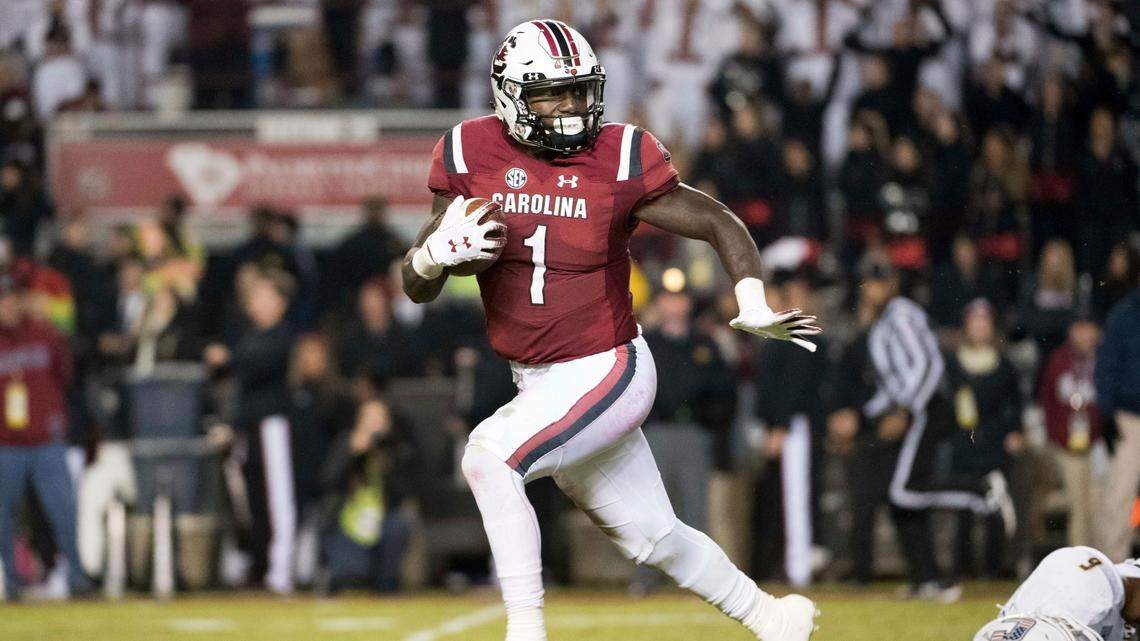
The two wideouts the 49ers added to their growing group were Deebo Samuel of South Carolina, taken with pick No. 36 in Round 2, and Baylor’s Jalen Hurd, a third-round selection who could be one of the team’s most versatile offensive players.
Samuel appears to be the favorite to replace departed veteran Pierre Garçon at the “Z” receiver position. The two have similar skills, such as playing bigger than their size while having fearlessness over the middle. Samuel (5-foot-11, 214 pounds), like Garçon, doesn’t have the height typically associated with physical, possession receivers.
“I just feel like you’ve got to have that dog in you,” Samuel said on a conference call. “Having that mindset, not one person is going to bring you down, and you’re going to make every catch that’s thrown your way.”
Shanahan believes height doesn’t necessarily define size. It’s more about playing style, and Samuel’s fits the 49ers offense well.
“Look at his body, look how he runs with the ball. It hurts for people to tackle him — it doesn’t hurt him as bad,” Shanahan said of Samuel, who has the compact build of a running back. “That’s a physical receiver to me.”
Samuel played outside and in the slot for the Gamecocks and many believed he would be limited to playing inside in the NFL. But his athleticism (4.48 in the 40-yard dash, 39-inch vertical jump) paired with his route running gives Shanahan the belief he can play outside the numbers.
“Playing on the outside, to me, has to do with be able to threaten guys on the go route,” Shanahan said. “And that, to me, has nothing to do with height. (It) has to do with how explosive you and how fast you are. And you can run by people. That allows you to play outside the numbers so people have to back up and you can run every other route.”
The 49ers got to know Samuel well at the Senior Bowl in late January. He was on the South team coached by Shanahan and his staff — and he showed off his route-running chops throughout the week of practice while also giving off a sense of charisma that left an impression on Lynch.
Samuel, who also returns kicks, regularly volunteered to work with special teams at practice and showed a passion for improving in a way that caught San Francisco’s attention.
“But when you watch him on that field, I think the thing that jumps out, just the fight, the grit, the toughness,” Lynch said. “And when you mix that with a guy who can catch a slant and be gone, that’s a pretty fun combination.”
Samuel was the third receiver drafted behind Hollywood Brown (Baltimore) and N’Keal Harry (New England) in what’s considered a deep class at the position. But Samuel isn’t a perfect prospect. He suffered a broken ankle in 2017 and dealt with hamstring injuries on two occasions. He had 882 yards on 62 catches during his best season as a senior.
He also had no problem finding the end zone. He scored 30 touchdowns in 30 college games — 16 receiving, seven rushing, four via kickoff returns, two passing and a fumble return.
Hurd was a surprise pick, given the way his college career played out. He spent his first three seasons as a running back at Tennessee before switching positions and transferring to Baylor. He sat out 2017 and then logged 69 catches for 946 yards and four touchdowns last fall.
At 6-foot-5 and 226 pounds, Hurd thought he was built more to play receiver, where he could have a longer career and take fewer hits. But Shanahan is open to tapping into his skills as a running back, which he played closer to the 250-pound range from 2014-16 at Tennessee.
“I think if he would have stayed a running back, I think he would have gotten drafted as an NFL running back,” Shanahan said. “Today he got drafted as an NFL receiver, kind of. I believe if he tried to play tight end, he would have gotten drafted as an NFL tight end. That’s a pretty unique thing to have. I don’t remember being able to say that about any player I’ve studied before.”
With Hurd’s weight fluctuating throughout college, Shanahan didn’t rule out a future position change, perhaps as a pass-catching tight end to complement George Kittle if his body were to fill out.
The skill positions in Shanahan’s offense are defined by alignment. In other words, there are plays where running backs line up at “X” receiver and tight ends play “F” in the slot.
How Hurd gets used could be defined by matchups, making him unique to San Francisco’s roster. For now, he’ll start at receiver and work with new position coach Wes Welker and assistant Miles Austin.
“What’s neat is when you have a receiver who can fluctuate (weight) like that, but also it’s the mentality to go play at running back or to play tight end,” Shanahan said. “There’s a lot of receivers who maybe could have the ability to do it, but it’s very rare to have the ability and the mentality with it because playing running back is a lot different than playing receiver and it’s a lot different than playing tight end.”
Taking two receivers, particularly two who could help in the red zone, could improve San Francisco’s offense significantly in 2019 after ranking last in red-zone offense last season.
The 49ers enter the draft’s final day Saturday with just three picks: 104 (Round 4), 176 and 212 (Round 6). Their most pressing needs are in the secondary, at corner and safety, and they could use offensive line depth.
This story was originally published April 27, 2019 at 1:08 AM.