Bubba Wallace’s long road through racism, and how it led to his being targeted by Trump
Bubba Wallace texted his mother a screenshot of the president’s tweet just before 9 a.m. Monday, and at first, Desiree Wallace was as surprised about her typically-late-rising son just being awake at that hour as anything else.
“What are you doing up?” she replied.
Then she read what Bubba — the first full-time African American driver in NASCAR’s Cup Series since 1971 — had forwarded:
“Has @BubbaWallace apologized to all of those great NASCAR drivers & officials who came to his aid, stood by his side, & were willing to sacrifice everything for him, only to find out that the whole thing was just another HOAX?”
“Is this for real?” Desiree asked her son.
“Yup,” he texted back. It had, in fact, been written by Donald Trump, and published on Twitter about 20 minutes earlier.
“Well, don’t respond to it,” she advised him, “because you can’t fix stupid.” Then she added, with a laugh: “At least the president was thinking about you.”
Meanwhile, just after 9 a.m., Bubba’s father — Darrell Wallace Sr., now Desiree’s ex-husband — hung up from a 30-minute call to find a text message from his nephew about Trump’s tweet. Darrell promptly fired up Twitter, and fired back:
“I just said, ‘I can’t believe with all the people you have working for you that you’re not informed on what you’re commenting about,’” Wallace Sr. told the Observer. “And then I said the same thing I would say to anybody who would make a comment like that: ‘You and I both know you’re an idiot.’”
How did a NASCAR driver find himself being targeted by the president?
The situation seemed to escalate practically overnight. A mere six weeks ago it would have been close to impossible to imagine Bubba Wallace’s name dominating the news cycle.
But the Mobile, Ala. native — whose father is white and whose mother is Black — became a vocal supporter of the Black Lives Matter movement; then he challenged his sport’s sanctioning body to ban Confederate flags from its tracks (successfully); then a rope fashioned into a noose was found hanging in his team garage at Talladega Superspeedway; then FBI investigators concluded the rope had been there since last October and that it wasn’t a hate crime.
And all of a sudden, it would seem, Wallace went from being a race-car driver who broke through a color barrier while keeping his head down to being both a bona fide activist and an unwitting magnet for controversy.
Yet this transformation didn’t happen overnight, or even over the course of six weeks.
In fact, according to his family, it took 26 years.
‘They’re gonna see you as Black’
Though “William Darrell Wallace Jr.” is what’s on his birth certificate, he quickly was dubbed “Bubba” by his big sister, Brittany, who was almost 5-1/2 when he was born on Oct. 8, 1993.
“Honestly, I really didn’t care for his government name,” she recalled, “and I also think ‘Bubba’ was the easiest thing for me to say back then. So it just stuck with him.” (Brittany Gillispie is Bubba’s half-sister; her biological father, whom Desiree was involved with before marrying Darrell Sr. in 1990, is also African American.)
When Bubba was 2, the Wallaces moved from Mobile — which was nearly 40 percent Black — to less-diverse Concord, where just 20 percent of the population was Black.
But by then, Darrell Sr. and Desiree had gotten so used to getting stared at as they walked down the street that they didn’t think about it much, and the family didn’t often talk openly about race or color.
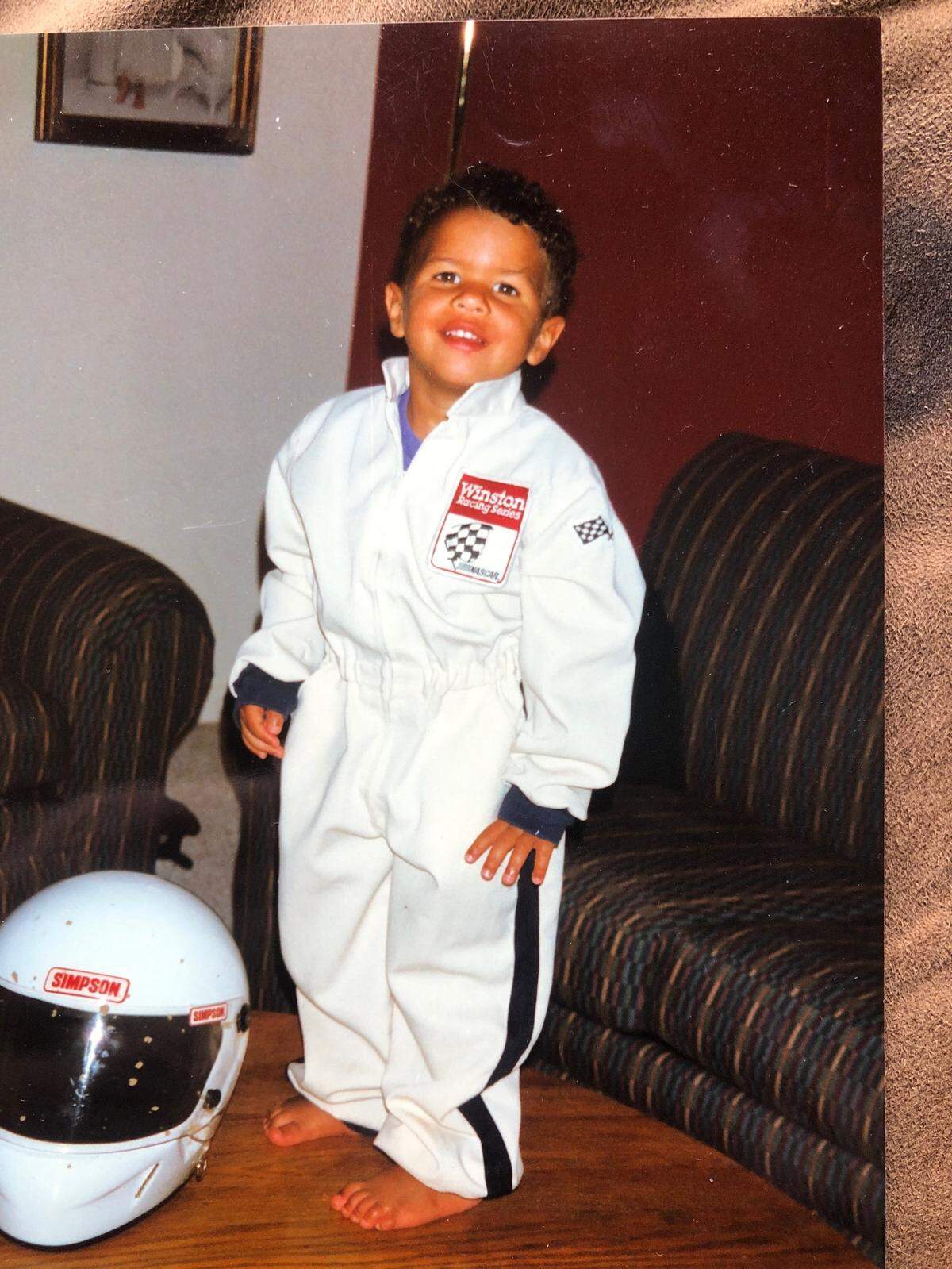
Asked whether she thought Bubba considered himself Black or white as a young boy, Desiree Wallace struggled to answer before saying: “I think he just considered himself to be a person.” At the same time, she said she does remember telling him “that, at the end of the day, when people see you, they’re gonna see you as Black.”
This was especially true, he would find, after his dad bought him a go-kart and started entering him in races at age 9.
Everywhere they went, Bubba was the only Black kid behind the wheel, and when Desiree and Brittany had a break from Brittany’s AAU basketball games and could make it to the racetrack, they were the only Black spectators.
It wasn’t a particularly welcoming environment either, the family said.
Darrell Sr. recalled an instance — when Bubba was a middle schooler at Northwest Cabarrus and racing Legends cars — in which someone at a track used a racial slur that Bubba wasn’t familiar with. His parents had to explain it to him.
Desiree Wallace said she remembers another time, at Franklin County Speedway in Callaway, Va., when several individuals repeatedly hurled the same racial slur at him after he made a shifting error that inadvertently knocked a local-favorite driver out of the race. He was about 14 at the time.
“I just told Bubba, ‘The best thing for you to do is just to go out there and win, because people are going to feel the way they feel. And there’s nothing that you can do about it,’” his mother said.
Once again, she reminded him: “‘When they see you, they see you as a Black driver, period.’”
Still, it would take another few years — and a frightening run-in with troopers, while traveling from North Carolina to Virginia — for the point she’d been trying to make to truly start sinking in.
Trouble on the side of the highway
By the time he was 18, Bubba Wallace was making decent money as a driver.
He was an alumnus of NASCAR’s Drive for Diversity team (aimed at attracting minorities and women to the sport) and the NASCAR developmental K&N Pro Series East, had made his debut in the NASCAR Xfinity Series, and was on the cusp of breaking into the NASCAR Truck Series.
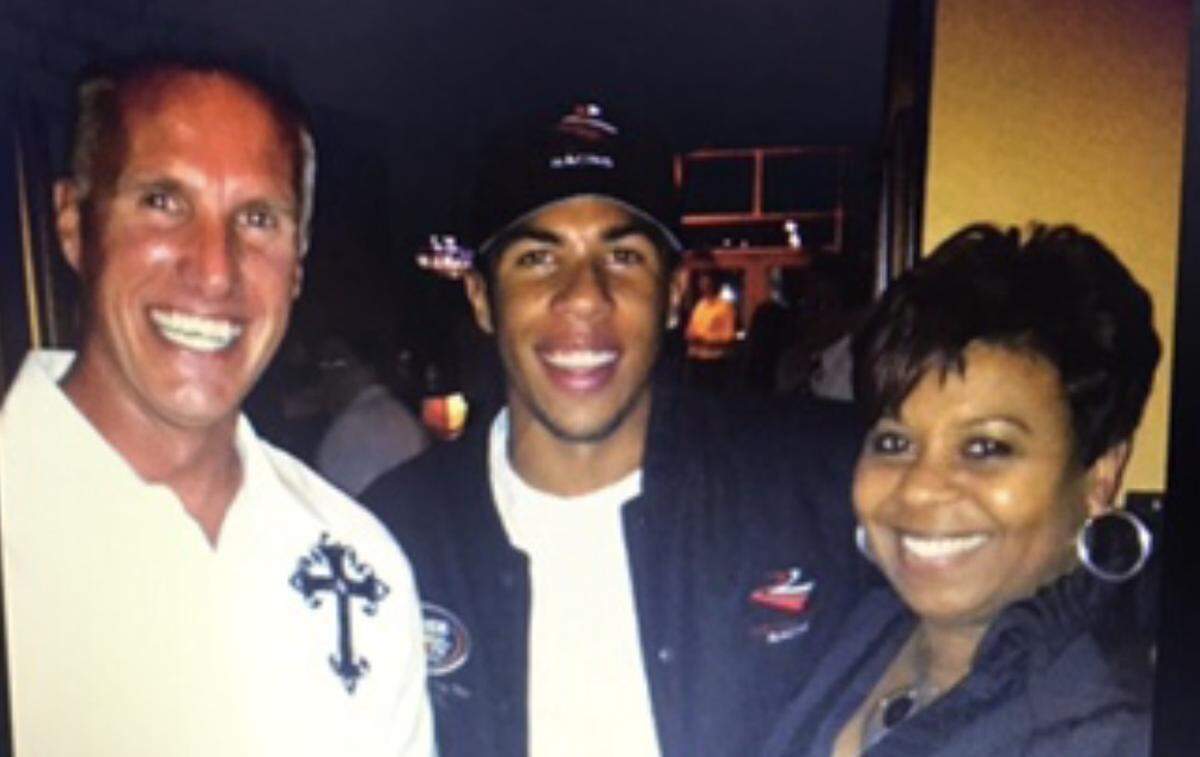
In fact, he was fresh off of a win when he hopped into his shiny, expensive SUV and headed north to visit his friend Sergio Peña, whom Wallace had gone through the Drive for Diversity program with.
But on his way, his parents said, Bubba was pulled over by a state trooper on the highway for not using his turn signal. Within minutes, Desiree Wallace said, three white troopers were on the scene.
It’s an incident Bubba talked about with Dale Earnhardt Jr. on Earnhardt’s “Dale Jr. Download” podcast last month. “(They asked) ‘Can you afford this car? It’s a nice car.’ I said, ‘Yes sir, I can,’“ Bubba told Earnhardt. “What I wanted to say is, ‘Yeah, I’ll have you one here Monday. I’ll have your momma here one on Tuesday and the rest of your family on Tuesday because that’s how much money I make.’“
“But, I didn’t. I let it go because one wrong move ’cause I’m Black, could of had me on the pavement saying, ‘I can’t breathe.’“
He said at one point guns were drawn (though not pointed at him); his parents said his car was searched, without cause.
When he got home, his mother said, Bubba was clearly upset by what happened. While discussing it with her son and her husband, she said, an argument broke out.
“His dad and I had two different views on it, of course,” Desiree Wallace said. (Darrell Wallace Sr. said he doesn’t recall this conversation.) “His dad was upset at the fact that they searched his car without any cause. He was like, ‘Well, you shouldn’t have let him search your car.’ And I’m telling him, ‘Yes, you should have done exactly what they told you to do’ ... I’m like, ‘It would have been their word against his, had he tried to resist or do anything. We could have been discussing this over his dead body. So no, Bubba, you did right.’
“That was the first time that I had to tell my husband, ‘You will never know or understand what it’s like to be Black.’ That was the first real conversation that we had about race. And I told Bubba, ‘Unfortunately, this was your first time with the racial profiling. But it’s not gonna be your last time.’
“I think it was like a wake-up call for him.”
Still, he continued to keep his head down while breaking barriers, becoming, in 2013, the first Black driver to win a NASCAR race in half a century; and then, in 2017, becoming the first Black driver to race at NASCAR’s top level since Bill Lester started two races in 2006.
He was proud of those accomplishments, said his parents (who went through a divorce during this time, in 2016). But he also tried not to make too big a deal about the color of his skin. He just wanted to focus on racing.
“Bubba’s not really a confrontational person,” said his sister, Brittany. “He’s very humble. He doesn’t like a lot of attention. He wants to be happy. He wants everybody else to be happy.”
But he was increasingly feeling pressure, too. “He gets criticized if he doesn’t speak out,” Brittany said, “and he also gets criticized when he does speak out.”
So one day, he decided he might as well just start speaking out.
‘What do you think about the flag?’
The Confederate flag had really never been that big a deal to the Wallace family.
For her part, Desiree Wallace said she was much more concerned with the lack of African Americans at tracks than she was by the presence of the controversial symbol of Southern sovereignty.
But while processing what he saw in the videos that showed the killings of Ahmaud Arbery in rural Georgia and George Floyd in Minneapolis, Bubba Wallace also reflected on the death of his cousin — a tragedy he hadn’t been old enough to fully grasp when he was 9 years old.
Sean Gillispie, a Black 19-year-old, was shot and killed in 2003 by a white police officer in Knoxville, Tenn., while reaching for his cellphone, according to the family; police argued that he was reaching for a gun.
And as Black Lives Matter protesters marched in cities and towns across the U.S., as companies large and small pledged to make impactful changes in the name of diversity, inclusion and justice, and as famous people with platforms took to using them, Wallace entered the fray.
First he turned heads on June 7 by showing up for a pre-race event in Atlanta wearing a T-shirt that read “I Can’t Breathe” and “Black Lives Matter,” then two days later he went on CNN and told anchor Don Lemon: “No one should feel uncomfortable when they come to a NASCAR race. It starts with Confederate flags. Get them out of here. They have no place for them.”
Two days after that, NASCAR banned all Confederate flags at its racetracks, where they have been a familiar sight atop RVs on infields or in fans’ hands in the grandstands for the past 72 years.
Yet, just as an example of how tricky the flag issue can be for some, consider Darrell Wallace Sr.’s thoughts about it:
“I mean, I’ve got friends that have Confederate flags at their house, or on their RV, or whatever,” Bubba’s father said this week, close to a month now since his son denounced them. “Everybody’s different. Some people have the Confederate flag for different reasons. Some of it’s for hatred, some of it’s for heritage. And I get it.
“I was asked on TV a question, ‘What do you think about the flag? Does it bother you?’ It took a second for me. I paused and thought about it. ... I guess if you’re with me and you have a problem with it, then I have a problem with it. But if I come to your house and you have it, and we’re friends and I know who you are and what you’re about, then I’m fine.”
Relatively speaking, though, the flag issue turned out to be fairly straightforward — for his son, at least — to navigate.
The noose situation, on the other hand, was a nightmare.
Trouble on the inside of a garage stall
You may know the story by now, but here’s a recap:
On June 21, a noose was discovered by a member of Bubba Wallace’s team in the team’s garage stall at Talladega Superspeedway in Alabama.
NASCAR president Steve Phelps vowed to permanently ban the person responsible. Wallace issued a statement decrying it as a “despicable act of racism and hatred.” Several acts of solidarity were on display at the GEICO 500 in Lincoln, Ala., on June 22, including a scene that saw all 39 other drivers and their crews march down pit road alongside Wallace as they pushed his No. 43 car to the front of the line before the race.
NASCAR investigated, and found that — in 1,684 garages at 29 racetracks — only 11 pull-down ropes were found tied into a knot; only one — the one discovered in Wallace’s team’s garage — was fashioned into a noose.
An FBI investigation, however, determined that the noose had been hanging there for months, long before anyone would have known Wallace’s team would be assigned to that garage.
There was no hate crime, they said.
In the days that followed, some inaccurately referred to it as a hoax and used false equivalency to compare Wallace to Jussie Smollett, the Black actor indicted after allegedly faking a hate crime in Chicago in 2019.
Sports columnists, meanwhile, published a parade of columns explaining why it wasn’t a hoax and how comparisons to Smollett were completely unfair. But Wallace was frustrated by the incident and increasingly gave indications that he was tiring of the media.
In an interview with Elana Scherr published by Car & Driver last Saturday, when asked how many journalists he’d spoken with that week, he replied:
“S---, I don’t even know,” he said. “I think the PR team has had something like 300 requests.”
One of those was from the Observer. He initially agreed to an interview on Tuesday afternoon, though only if there would be no questions about the noose situation.
Then just over 24 hours before that interview was supposed to happen — and about five hours after Trump revived the “hoax” allegation by swinging at Wallace on Twitter — Richard Petty Motorsports requested to reschedule the interview at a later, to-be-determined date.
A few minutes after that interview with the Observer would have ended, he responded to Trump with a tweet of his own.
“Always deal with the hate being thrown at you with LOVE! Love over hate every day. Love should come naturally as people are TAUGHT to hate.
“Even when it’s HATE from the POTUS.
“Love wins.”
Still, Wallace hasn’t exactly been feeling warm and fuzzy all the time himself lately. Ahead of its Friday airing, Fox News shared excerpts from an interview to be presented on FOX Nation (with host Lawrence Jones) in which the driver said: “Just being me, I don’t sugarcoat anything. If I’m pissed, you’ll know it. If I’m happy, you’ll know it. If I’m tired of interviews, you’ll know it. And I’m f------ tired.”
Which naturally begs the question: Will he be able to withstand the pressure — and the risk — of being a professional athlete who is also an activist?
‘This definitely puts a bigger target on him’
There is certainly the potential for some benefits to come along with his higher profile, and he’s starting to reap them already.
On Monday, headphone maker Beats By Dre signed Wallace to an endorsement deal, with the company stating that it moved up its announcement after the president scolded Wallace and the driver issued his own statement.
Darrell Wallace Sr. hopes more deals are on the way.
“I mean, all media is good media,” he said. “So just think how much he’s fixing to blow up now, because the guy who runs our country is tweeting about him. I love it.”
But as much as Wallace Sr. is excited about the exposure, he does feel a sense of uneasiness.
“Yeah, this definitely puts a bigger target on him,” his father said. He said that although he and Bubba are not as close as they used to be since the divorce, “we’re working on it” — and he said they had a conversation in the wake of the noose situation during which he told Bubba: “You need to watch your surroundings. Know where you’re at, know who you’re with, know who’s around you. Because there is a lot of crazy people, and this has made a lot of people mad and upset.”
As for his mother? She’s clearly troubled, too.
It’s not so much the people who taunt him for having failed to find consistent success in 92 Cup Series starts since his 2017 debut. That just comes with the territory when you’re a pro athlete: You have to win to shut up your critics, and even then you’ll never shut up all of them. (Bubba Wallace’s best-ever Cup Series result was second at Daytona in 2018, and he has only one other top-five finish.)
Rather, it’s the more sinister stuff.
“One guy said, ‘I know you’ve been dealing with depression lately. Why don’t you just go ahead and end it?’” (In interviews over the past year, Bubba Wallace has begun openly talking about his battle with depression.)
“It really just — it gets me angry, because if Bubba wasn’t as strong of a person as he is, then maybe he would have ended it.”
Yet she seems to understand that dealing with vitriol is the price to be paid if you want to effect positive change in the world today — that you have to be prepared to deal with bitter and often unfair criticism, whether it comes from someone with 83 followers or someone with 83 million.
And she also thinks he’d say it’s a price worth paying.
“If you’re asking me if he had to do it all over again,” Desiree Wallace said of her son’s foray into activism, “I think absolutely he would do it all over.”
This story was originally published July 8, 2020 at 10:23 AM with the headline "Bubba Wallace’s long road through racism, and how it led to his being targeted by Trump."