Hurricanes rookie Jackson Blake oozes ‘hockey sense.’ What is that, exactly?
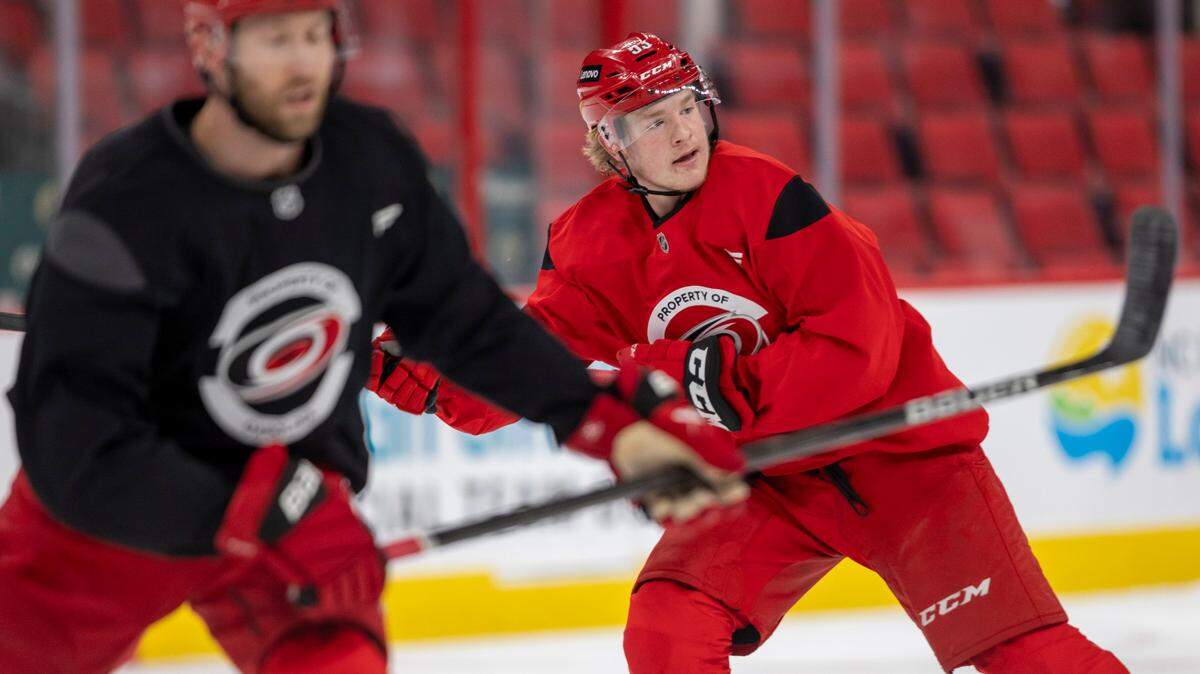
Jackson Blake is small for an NHL player. His father, Jason, was even smaller for an NHL player and carved out a 12-year career as an undrafted free agent. It’s a difficult league for the undersized, where hulking bodies not only jostle for space but get a benefit of the doubt smaller players do not.
Officially 5-foot-11, 178 pounds in a league where the average player is 25 pounds heavier and 3-4 inches taller, Blake’s physical gifts lie elsewhere — in the hand-eye coordination and quick-twitch strength that allows him to maneuver through tight areas and make deft plays with his stick. Not surprisingly for someone with such exceptional fine motor skills, he’s also a scratch golfer. It’s what small players have to be able to do to thrive in a brutal, punishing league. It’s also not what comes up first when hockey people talk about Blake, as impressed as they may be with his talent.
What sets Blake apart is that rare combination of vision, anticipation and composure that gets mashed together under the broad and sometimes confusing term “hockey sense.” Scouts and executives love to talk about hockey sense. If nothing else, it’s a catch-all adjective to explain why you just took the general manager’s nephew in the fifth round of the draft in the absence of any other evidence. It’s expansive enough to mean whatever you want it to mean, and specific enough that every NHL player has his own definition in his head.
When it comes to Blake, that manifests in different ways. He wasn’t a big kid whose peers outgrew him as teens; he started out small and stayed that way. Because of that, he’s had to learn to dodge contact and find open space, not only to be able to make plays, but to avoid being clobbered. He grew up around the game, hanging around the locker rooms where his father played, mentored by NHL players, immersed in hockey from the time of his earliest memories. You can’t watch that much hockey and not absorb and internalize some of what you’re seeing.
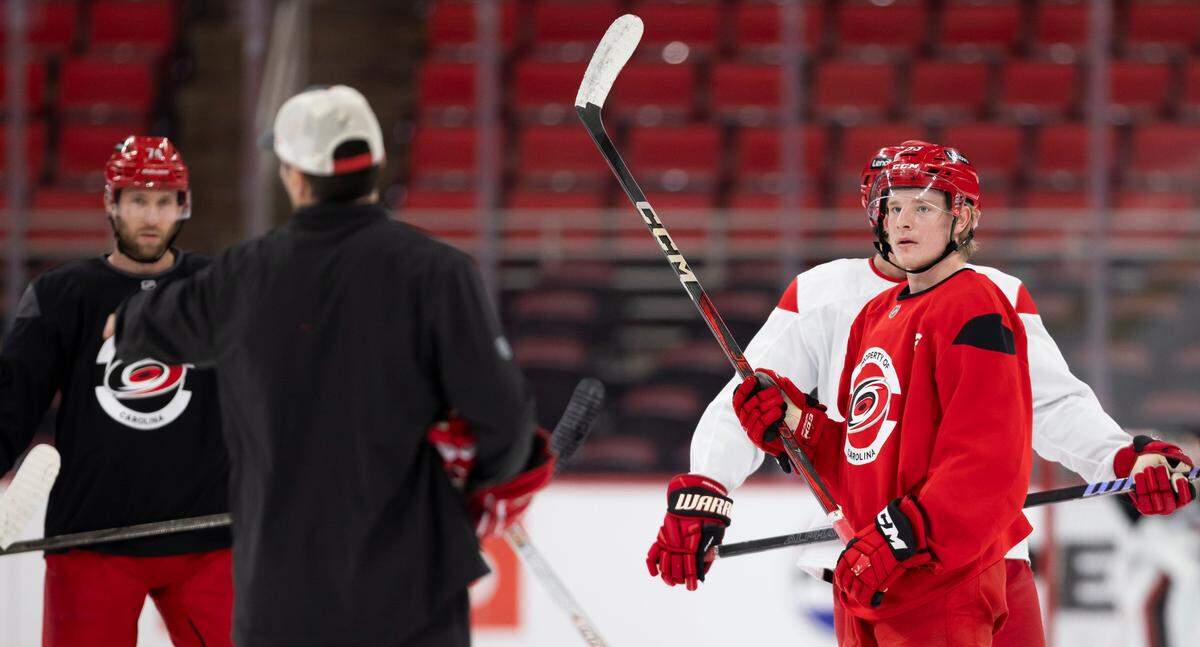
But there are a lot of small players with hockey pedigrees who didn’t walk into the NHL straight out of college and end up playing alongside stars like Sebastian Aho and Andrei Svechnikov on the top line of one of the eight teams still playing in May. Blake scored 17 goals as a 21-year-old rookie for the Carolina Hurricanes this season and two more in the playoffs so far. That’s a lot for what might otherwise have been his junior year at North Dakota.
“He didn’t play a ton early, but that was by design,” Hurricanes coach Rod Brind’Amour said. “Just kind of get him up to speed and feeling good. But whatever we threw at him, he just took it in and said, ‘OK, give me more.’ And we just kept throwing him more ice time and more responsibilities and he kept doing well with it.”
It’s something about the way Blake’s brain works that enables him to make plays others cannot, mesh with elite players and survive in a league where players almost a foot taller are trying to knock him through the end boards. It’s not just his superlative physical talent that allows him to overcome his size; it’s his superlative hockey sense. He wouldn’t succeed without both.
“I’ve always been the smallest guy,” Blake said. “Honestly, I think it’s kind of an advantage for me. You kind of grow up already being one of the smaller guys and playing against bigger kids. It helped me avoid hits. I learned that at an early age, so now I have that as a skill.”
Hockey sense means specifically different things to different people, but it generally means the same thing to everyone, and there’s one unquestioned certainty here: Whatever hockey sense is, Jackson Blake has it.
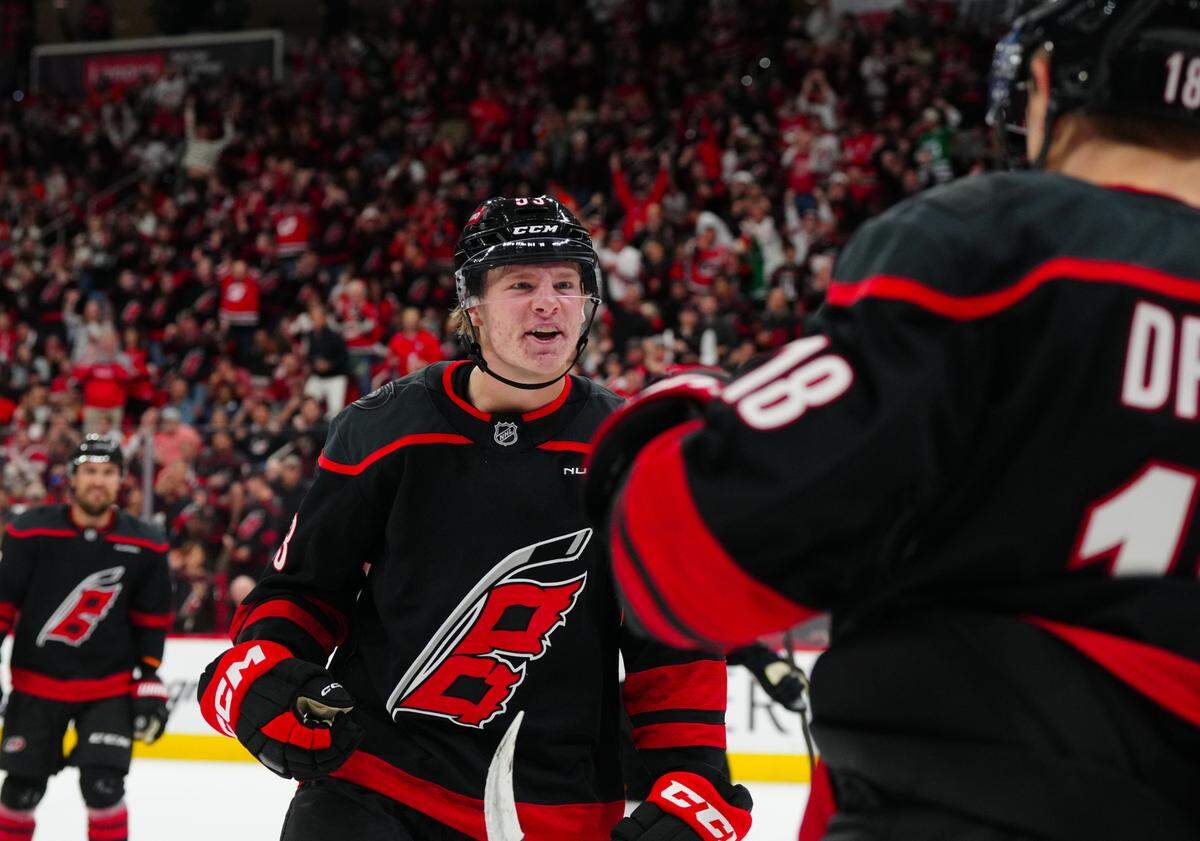
“He’s slithery, I think is a good word, in the corners,” Hurricanes captain Jordan Staal said of his younger teammates. “He’s not the fastest player but he can turn on a dime and take three steps. It’s hard to read off of guys like that. He turns at the right time and finds a hole at the right moment.
“That’s smarts, just understanding how to create room for himself. He does that well on top of being very skilled and being able to make great passes and seeing open players. It kind of creates a deadly animal there.”
‘The puck seems to follow them’
The purest summation of hockey sense comes from the player who most personified it.
“I skate to where the puck is going to be,” Wayne Gretzky famously said, “not where it is.”
It’s a good line, but every player is trying to do that. What distinguished Gretzky from every other player down the sliding scale of hockey sense was knowing better than anyone where it was going.
Anticipation is the core value of hockey sense, but it’s only one aspect of something that encompasses far more than that. Ask 20 hockey people — players, coaches, executives, scouts, agents, broadcasters — and you’ll get 20 definitions, but they all draw on a few key attributes that can be mixed into a million combinations, like oil paint on a palette: anticipation, composure, concentration, creativity, positioning, teamwork, vision.
Elite players, the best of the best, the 99th percentile, have elite hockey sense. It’s one of the things that makes them elite. But among the other 730 or so NHL players, hockey sense exists on a wide spectrum, typically in equilibrium with size or scoring ability. If you’re big or can fire a puck over a goalie’s shoulder and under a crossbar, you might not need to see the ice all that well. If you’re Blake — or new teammate Logan Stankoven, the league’s shortest player at 5-8 — it has to be what sets you apart.
“You see a player that maybe isn’t the fastest, isn’t the strongest, isn’t physically ahead of everyone else, but still seems to beat guys wide with their speed and find holes you might not see unless you’re way up top,” Staal said. “Really, the puck seems to follow them around. They just understand the game and they know where the puck is going before it gets there and they create something out of nothing at times and find open guys when you don’t even quite see it.”
In Blake’s case, it pairs with his hands and his mentality — “Hypercompetitive,” Brind’Amour said — to give him the edge he needs to play in the NHL.
“He feels the game the right way,” Svechnikov said.
There’s no question about that. The evidence is clear. But what does that actually mean?
Hockey sense and the draft
In the draft process, the Hurricanes are often willing to compromise in areas other teams treasure — size, skating ability — for players who exhibit high skill levels and show evidence of exceptional hockey sense. The theory is that so few draft picks actually make the NHL, especially outside the first round, that it’s better to focus on players with a chance to become stars, however small that chance may be.
Evaluating hockey sense is a multifold process, which basically involves watching … everything. It defies simple definition, but like obscenity, you know it when you see it.
But what are you looking for?
“How much time do you have?” asked Darren Yorke, the Hurricanes’ associate general manager who oversees amateur scouting.
“You’re watching his play with the puck and the decisions he’s making in terms of vision and playmaking and space-reading,” Yorke continued. “If we’re sticking to plays with the puck, is he able to make plays with less time and space? Is he able to create time and space? Navigating tight spaces, is he able to use his body to make plays? What if he can’t make a play? What about versus a tight gap or loose gap? On the forecheck, can he read handedness and understand where the puck may go, where the defenseman is or where the defenseman’s outs are? Defensively, is he able to read where the play is going in a variety of different chaos situations?”
That’s a lot of anecdotal evidence, which raises the question whether a franchise as analytically focused as the Hurricanes, run by a chemistry Ph.D., considers it quantifiable?
“Of course it is,” Hurricanes general manager Eric Tulsky said. “We basically use ‘hockey sense’ as a synonym for ‘decision making.’ You could quantify it by grading every decision as a positive or negative and reporting a percentage.”
Even then, it’s a difficult element to isolate in a game that moves as quickly as hockey. For Jack Han, a coaching consultant who worked in the Toronto Maple Leafs organization and publishes the indispensable Hockey Tactics e-book, it’s almost better to look at surrogates for hockey sense rather than try to assess it in the abstract, because it isn’t useful without at least some NHL-level skills.
“You need to pair it with something else at this level, or multiple other attributes,” Han said. “One thing teams very much care about are loose-puck recoveries. Something like loose-puck recoveries, at the NHL level or scouting for junior players, I find it to be very telling because it’s a composite attribute or analytic.
“Skating ability, hockey sense, the ability to be strong physically, to anticipate what’s happening next — so much goes into that one sort of ability. The players who have it tend to translate their games really well to the next level. They’re able to draw from several different areas to create competitive advantage.”
In Blake’s case, it was harder to discern in his draft year. He split time between Minnesota high school hockey, where he dominated lesser competition and won a state title, and junior hockey, where he wasn’t used as often in high-leverage situations among older players. His size is one big reason Blake didn’t go until the fourth round, with the 109th pick, but the Hurricanes thought they saw a player who saw the game equally well at each level. If his hockey sense continued to translate at North Dakota, it might into the NHL, as well.
It continued to translate. His freshman year in Grand Forks, he scored 16 goals in 39 games. His sophomore year, he was fourth in the country in scoring and a finalist for the Hobey Baker Award, the hockey Heisman. (“And we thought he should have won,” Yorke said.) His junior year, he was gone, a professional, criss-crossing the continent with the Hurricanes and making $925,000 to do it.
“Every summer you see kids come in as freshmen who are highly skilled and you’re like, ‘Wow, these guys are really good,’” said Charlotte Checkers forward Riese Gaber, North Dakota’s senior captain during Blake’s sophomore year. “A lot of the time, that’s just summer skate stuff. You never know what a player is going to be like in games, once he gets some real action. Blaker did everything he did in the summer. He wasn’t afraid. He didn’t shy away from it in games.”
A father’s lessons
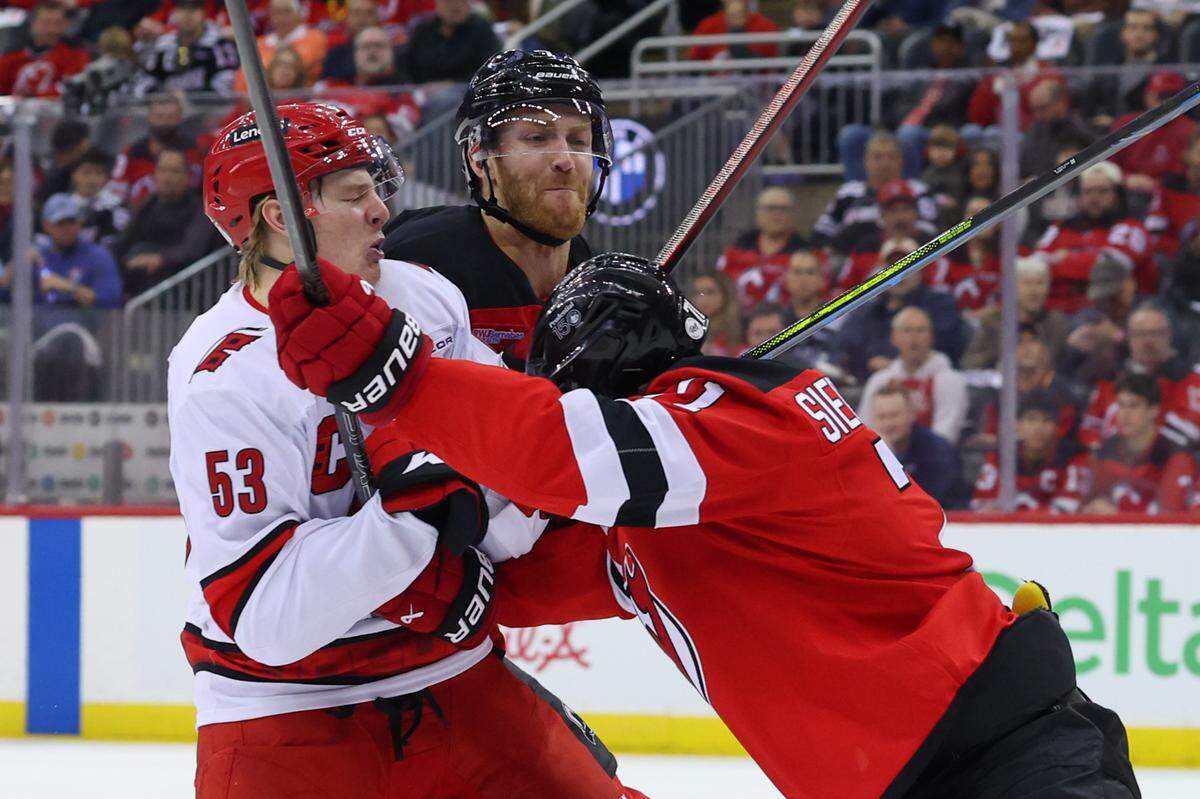
Blake grew up around the game, especially when his father Jason was finishing up his career with the Anaheim Ducks. Ducks forward Bobby Ryan, then 23, particularly bonded with 8-year-old Jackson, not unlike young Seth Jarvis playing with Brent Burns’ kids at the defenseman’s house. His father was undrafted out of North Dakota and made the most of every chance, a five-time 20-goal scorer who was always one of the smallest players on the ice, but found a way to play in the NHL until he was 38.
“When I played, I was a little rat. I can admit that now,” Jason Blake said. “But I was so competitive and I think that wore off on him, because I demanded so much from him. I knew that he had hands. I knew that he could skate. I just wanted to sharpen everything else up and make it perfect.”
Father and son would spend hours on the Sport Court in the backyard working on hockey skills. And every conversation, after every hockey game, started the same way: How do you think you played? But they also watched a lot of hockey together. A lot of hockey.
“He’s gifted, but we watched a lot of videos,” Jason Blake said. “We watched a lot of hockey every night, and any play that happened, we’d talk: ‘See what they’re thinking? You always have to be two steps ahead of somebody else.’ That’s impossible in this league, because you’re playing the best of the best. But this is at like 12, 13. So we’d go on the Sport Court and try to emulate someone else. He worked hard.”
Jackson Blake’s size was the subtext to all of that. He wasn’t the kind of player who started out the same size as his peers and watched other players shoot past him; he started small and stayed small. But like his father, he found ways to thrive regardless.
Always the smallest guy
Blake watched bigger players score more, catching the eye of scouts and college recruiters. Even as a pre-teen, he knew he’d have to find a different route to college, let alone the NHL. There was nothing he could do about the attention the bigger kids got. It was frustrating, but it was a reality he could not escape. Not then. Not in the draft. Even now.
“Growing up, being the smallest guy, there were kids in Peewees (age 11-12) scoring 100 goals, man-childs, and everyone’s like ‘These guys are so good!’” Blake said. “When you grow up, people start to catch up with their weight and their height. I was always a smaller guy. But now, there are some huge guys, like (6-5 Nikita) Zadorov on the (Boston) Bruins. That’s definitely an advantage, being that tall, but I don’t look at it as a negative thing. I think it’s good that smaller guys have to prove themselves.
“I wouldn’t want it any other way, honestly. Same thing with my dad. He wasn’t drafted at 5-8, 5-9, whatever. It might say 5-10 but he’s not actually. He was the definition of just grinding to get to the league. I wouldn’t say I had it as hard as him, but I had to prove myself. Everyone does. But especially for me.”
The Hurricanes had been aware of Blake for years, through an unexpected local connection. Colin Muldoon, a longtime Triangle hockey coach, roomed with Jason Blake at North Dakota and, later, coached Brind’Amour’s son Skyler here. Muldoon was always a believer in Jackson Blake, even as a 10-year-old.
“He was even smaller back then,” Brind’Amour said, but the coach still had an idea of what to expect when the Hurricanes signed him and brought him in last April.
Blake made his NHL debut in the 82nd and final game of last season, then hung around the team throughout the playoffs along with another prospect, 2023 first-round pick Bradly Nadeau. No one expected Blake to make the team this fall. More likely he’d spend the season in the AHL like Nadeau, who made the all-rookie team there.
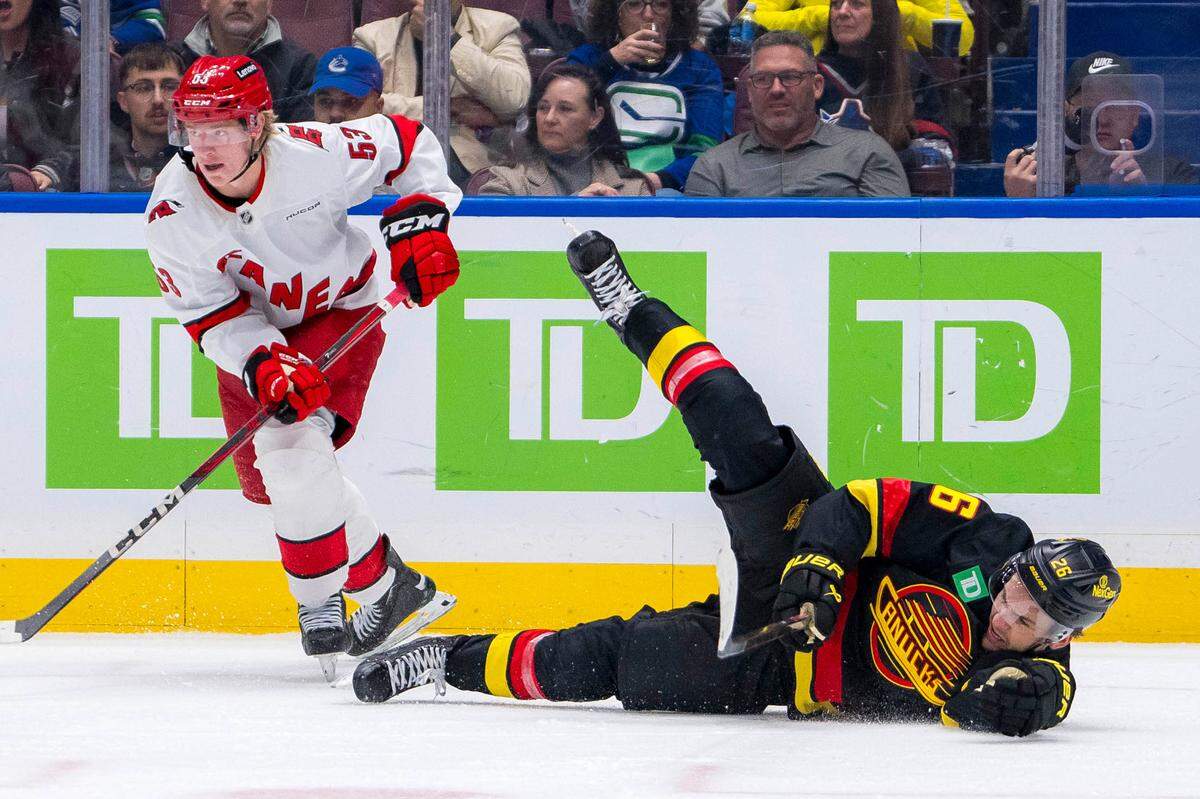
As Brind’Amour introduced Blake to the team’s defensive system in training camp, one he had never played before, Blake grasped the concepts intuitively. He got his first opportunity on a defense-first checking line and thrived. Whatever the Hurricanes threw at him, he mastered. By the end of the season, he had played himself onto the top line with Aho and either Jarvis or Svechnikov.
“You may have watched him at North Dakota and questioned his defensive play, but it was so easy and intuitive to put him in an NHL system he’s never played before,” Yorke said. “It’s like ‘Good Will Hunting,’ when Matt Damon is talking about solving math problems and talks about the great composers sitting at a piano. They don’t see notes. They just get it.
“Jackson is like that when it comes to hockey. He just gets it. He was asked to play a role at the very beginning of the year that he’d never done before. He didn’t just do it. He excelled at it.”
Thinking the game
Hockey, like any sport, will make any number of apologies for the truly talented and the exceptional physical specimens. (In the NFL, former New York Giants general manager George Young had his “Planet Theory:” There are only a certain number of people on the planet big enough and quick enough to play on the line of scrimmage, so you better draft them when you have the chance.) A player who’s 6-5 and 250 pounds and hits like a dump truck going down hill with the hockey sense of a fire hydrant will find a place in the NHL.
“It’s not just size,” said Jim Rutherford, the former Hurricanes general manager and current Vancouver Canucks president. “Energy players — those guys that give it the extra, the hard-working guys, that also get away without it but contribute to winning teams. It may be a guy that’s just a pure goal-scorer. He’s just got to get himself in a position and somebody gets him the puck. There’s lots of guys that play with average or below-average hockey sense and are good contributors to the game. But the guys with real good hockey sense find the game a little easier to play.”
Most sports have a version of this kind of specific nous, but none is as essential to performance as it is in hockey. Basketball scouts love to talk about “basketball IQ,” but it tends to apply more to certain positions than others. The same is true in football, where the closest comparison may be evaluating quarterbacks’ processing ability, since it’s almost impossible to discern whether their decision-making will translate from the slower tempo of college football to the NFL. Soccer also asks players to assume multiple roles, but only hockey does at full speed, in tight quarters, at risk of dismemberment, at all times.
“Hockey is such a composite,” Han said. “You’re doing a bunch of different things and using several skill sets at the same time: Skating plus agility plus toughness, shooting on the backhand or shooting on a screen. Nothing is being done in isolation. And then there’s how fast the game is and how fast the pressure comes.
“If you have amazing hockey sense but zero ability to create separation with skating, or your passing is not accurate, or can’t shoot the puck, or you’re afraid to get hit and get hurt, it’s not going to show. Maybe you’re not dumb, you’re scared. Maybe you’re not dumb, you’re gassed.’
In a 30-year career as an NHL executive, Rutherford said one player stands out above all the others when it comes to hockey sense: Ron Francis. The former Hurricanes general manager was the linchpin of the team’s early days in North Carolina, the free-agent signing who gave the franchise a sheen of legitimacy when it needed it most.
‘Ronnie Franchise’
Francis was a tremendously skilled playmaker, with hands that could make the puck dance. The Hurricanes used to host a fiercely competitive media ball hockey game before training camp, and one day during his tenure as GM, Francis stepped onto the floor in dress slacks and loafers and, without moving his feet, whizzed passes onto the sticks of players — who, in most cases, weren’t expecting them — for tap-in goals.
That’s how Francis played. In 2001, when Jeff O’Neill scored a career-high 41 goals, Francis had the primary assist on 13 of them. His passing ability prolonged his career into his 40s despite the fact Francis was never the best skater on any team he was on. He played on skate blades that had almost no edge to them; he needed to be able to glide more than he needed to stop and start, in part because he had the innate ability to know where he needed to go before anyone else saw that he needed to go there.
As elite as Francis’ hands were, his hockey sense went even a level beyond.
“It’s that anticipating what’s going on in the game, reading the plays,” Rutherford said. “He was a step ahead of other players in thinking the game. And then of course, whatever’s going on in the game, being able to make a quick correction in how the game is played.”
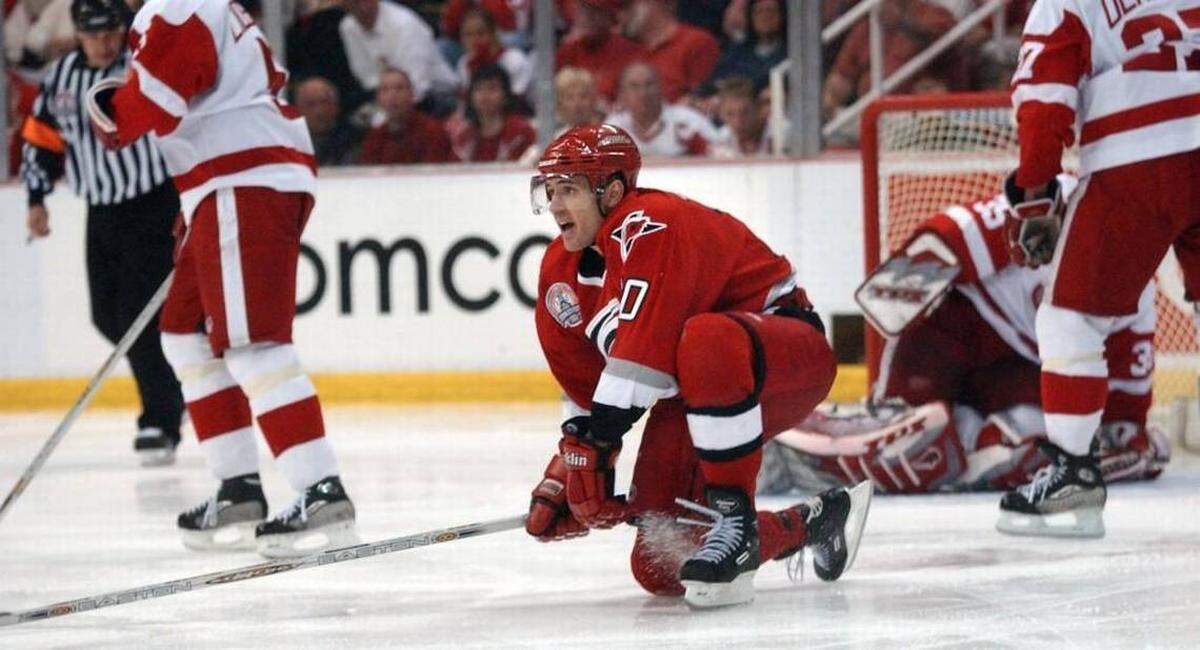
Francis became a first-ballot Hall of Famer because hockey sense is not merely what keeps smaller or slower players in the game. It’s what turns good players into great ones, and great ones into legends. If you can put Blake’s hockey sense in a bigger, stronger or even more skilled player, you end up with a Gretzky or Bobby Orr or Sidney Crosby.
“Those are those elite guys,” Staal said.
Over the years, especially in amateur scouting, hockey sense has become a more important element of evaluation. The Hurricanes aren’t the only team focusing on it, even if they may prioritize it. Columbus Blue Jackets general manager Don Waddell, the Hurricanes’ general manager from 2018-24, said his sense of hockey sense has evolved over the years, and so has the emphasis placed upon it.
“On our scouting reports, it’s the No. 1 thing,” Waddell said. “It used to be skating was No. 1, then stickhandling, handling the puck. Now hockey sense is the first thing, the first box that you check off. It’s something we always talked about but probably didn’t emphasize enough, but the game’s changed. It used to be size — how big is this guy? Now size has been proven by lots of players that it’s just a number. It’s how they use that size.”
360-degree vision
November 11, 2023. Duluth, Minn. North Dakota leads Minnesota-Duluth, 1-0, early in the second period. Gaber chips the puck ahead to Blake in front of the benches, and Blake carries the puck across the blue line into the offensive zone on the right side. Three defenders surround him, one directly in front of him, two just behind on either side. Gaber is coming down the right wing behind him, skating to catch up.
As he reaches the right faceoff circle, Blake, a right shot, cuts inside on his forehand. The defender can’t pivot quickly enough to cut off his route, but stays close enough to deny him any room. The move allows the two trailing defenders to close the gap, and as Blake pushes off his right skate to move to the center of the ice, between the circles, the three Duluth players all move toward him.
Just as the space is collapsing, Blake makes a blind backward pass behind him and to his right, on his backhand, between two of the closing defenders to Gaber, who is cruising past the right faceoff dot with speed. The pass is right on Gaber’s tape. All he has to do is shoot. Unobstructed, Gaber rips a forehand shot past the goalie, who’s desperately lunging across the crease.
“I was just kind of following the play, hoping for some loose change, seeing what Blaker does with it,” Gaber said, describing a play he can recreate from memory 18 months later. “It honestly surprised me. I almost wasn’t ready for it. Luckily I was.”
It’s easier to make plays like that in college hockey than in the NHL, where defenders have longer wingspans, nimbler feet and aren’t often caught watching the puck like that, but the pass itself is equally stunning in both its execution — a perfectly placed, no-look pass in traffic — and its audacity, to a teammate Blake had no earthly way of knowing was there.
Could he pick up Gaber on the edge of his peripheral vision? Was that a slight turn of head to scan, almost imperceptible on the YouTube highlight? Was it just knowing where Gaber would be if he went where he was supposed to be?
Or was it all of that, because that’s just how his brain is wired?
“He sees everything,” Yorke said.
Nature vs. nurture
One of the all-time great experiments in hockey sense played out on a sod farm in northern Ontario. If it’s hard to define hockey sense, it’s equally hard to figure out where it actually comes from. Nature and nurture, to be sure, but a little of both — and sometimes neither.
Staal is a two-time finalist for the Selke Trophy, which goes to the NHL’s best defensive forward. In his case, size helps. He’s a hulking 6-4 and a stoutly muscled 220-plus pounds, at age 36. Even as his quickness wanes, his wingspan covers an extraordinary amount of ice, and he long ago learned how to use his strength to lean on the opposition’s best players, a duty he draws almost without exception. Just as Brind’Amour was one of the great defensive forwards of his generation in his playing career, Staal is his ultimate safety net as a coach, a player he can put out in any situation, to win any faceoff, secure he’ll do the right thing.
What makes Staal a great defensive player is not just his physical gifts; it’s a sense of defensive expectation that enables him to sense where an opposing player is going even when that player is a swifter skater than Staal, and most are these days. That’s hockey sense, in a sense, and Staal can pinpoint where it comes from.
The early days of the four Staal brothers are hockey legend at this point, battles fought day after day, night after night, on the outdoor rink their father built out of plywood and chicken wire on the family’s Thunder Bay sod farm. Jordan was the third in a span of four years and the physically strongest, if perhaps not quite as offensively gifted as Eric, the oldest, who the Hurricanes took with the third pick of the 2003 draft and ended up leading the NHL playoffs in scoring as they won the Stanley Cup three years later.
Jordan Staal spent his entire childhood trying to get the puck from Eric, chasing him around the rink along with second brother Marc, a future first-round draft pick and NHL defenseman. None of them needed any time in the minor leagues; they were all NHL-ready at 18 or 19. Eric was, at his best, an offensive dynamo, fast and nimble for his size with a knack for clutch goals, while both Jordan and Marc built their careers on their defensive prowess.
“He was four years older than I was, and I didn’t have the puck,” Jordan Staal said. “I was constantly reading him, trying to get it off of him. I would 100 percent attribute a lot of how I can angle and read and understand how to get the puck back to that.”
The three oldest brothers all had long NHL careers, playing into their late 30s, a total of 3,829 NHL regular-season and 289 playoff games (and counting, in Jordan’s case), winning three Stanley Cups. But Jared, the youngest, was just as big and had all the same experiences his entire life and played all of two NHL games after being picked in the second round.
They all drew from the same gene pool and had similar experiences growing up, and it was enough for three of the four siblings to make hundreds of millions of dollars playing hockey in the NHL, but not the fourth, and the three who did make it each carved out completely different roles for themselves: the offensive superstar, the two-way workhorse, the defensive stopper.
“They all played the game different, but I think it’s fair to say in that group, hockey sense helped their careers a lot,” said Rutherford, who drafted Eric Staal as Hurricanes GM in 2003 and traded for Jordan in 2012. “They just played different roles.”
The little-brother scenario is not an uncommon one. When the Hurricanes drafted Aho in 2015, he slipped to the second round because of concerns about his size, but the Hurricanes always liked his skill and hockey sense. He also grew up around the game — his father is now the general manager of Finnish club Karpat Oulu — but he didn’t just play hockey. In every sport, he was always looking up at his brother.
“I was always the smaller guy,” Aho said. “I kind of had to find different ways to beat him. It wasn’t size or strength. I got my ass kicked all the time.”
Aho paused, then tapped his head.
“I had to do it up here.”
‘He just gets it’
But it’s facile to assume that older siblings or NHL-playing parents bequeath hockey sense as a rule. There are plenty of examples of players who emerge from such environments unable to see the game at that level, and just as many others who appear to be gifted with hockey sense as if touched by the finger of a god for no apparent reason.
“I think you can make a lot of mistakes if you do it that way,” Yorke said. “That’s a bias. Just because the brother played in the NHL or the father did, that’s an inherent bias that can get you in trouble and lead to mistakes. Obviously Jackson has a dad who was a hell of a hockey player and he grew up around hockey, but that’s not necessarily the reason he’s so smart. Give him some credit for everything he’s accomplished on his own.”
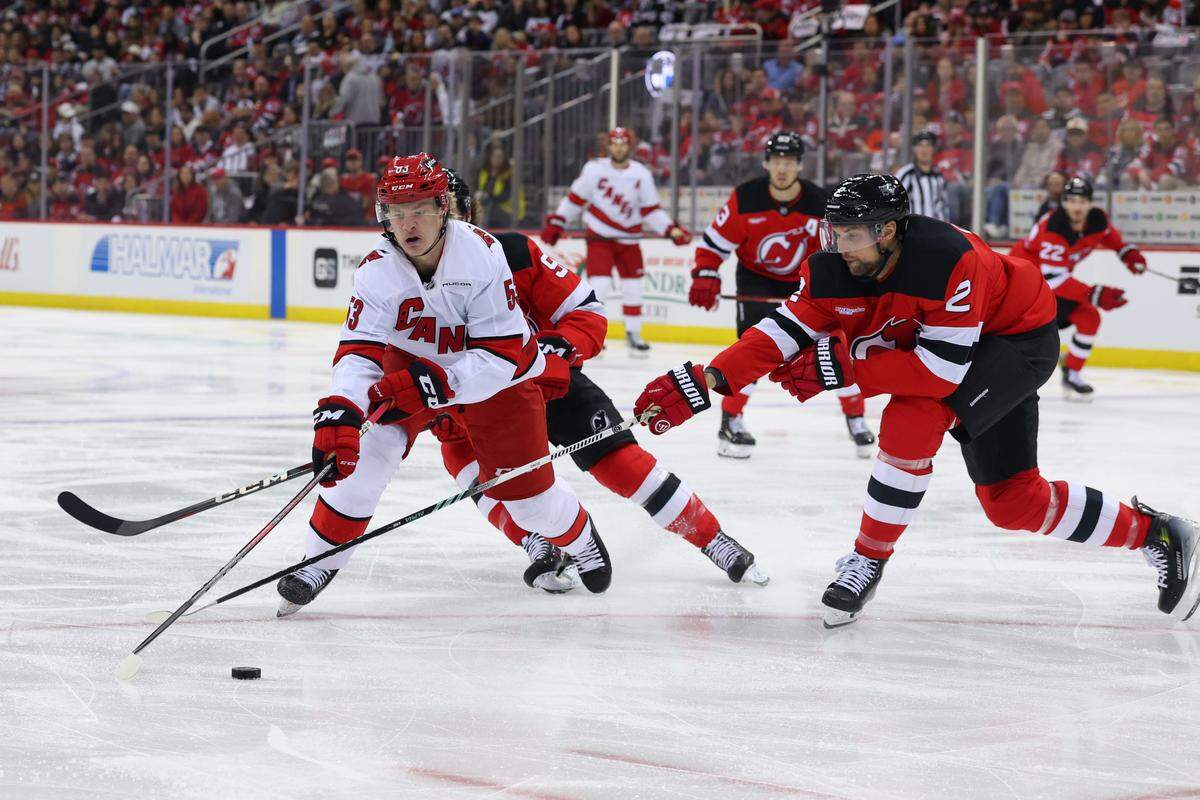
Which raises the inevitable next question: Genes and siblings aside, can hockey sense be taught? Some of it is unquestionably innate, but some skills coaches who believe there are techniques a player can work on to improve his or her hockey sense throughout a career. Often, after a player makes a play no one saw coming, a review of the video will reveal a slight turn of the head a moment or two earlier.
This is “scanning,” the ability to look away from the play for a split-second to survey the entirety of the ice, and it’s a skill that can be taught and practiced like any other. “Shoulder-checking” is what fighter pilots call “checking 6,” a glance over the shoulder at what’s happening behind you. Gaber talks about “pre-puck awareness” as well, consciously envisioning where players will be on the ice, so you know what you’re going to do before you even have the puck on your stick.
Just because Gretzky was born with a perfect grasp of it doesn’t mean the rest of humanity can’t try to get better.
“In the summer, there are lots of different things you can do,” Gaber said. “Shoulder-checking. Pre-puck awareness. Scanning the ice constantly. Scanning is something Blaker does really well. He knows where guys are and extends plays. It’s something that makes his hockey sense what it is.”
But there are diminishing returns, and a pro-caliber player may be able to improve his hockey sense, but it’s also not something that can be conjured from nothing.
“We can teach a lot of things in our sport,” Waddell said. “We can make a player a better skater. We can work on his shot. You can’t teach hockey sense. Either you have it or not. Everybody that plays the game has some hockey sense. But some players have more than others.”
In Blake’s case, there were so many factors that combined to make him the player he is. His size. His father. His mother, a star athlete in her own right. Growing up around the NHL. Even hockey video games — “You can be creative on that, and learn new stuff,” Blake said. But there’s also just the mere coincidence of human life, that some people have a genius within them that others do not, even if it’s a matter of degrees.
NHL players are the best on earth at what they do, at this particular combination of physical and mental skills, athleticism and intelligence. Even by that standard, Blake stands out.
“It just makes sense,” Yorke said. “He just plays. He just gets it.”
In the end, no one knows why Blake’s hockey sense is exceptional, why he developed an ability to think and see the game that allows him to play a brute-force game without brute force. Only that he wouldn’t be here, now, without it.
Never miss a Luke DeCock column. Sign up at www.newsobserver.com/newsletters to have them delivered directly to your email inbox as soon as they post.
Luke DeCock’s Latest: Never miss a column on the Canes, ACC or other Triangle sports
This story was originally published May 13, 2025 at 6:00 AM with the headline "Hurricanes rookie Jackson Blake oozes ‘hockey sense.’ What is that, exactly?."