His wild NHL story could be a Disney movie. But for David Ayres, one thing was missing
More than seven hours before the Carolina Hurricanes’ game against the Dallas Stars on Tuesday night, David Ayres walked into the Hurricanes locker room at PNC Arena with his wife by his side. The team had flown Ayres to Raleigh, to celebrate his improbable story, and while the longest dream of his life morphed into reality parts of it still felt unreal.
It began three days earlier, on Saturday night in Toronto. That was when Ayres went from the upper deck to the ice; when he went from eating a Reuben sandwich in section 317 to playing goalie for the Hurricanes during the final 28 minutes of their victory against the Maple Leafs.
Ayres, from Whitby, Ontario, was 42-years-old, a former Zamboni driver and the current operations manager of the historic arena where the Maple Leafs used to play. He’d survived a kidney transplant. He’d lived his improbable dream of one day playing in an NHL game. Now everyone wanted to meet him.
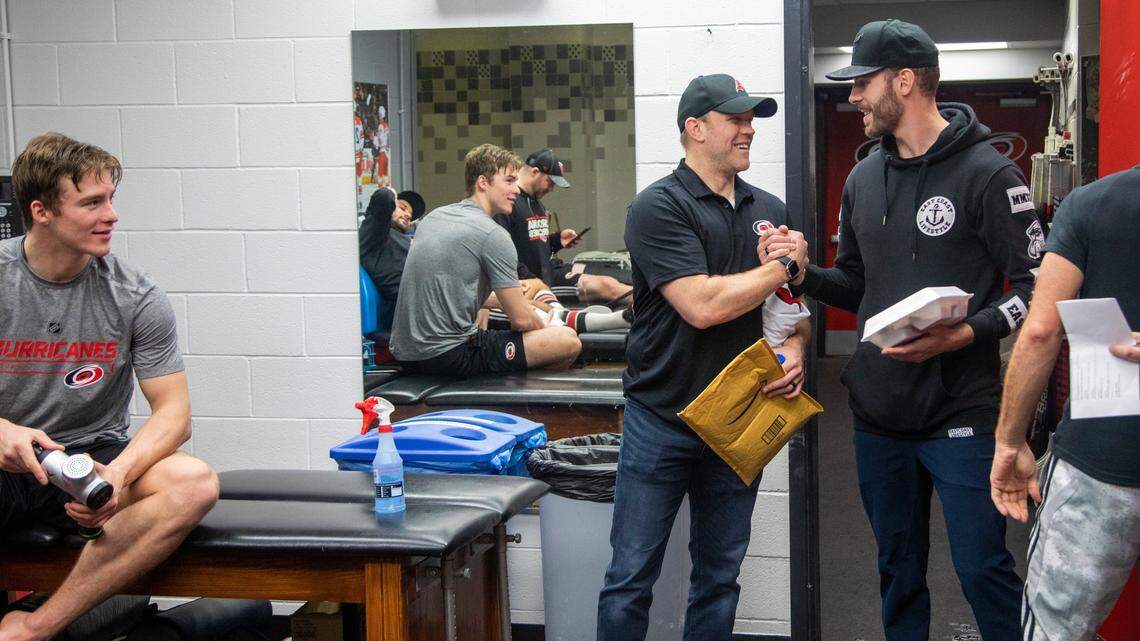
At around 11:30 on Tuesday morning, a Hurricanes’ staffer led him through the locker room, giving him a tour. Ayres paused to check out the weight room, then the lockers and then walked down a hall where some of the team’s players received treatment in a training room. Ayres walked in to cheers.
“There he is,” one of the players said, his voice rising.
“The legend’s here!” another shouted.
“Oh, no,” Ayres said, laughing, smiling, downplaying his newfound celebrity. “What a wild ride, man.”
Andrei Svechnikov, the Hurricanes’ 19-year-old right winger and one of the bright young stars of the NHL, sat on a table to Ayres’ right. Svechnikov, the second overall selection in the 2018 NHL draft, had his entire career in front of him, and his future seemed limitless. Ayres, meanwhile, had likely just played in the only NHL game he’ll ever play in — and that it happened at all was enough of a miracle that his story became national news.
When the two met, Svechnikov appeared to be the one in awe.
“How was New York yesterday, good?” he asked.
Ayres smiled and shook his head. He told the story of being on Stephen Colbert’s late-night show, and skating at Rockefeller Center. Ayres wore a black Hurricanes polo and hat and his wife, Sarah, stood near him, taking in this scene — her husband casually chit-chatting with his former teammates, for one game, in an NHL locker room.
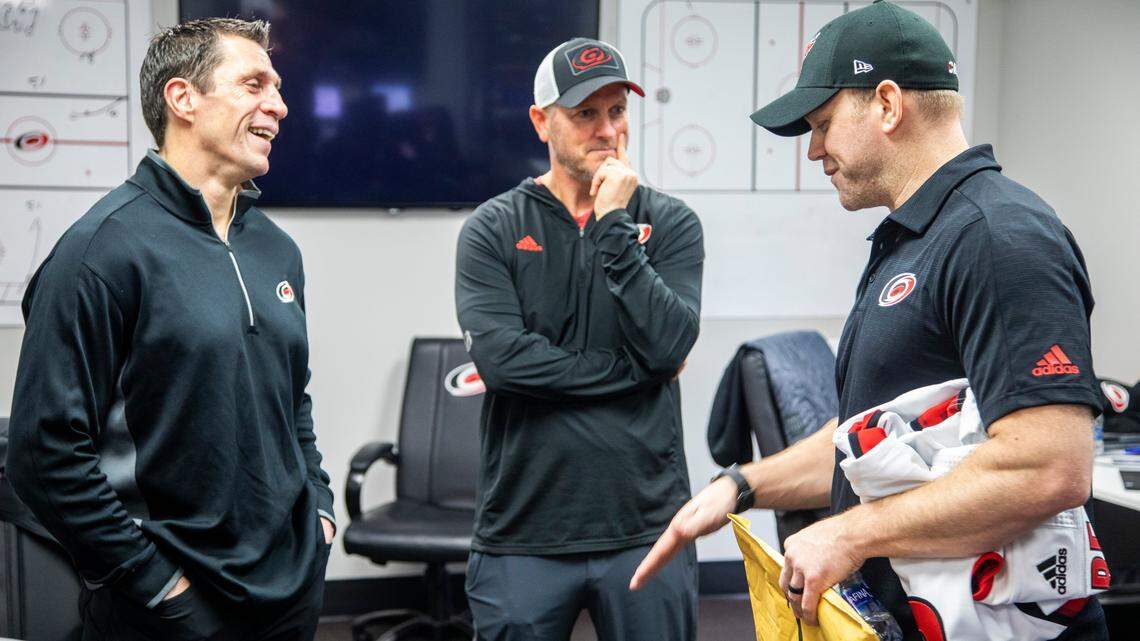
Soon Ayres was in another room, meeting with Tom Dundon, the Hurricanes’ owner, and Rod Brind’Amour, their head coach. They all talked like they’d been friends for a long time. Brind’Amour knew the players had something special in the works for the postgame — a special Zamboni ride. But, he said more than once, “We’ve got to win.”
Instead they suffered a 4-1 defeat. No Storm Surge. Ayres’ life moved closer to returning to normalcy. Fans filed out of PNC Arena. Some of them wore white Hurricanes’ shirts with the No. 90 and Ayres’ name on the back. Days later, it all still felt surreal.
More than a Zamboni driver
When Ayres’ story began to spread Saturday night, it sounded like the plot of a Disney movie. A 42-year-old Zamboni driver, thrust into an NHL game. A man who grew up in rinks and atop frozen ponds, achieving a lifelong dream of playing at the highest level of professional hockey. The emergency, on-call goaltender coming to the rescue, leading a team of strangers to victory. A kidney transplant survivor who persevered.
It was easy to distill Ayres, and his story, into a tweet or two and, indeed, it was the kind of story that seemed made to go viral. By the time he saved the final eight shots he faced Saturday night, and helped lead the Hurricanes to a 6-3 victory against the Maple Leafs, Ayres was trending on social media. The public could not get enough of him.
And yet, like with a lot of things on Twitter, important details were lost along the way, or left out. The “Zamboni goalie,” as Ayres quickly became known, only described part of his identity. It said nothing of his lifelong pursuit of this moment; or about his connection with his late father, who taught him the game; or about what he’d overcome after a kidney transplant.
Still, Ayres embraced the “Zamboni goalie” moniker, even if it was something of a caricature. Years ago, the woman he married knew Ayres for driving a Zamboni before she met him. Now he and Sarah have known each other for about four years, and been married for two and a half.
“It’s going to sound like I’m pumping his tires for a little bit,” she said during a phone interview earlier this week. “But I don’t know one person that could ever say anything negative about him. … He constantly gives (at) every opportunity, every chance he can.
“And he’s the funniest guy you’ve ever met.”
Not long after they met, Ayres asked her to dinner. During the dinner, he asked her if she’d ever heard of a guy known around Toronto as the Zamboni goalie. Even by then, in 2015, Ayres’ story was known around Toronto. He’d turned his stint as the Zamboni driver for the Toronto Marlies, a Maple Leafs minor league affiliate, into an opportunity to become the Marlies’ emergency goalie. That’s how Ayres began his journey that led to the NHL.
Looking back, Sarah said Tuesday, it was something of a smooth pick-up line:
“Ever hear of that Zamboni goalie guy?”
She had heard of him. She’s a hockey fan in Toronto, and hockey fans in Toronto are aware of stories like Ayres’. They married a year and a half later, and Ayres immediately became a father to Sarah’s three children. At Maple Leafs games, Sarah had been there the three previous times Ayres had been called down, only for those calls to be false alarms. When reality began to set in Saturday night and it became certain that Ayres would have to enter the game, Sarah tweeted a profane colloquialism that soon went viral.
“I don’t know if he ever felt like he would go into a game,” she said. “It was kind of a dream sort of thing. But it has meant everything, because for him, in his mind, it’s that ultimate achievement, right?”
Sarah said she doesn’t drink but when her husband entered the game on Saturday night a Maple Leafs fan bought her a beer. She drank about half of it to calm her nerves. She’d been on the phone with her mom, screaming the news. Her heart pounded. Down below, Ayres stepped onto the ice and skated to the net. He thought of the one person who’d most appreciate seeing this moment, but who wasn’t around to experience it.

Son of a beer-leaguer
Not long after his NHL debut began, Ayres surrendered two goals on the first two shots he faced. Days later, Dundon, the Hurricanes’ owner, told Ayres that he began to feel badly for him when he allowed those early goals — that he felt like Ayres was overmatched. Ayres, though, entered the arena Saturday night with no shortage of experience against pros.
For years, he’d been a practice goalie with the Maple Leafs and the Marlies. He knew the tendencies of the players he was facing. He knew how they might try to score against him. After the second goal, Ayres said days later, recounting the moment, he looked up at the scoreboard and tried to focus.
“You can’t go out and embarrass yourself like this,” he told himself.
Soon it was intermission between the second and third period. His nerves calmed. He didn’t allow a goal in the third period and saved the final eight shots he faced. At one point during a timeout that period, he tried to absorb everything that surrounded him: The scene of 20,000 fans.
He wished his dad could see him now.
Ayres became a goalie because of his father, Robert, and he thought about what his dad might say if he were around — especially if he were around to see Ayres allow two early goals. He imagined his dad would’ve told him to breathe.
“That’s what my dad used to say — ‘Just relax,’ ” Ayres said. “‘You can’t get that one back.’”
That his father wasn’t around to witness Saturday night was perhaps the only disappointing thing about it. Robert Ayres died in 2015, leaving behind his wife, Mary, and three children who grew up, like a lot of Canadian kids, with a healthy obsession with hockey.
David Ayres was no different. He began playing when he was about 3. By the time he was 6, he knew he wanted to be a goalie. Other kids could chase glory in the pursuit of scoring. Ayres found meaning in not allowing the puck to pass him by. He didn’t mind the bruises that came with the position, because he viewed those as proof of success.
“As weird as it sounds,” Ayres said, “you come home from a practice, or even a game, and you’ve got a couple of bruises here and there, and you don’t look at it as like, ‘Oh that hurts.’ Like, that’s a save. That’s the good thing about that as a goalie. You look at that differently.”
On Saturday nights during Ayres’ childhood, the family made a habit of watching Ayres’ dad play at Scarborough Centennial Arena, outside of Toronto. The setting wasn’t fancy and neither were the games.
Ayres said his father was “a beer leaguer,” and that it took the passage of some years to appreciate the value of seeing his dad compete, regardless of the quality of competition. Eventually the lessons became clearer.
In some ways, they shaped his passion for the sport. He told his parents the same thing that a million other Canadian boys tell their own: That one day he’d grow up to play in the NHL. That was his goal, from childhood, and he refused to let it die when he realized the odds and while he drifted through stints with lower-level minor league teams.
He kept it alive in 2005 when, after an extended illness, he needed a kidney transplant.
Mom’s kidney
It is “pretty rare,” Mary Ayres said during a phone interview earlier this week, for a mother to be able to donate a kidney to her child. But she proved to be a match for her son, and made the easy decision to become a donor. The transplant happened at St. Michael’s Hospital, in Toronto.
At the time, in 2005, David Ayres feared that his health might preclude him from ever playing hockey again. The physical demands of goaltending strain the body in such a way that he knew a return to the sport was not necessarily a given.
“He was devastated because, to him, the first thing that went through his head was I’m never going to be able to play hockey again,” Mary said. “But that just goes to show you he has the drive and he said, ‘Yes, I am’” going to play again.
By then it might have been easy to give into reality, and to all the evidence that suggested the best moments of Ayres’ life, as a hockey player, were behind him. He was already 27 — well past the age when players reach the highest level, if they’re ever going to. He was facing a life-altering transplant that wasn’t guaranteed to work.
And yet, still, Ayres held onto his belief. He told his doctors they needed to be careful with the transplant, that he had a hockey career to get back to. At the time, he was playing for lower-level minor league teams, clinging to hope of working his way up. For years, and years, Ayres stuck around the sport, refusing to let go.
Eventually, he became the operations manager at the Mattamy Athletic Centre, where the Maple Leafs played for six decades, until 1999. The building was known then as Maple Leaf Gardens. Every day, Ayres goes to work inside of one of hockey’s classic cathedrals.
The people closest to Ayres often speak of his refusal to give up. For evidence, they use the story of his transplant, and how easy it might’ve been for him to slow down, or stop playing.
“Dave’s 42,” said Mike Hanna, one of his closest friends from back home. He and Ayres coach a team of 13-year-olds together outside of Toronto — the Whitby Wildcats. “He kept working at it, he kept plugging away, he didn’t give up, he didn’t quit.
“Obviously, the Leafs have been great to him in giving him a great opportunity. But I said he just kept on working and pushing — that just shows that anything is possible if you want to put the work in and the time and the dedication into it.”
Fifteen years have passed since the transplant. It’s a distant memory but the scar endures. Ayres has often thought about it in recent days, and so has his mom. That he appeared in an NHL game, after all of these years, has brought a sense of catharsis. That’s one reason why Ayres, who is more comfortable amid quiet, has embraced the attention. He hopes his story can inspire.
“There’s nothing too big that you can’t handle in life,” Mary said by phone.
The next morning, Ayres shared his story in front of a new audience in Raleigh.
When people go through something like he did, he said, “it’s not the end of the world.”
Waking from the dream
By the time Ayres woke up in Raleigh on Tuesday, he’d slept for about 12 hours over three nights. He hadn’t had time to sleep, or much of a need for it, given the adrenaline. Parts of his new life still felt unreal.
Ayres began the day before, on Monday morning, with an appearance on The Today Show. He’d ended Monday on The Late Show with Stephen Colbert, who worked Ayres into his opening monologue. Toward the end of it, Colbert grabbed his leg and said he pulled his hamstring. Moments later, Ayres rushed to the rescue.
“It’s David Ayres!” Colbert said. “Zamboni hockey hero! It’s David Ayres, everybody!”
Soon Ayres was on his way to Raleigh, where Mary-Ann Baldwin, the mayor, had proclaimed Tuesday David Ayres Day. Before Tuesday, he’d never even been to Raleigh. Now he had a day in his honor, and Roy Cooper, the governor, had proclaimed Ayres an honorary North Carolinian. The Hurricanes were selling shirts with Ayres’ name, with proceeds going to the National Kidney Foundation.
At about 10 a.m. Tuesday, Ayres walked into the media room at PNC Arena. More cameras awaited. Even after a day full of interviews in New York City, it still felt a little unnatural to him — that all of this was for him. He was more the reserved type, he said. For a long time, Ayres had been driven by the improbable goal of playing in an NHL game. He never gave much thought to how his life would look, how it might change, if it ever actually happened.
When it started to come true, on Saturday night, he was standing in the upper deck of Scotiabank Arena in Toronto. He was standing with his wife by his side in section 317, in their usual spot. They preferred it there, compared to sitting in cramped seats. He did not receive money to be an emergency goalie — only tickets for games. Ayres had just finished his sandwich when the Hurricanes’ starting goaltender, James Reimer, left the game with an injury in the first period. Soon Ayres’ phone buzzed.
He was told to start preparing, just in case. The next period, the Hurricanes’ back-up goalie, Petr Mrazek, left the net in pursuit of the puck and collided with a Maple Leafs’ player. Mrazek left the game, too, with a concussion. Ayres had little time to process what was happening. He heard a voice:
“Get your gear on — you’re going in, man.”
He always wondered what it might feel like to step onto the ice and enter and NHL game.
“My only thought was let’s go out there and save some pucks,” he said later.
He became the oldest goalie in NHL history to win in his debut. He celebrated the moment with teammates he’d known for a little more than an hour. For one night, he was one of them.
Soon enough, David Ayres was flying to New York City, where on Monday he told his story over and over during two dozen interviews. And after that it was onto Raleigh.
Later, on Tuesday night, a Hurricanes staffer told Ayres they’d already sold 7,000 shirts with his name on them. Before the game, people lined up in the concourse for his autograph, and then Ayres sounded the pregame siren while fans gave him an ovation.
He didn’t know what might come next. Someone asked him about a book or a movie.
“I’ll be going back to work on Thursday morning,” he said.
This story was originally published February 26, 2020 at 12:20 PM with the headline "His wild NHL story could be a Disney movie. But for David Ayres, one thing was missing."