When he was 15 his mother died of stomach cancer. He’s honoring her at UNC basketball
Before every game, Christian Keeling closes his eyes and prays. He thanks God for blessing him and allowing him to play basketball.
Then he talks to his mom — the woman who supported him through it all.
He thanks her for all she did for him. The sacrifices she made when he was young. For helping him get to where he is.
And he promises her that he’ll continue to do everything for her.
Four years ago, on April 23, 2015, Keeling’s mom, Deirdre Keeling, died of stomach cancer. She was 50.
“My motivation comes from that,” Keeling said of his mother’s death. “I feel like that day changed my life and I wouldn’t be here if that never happened to me.”
Today, Keeling is a graduate senior at UNC. He transferred last April from Charleston Southern, where he was one of the school’s all-time leading scorers.
When he got to UNC, it took him a while to get adjusted.
But after struggling early in the season, Keeling has become one of the Tar Heels’ most reliable scorers. And he’ll be counted on as UNC tries to make a run in the ACC tournament.
Keeling credits the turnaround to his hard work and determination. Keeling wants to make his mother proud. It was her dream for him to go to college and get an education.

And Keeling, who graduated from Charleston Southern in three years and is making progress toward a masters degree at UNC, sees basketball as an avenue to achieve her dream.
Had he not gotten a basketball scholarship, he would not have been able to afford school.
At the time of her death, Deirdre was a single mom raising Christian after his parents divorced when he was a small child. His father was still a big part of his life. However, he lived in San Francisco and Keeling lived more than 2,600 miles away in Augusta, Georgia.
There were times when the family struggled financially. Deirdre Keeling sometimes went without eating so Christian and his older brother C.J. could eat. She sometimes worked three job.
When she was diagnosed with cancer, she had to undergo chemo-therapy. She couldn’t work. They lost their home and moved in with his aunt and her family in a one-story, three-bedroom home in Augusta, Georgia.
Keeling said his mother was his world. And her loss still weighs on him.
Sometimes he’s triggered when he sees teammates with their mother. Like on senior night, when all the seniors were recognized at halfcourt and walked with their parents. Christian’s mom was not there physically.
“It challenges you as a man,” Keeling said. “Sometimes at that moment, you want to go down bad paths. You want to give up.”
But Christian didn’t.
A tight relationship
Keeling was born in Decatur, Georgia, a suburb of Atlanta, where his mother and father first met.
But a couple years after his birth, his parents split up and eventually got a divorce. His dad moved to San Francisco. And his mother took Christian and his older brother C.J., to Augusta, Georgia to be closer to her family.
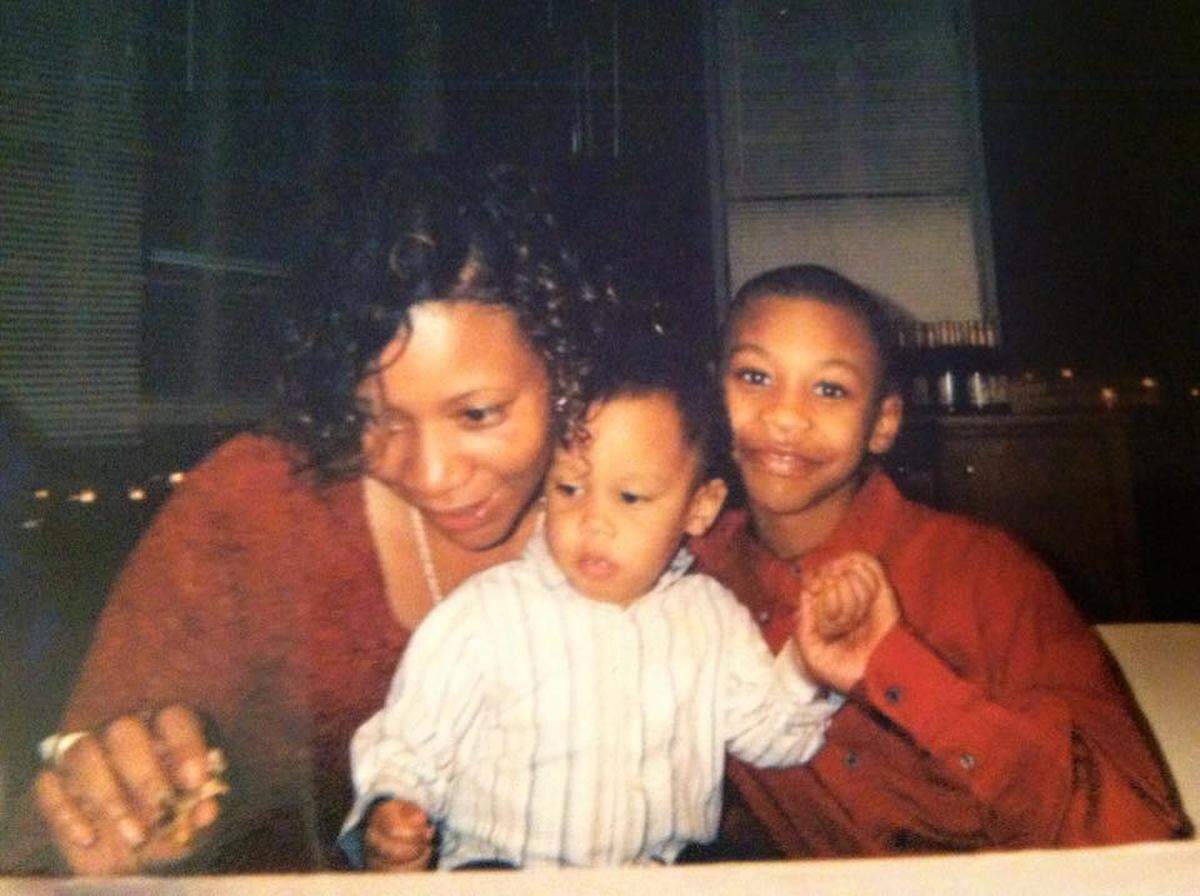
As the baby of the family, Christian was close to his mother, Deirdre. Wherever she was, Christian was, as he often clung tight to her leg.
“He was her pride and joy,” said Shanda Butler, Christian’s aunt and Deirdre’s younger sister, whom Christian affectionately calls “auntie.” “She loved all her kids, but that was the one with her all the time.”
His father, Curtis, who is a basketball coach, put him in basketball.
And when Christian played basketball, Deirdre tried to be at every game. She’d sit in the stands and cheer for him.
“That’s my boy!” she’d yell from the crowd.
Or if he wasn’t doing what he was supposed to do, she’d let him know that, too.
“She’d say, ‘You’ve got to play defense, or ‘stop fouling,’” Keeling recalled. “Or, ‘stop turning the ball over. Coach get him out! He’s playing horrible!’”
She always kept it real, Keeling said. That was who she was. She was sweet, but tough. She took her children to church and wanted the best for them.
So Deirdre, a nurse, sometimes worked three jobs, just to make sure her children were stable.
Deirdre’s dream was for her children to go to college and get an education. So she didn’t mind that Christian played basketball. But his grades had to be in good shape or he couldn’t play. That was the rule.
He played high school basketball at Laney High School.
Buck Harris, his high school coach for three years, said the first time he met Keeling was when he was in eighth grade. Harris was watching Keeling’s middle school basketball game.
As Keeling came off the court at halftime, he spotted Harris and stopped.
“You’re the coach at Laney, right?” Christian asked.
“Yes,” Harris replied.
“I’ll see you next year,” Christian said in a confident tone. Then he ran off.
Harris was impressed.
“That was the first time that had ever happened,” Harris said. “I said, wow, that kid got a lot of moxy.”
‘Mom, are you good?’
Christian’s mom was diagnosed with cancer in 2014. She had complained that the side of her body had been hurting for some time. So her sister, Butler, encouraged her to go to the doctor.
Deirdre went. She called Christian, who was 15 at the time, to let him know that she had to stay overnight at the hospital because doctors had found a tumor.
It was stage IV stomach cancer. But she kept that detail from her children.
“She didn’t want none of her kids to worry,” Butler said.
Keeling figured that it wasn’t serious. He thought she’d recover and get better. He never expected his mom to die.
“I thought she was invincible,” Keeling said. “I thought she was a super woman. She’s a nurse. She knows how to take care of herself.”
But the cancer was aggressive and she underwent chemotherapy treatments.
The chemo drained Deirdre. She lost weight, had trouble eating and had to take a lot of medicine. She assured Christian that it was part of the process.
But she couldn’t hide how sick she was when she finally decided to cut her hair.
His mother, a Christian woman, as the family describes, was against cutting her hair. But she finally relented when it started to fall out. Keeling said he came home from school one day and saw his mother’s friend shaving her head.
She was sitting in a chair in the middle of the living room. His mother was crying.
“Look Christian, my hair is all gone. My hair is all gone,” she said, trying to make light of the situation. Christian was worried.
“Mom, are you good?” he asked.
She told him that it was part of the chemo and radiation treatments. She assured him that she’d grow it back. The two began to cry.
“It was overwhelming for me at that point,” Keeling recalled. “It was more serious than I thought.”
He told her that when she got better, they’d take a trip together.
But that never happened.
She was gone
The day Christian found out his mother was dying was an ordinary day. He had come home from a week-long AAU trip in Louisville, Kentucky, and saw a number of cars lined up at his house.
This wasn’t normal.
He walked into his aunt’s one-story house and family members and friends immediately started to hug him. They told him how sorry they were. But Christian had no idea what they were upset about.
Then he saw his cousin crying over his mom.
He walked over to see his mother lying in a bed. She didn’t look like his mother.
Her skin was flaky. She was so thin that her skin pulled tightly against her bones. She resembled a skeleton.
“She just looked dead,” Keeling recalled.
The only thing that moved was her eyes. She made noises that no one could understand.
His aunt finally told him what had been going on. His mother actually had stage IV stomach cancer, and she was dying.
Christian got in the bed beside her and comforted his mother. He began to talk to her. He told her how much he loved her, and how much he was going to miss her.
And he made her a promise that he would do everything for her. He’d get his education and take care of the family like she would.
A short time later, Deirdre drew her last breath.
She was gone.
When the funeral directors came to take her body away, it began to rain. They loaded her body in a casket in a limousine and drove away. When they left, the sun came back out.
Christian saw it as a blessing from God.
Keeling said he was initially upset that no one told him that his mother’s cancer was more serious than they had led on. Before he left for his trip, his mother was moving and still talking. She seemed all right. Christian had always believed that his mother would overcome the disease.
But his mother didn’t tell him because knew how much Christian loved her.
“I probably would have spent all my time with her and just have (colleges) understand that my mom is about to pass,” Keeling said. “But she knew what was at stake. She knew I had to have free scholarship because I could not afford it.”
“She sacrificed her life just to make sure I was straight.”
From that point on, everything he did was for his mother. When he was struggling he kept working. When he was having success, he went even harder.
‘Never looked back’
In the first few weeks after his mother’s death, Keeling was still struggling. He missed two weeks of school. Zep Jasper, Keeling’s best friend and high school teammate, said Keeling would have random outbursts.
“I can’t believe it!” he’d scream out. “I can’t believe my mom is gone.” And he’d break down crying.
Zep would try to take his friend to do fun things. He’d tell him, “Basketball is going to be the path. This is how you’re going to make your mom happy.”
Christian believed those words. He used it as motivation on the basketball court and in the classroom.
“Ever since that day, he never looked back,” Jasper said.
Keeling was determined to get better. He worked hard in the offseason. And the following season, his senior year, Keeling increased his scoring average from 11 to 23 points per game.
He finally earned a few Division I scholarship offers, and ultimately chose Charleston Southern because it was a Southern Baptist school and it was close to home.
Meeting Roy Williams
Before transferring to UNC, Keeling spent three seasons at Charleston Southern and graduated a year early.
At Charleston Southern, Keeling was a star player. In three seasons there, he averaged 17.9 points per game, including 18.7 points in his last season, and 6.4 rebounds. He scored more points in three seasons (1,666) than any player in school history.
But Charleston Southern kept missing the NCAA tournament.
And that was Keeling’s goal. So his coach there agreed to help him transfer.
UNC needed some players, too. The Tar Heels were losing their top five scorers from the 2018-19 team, and had missed out on a few recruits.
ESPN ranked Keeling as the No. 7 grad transfer available.
UNC’s staff eventually reached out. Williams had never seen Keeling play, but Charleston Southern coach Barclay Radebaugh assured Williams that he would get a good player.
Efforts to reach Radebaugh were unsuccessful.
Williams first met Keeling around Easter. Williams was in Charleston with his family. He called Keeling to tell him that he would visit him at school.
He pulled up in his yellow jeep with the roof down. Keeling was puzzled. He joked he was looking for an “old man’s car.”
“Yeah, that’s my car,” Williams told him.
The two greeted each other and went inside where they sat and had a two-hour conversation.
“If you have ever visited with him, you’ve got to like the kid,” Williams said. “He’s a guy that walks in and I just drop my head, and he does the same thing. We enjoy each other, we have fun with each other.
“When I see him, 99 times out of 100, I start smiling, and I’m teasing him and he’s teasing me.”
Keeling was impressed and later that month committed to UNC, which was always his dad’s favorite school. When Keeling was small, the two would watch Duke and Carolina games together. Tyler Hansbrough was Keeling’s favorite player.
He announced his commitment on Twitter, four years and two weeks after his mother’s death. He said it was a tribute to her.
Always with him
When Keeling got to UNC, it was an adjustment. The offensive system was different, and the talent level in the ACC was a lot more difficult. He struggled with his shot.
In his first 19 games, he was averaging 4.4 points per game.
“I feel like I’m not contributing to the team,” Keeling told The News & Observer in an interview on Jan. 24 after a game in which he scored 2 points for the fourth consecutive game. “And that kind of hurts me. Especially when you lose.
“You feel like it’s your fault. Maybe if I would have helped score or helped rebound better, we would have won. I feel like I’ve got a role on the team being a rotation guy. I feel like I’ve got to be better.”
He was criticized on social media. And UNC coach Roy Williams was running out of reasons to play him.

Meanwhile, the Tar Heels were struggling. They lost the first five games of the new year, before winning the next two. Then lost seven more.
But Keeling kept pushing. He tried to focus on the small things, like trying to play better defense. He took shots that he was comfortable with, like the long 2.
It worked.
His shooting continued to get better and his confidence grew.
In his last 10 games, he is averaging 11.6 points per game, while shooting 52 percent from the floor. He’s 11-for-22 from behind the 3-point line in that span.
He’s scored more points in his last 10 games than he did in the first 21 games he played.
“To see him do that, to see him having fun, and smiling, it’s great,” Curtis Keeling, his father, said.
UNC won’t make the tournament unless it wins the ACC tournament. However, the Tar Heels have finished the season winning three of their last four games. Keeling has been a big reason for that.
Keeling credits his guardian angel for keeping him focused.
“I can hear her saying stuff through the game, or saying stuff she would say in the game,” Keeling said of his mother. “She’s not physically with me, but she’s always spiritually with me.”
This story was originally published March 6, 2020 at 1:30 PM with the headline "When he was 15 his mother died of stomach cancer. He’s honoring her at UNC basketball."