NCAA boss welcomes Trump panel on college sports: ‘Anything that helps us’
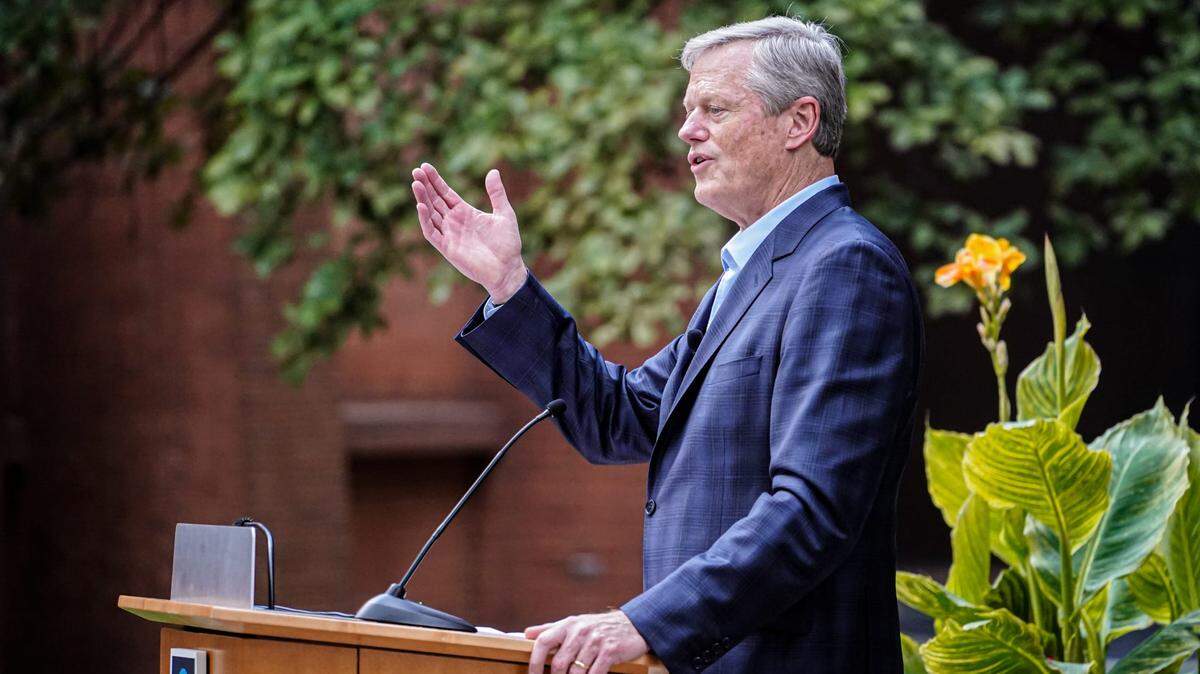
There aren’t many industries eager for unsolicited presidential intervention these days, but with the NCAA still looking for traction in Congress after several years of heavy lobbying, NCAA president Charlie Baker isn’t against it.
Multiple reports have indicated that President Donald Trump is creating a presidential commission on college sports led by former Alabama coach Nick Saban and Texas Tech regent/megabooster Cody Campbell, to look into everything from the transfer portal to Title IX and the employment status of athletes.
Baker, after briefing administrators, athletic directors and coaches on the NCAA’s reorganization plans and the impending House settlement at the ACC’s annual meetings Monday, said he was willing to entertain anything that moved the needle.
“I guess I think the fact that there’s an interest on the executive side on this, I think it speaks to the fact that everybody is paying a lot of attention right now to what’s going on in college sports,” said Baker, the former Republican governor of Massachusetts. “There is a lot going on, that’s not all bad, and I’m up for anything that helps us get somewhere.”
ACC commissioner Jim Phillips, a member of the NCAA’s board of directors, echoed Baker’s belief that presidential intervention could potentially prompt action in Congress.
“It’s coming from the Oval Office,” Phillips said. “When you have alignment with both sides of the aisle with this thing, which we’ve had, a lot of momentum with both parties, a task force that has the chance to solely focus on this when senators are stretched with their priorities and issues that they’re dealing with — a focus group can only help.”
The NCAA is looking for a federal law that supersedes multiple state laws — “Most of which are designed to give special standing to the schools in their states,” Baker said — as well as protections to keep college athletes from being classified as employees and an antitrust exemption that would allow the NCAA to make rules in areas like eligibility that aren’t subject to legal action.
While there’s certainly some debate over how limited or expansive that antitrust exemption would be, if the NCAA is even entitled to one, a completely separate debate, the eligibility issue is one that raises some legitimately awkward questions.
Some courts have ruled that non-Division I seasons, in junior college or elsewhere, shouldn’t count against the NCAA’s four-seasons-in-five-years eligibility clock. Vanderbilt quarterback Diego Pavia, a junior-college transfer, won an injunction in December that effectively granted him an additional year of eligibility — his fourth in Division I — while his case is adjudicated.
That could potentially create a situation where players go from junior college to Division III and arrive in Division I in their early 20s with four years of eligibility, an unintended consequence of the legal battles the NCAA has fought and lost on other fronts.
On Monday, a judge in South Carolina ruled against College of Charleston forward Ante Brzovic, who was seeking an extra year of eligibility after redshirting his first year in Division II, a decision Baker welcomed.
“We’ve won more than we’ve lost, but (the lawsuits) just create such uncertainty for schools, student-athletes, everybody, about how this is all supposed to work,” Baker said.
Whether presidential intervention, either through the proposed commission or an executive order, might push some of that along, Baker said at the Final Four the NCAA was going to need Congressional action in any case.
Speaking of lawsuits, Baker also said he hoped the latest modifications to the House settlement — attempting to answer Federal Judge Claudia Wilken’s concerns over players being cut due to the roster caps imposed as part of the settlement — would allow the case to be concluded so the NCAA could move forward.
“For the most part the proposal we made pretty much takes us back to the status quo before, which I think is pretty consistent with the language the judge used in her order,” Baker said.
As for whether Trump’s involvement could help spring something loose on Capitol Hill, where a bipartisan group of senators has been mulling legislation that would push some of the NCAA’s goals for more than two years, Baker was open to the possibility.
“I don’t have a crystal ball on that one, I don’t know,” Baker said. “I do think it’s quite clear at this point that a lot of people who are interested in college sports and we do need some help at some point to create some clarity out of some of these issues in Washington. Creating clarity one lawsuit at a time is just a really bad way to try to move forward.”
He’s right about that much, but that’s the poisonous fruit of an NCAA legal strategy going back 20 years, predating Baker, that fought any moderation of its strict code of self-proclaimed amateurism until athletes broke through in legislatures and courts. The giant mess everyone is complaining about, from sports bars to the Oval Office, all stems from that. It’s not easily unwound.
Never miss a Luke DeCock column. Sign up at www.newsobserver.com/newsletters to have them delivered directly to your email inbox as soon as they post.
Luke DeCock’s Latest: Never miss a column on the Canes, ACC or other Triangle sports
This story was originally published May 12, 2025 at 5:40 PM with the headline "NCAA boss welcomes Trump panel on college sports: ‘Anything that helps us’."