
Justine Lindsay explains how she made NFL cheerleading history: ‘This is meant to be’
Justine Lindsay didn’t know how, exactly, the world was going to react to the announcement on her personal Instagram account at the end of March that she’d made the Carolina Panthers TopCats cheerleading squad — and that oh, by the way, she’s a transgender woman.
No one made a very big deal out of it, though. At all.
Not until more than nine weeks after the fact, when BuzzFeed decided to drop a story just before 10 o’clock on the first Saturday night in June with Lindsay’s name in a headline heralding her as “The NFL’s First Openly Trans Cheerleader.”
Call it a delayed viral reaction. The Instagram post that had struggled to get to 500 likes in two months neared 5,000 within just two days, and by the middle of the following week, the news about the Haitian-born and (mostly) Charlotte-raised 29-year-old had spread all the way around the world.
“I didn’t think it was gonna get this much attention,” Lindsay (pronounced “Lin-ZAY”) told The Charlotte Observer while sitting in a suite at Bank of America Stadium last Friday, on an afternoon that saw Panthers PR folks shepherding her through a series of interviews. “It went all the way out to Honolulu, Germany, Australia — everywhere. People are excited to see that I’m in my prime and I’m doing what I love to do. ... I’m glad I made the decision.”
But while the BuzzFeed article did a fair job of explaining what making the TopCats as a trans woman meant to her, it didn’t do much beyond that.
Here, then, is a more-detailed look at Justine Lindsay’s path — which has included having a famous mentor as a child, going through an identity crisis unrelated to gender in her teens, and creating a bold audition video for the TopCats in her 20s — on her way to making NFL cheerleading history this past spring.
‘I was just dancing every single day’
Lindsay’s parents emigrated from Haiti when she was very young, with the family settling in Charlotte and she and her older sister and older brother being enrolled at Bruns Avenue Elementary School on the northwestern edge of uptown.
She first got interested in dance as an elementary-schooler, and wound up training in ballet, modern dance and other styles at the former North Carolina Dance Theatre (now called Charlotte Ballet). Before long, she says, “I was just dancing every single day of my entire life. From sun-up to sundown.”
Her childhood dream was to dance professionally with a company like Alvin Ailey American Dance Theater, or American Ballet Theatre.
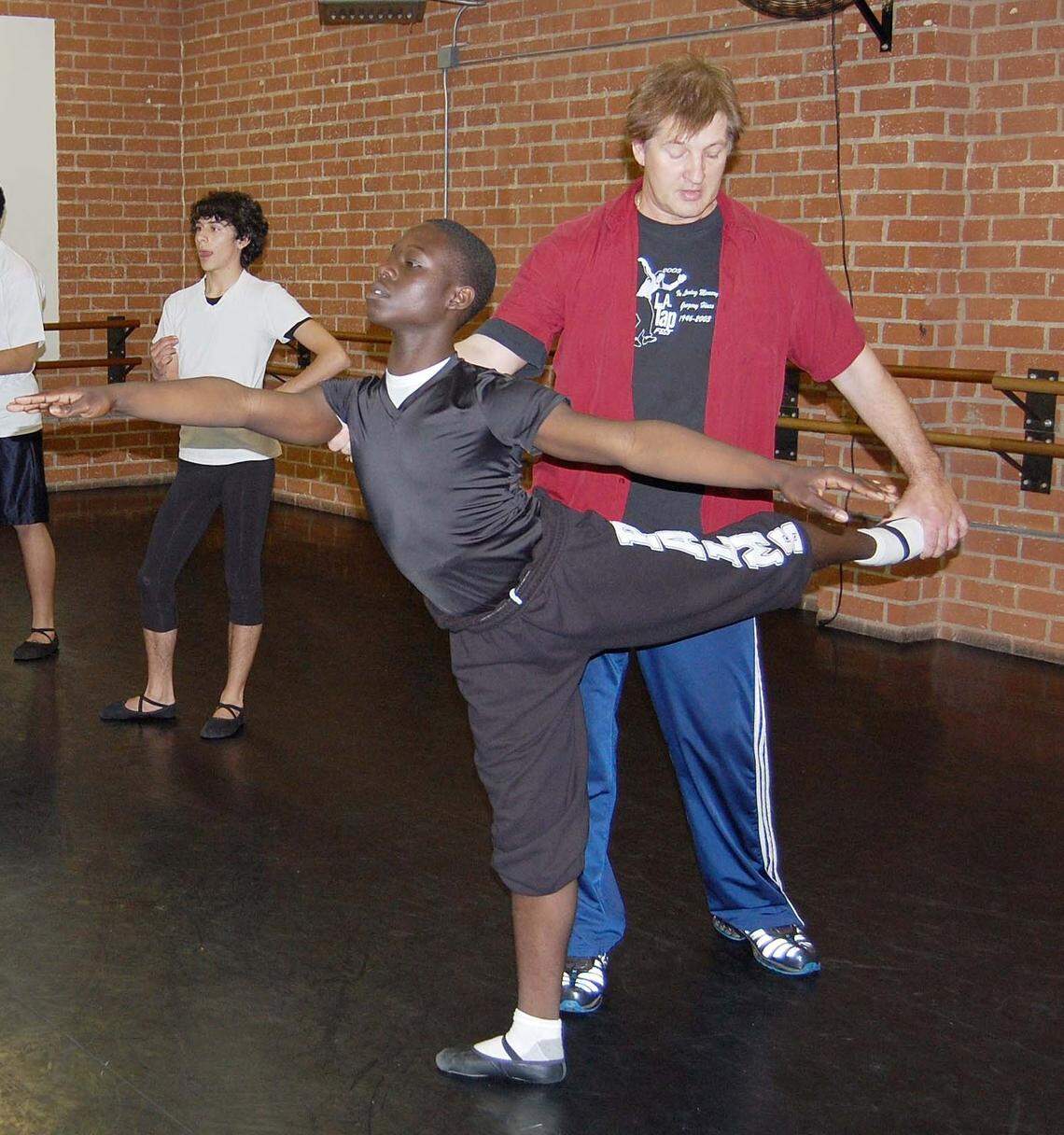
Lindsay caught the attention of famed director and choreographer Debbie Allen while attending a workshop for youth dancers in Chester, South Carolina. Lindsay says Allen saw potential in Lindsay, and — long story short — at about age 10 Lindsay left Charlotte to live in Los Angeles with a host mom so she could train at the Debbie Allen Dance Academy.
“When she saw me (in South Carolina) I was not the best dancer at all,” Lindsay recalls, “but once I got under her direction and trained with her, she was like, ‘Oh my gosh, you’re really good. I’m proud of the person you’re becoming.’”
‘I love you. I support you, regardless.’
Lindsay says she was “very, very young” when she started identifying as female. Though she kept it to herself till she was older, she says “my family knew very, very early on that I was different. They didn’t call it different. They would just say I was ‘their special child.’ ... They knew, and just let me just be who I was.”
While at Palms Middle School and Alexander Hamilton High School in L.A., she says, she considered herself “geeky” — but mainly in the sense that she cared deeply about good grades. Socially, Lindsay says, she “was amongst the popular crowd.” She wasn’t bullied or picked on.
The identity crisis she had as a teenager didn’t revolve around gender. No, what she was struggling with, more generally, was her place in the world. Though she was friends with the popular kids, she didn’t really feel like she fit in the popular crowd. “I just kind of felt like I was an outsider.” That feeling led to anxiety and depression. And although dancing gave her solace, happiness, and a clearer sense of belonging, Lindsay didn’t like that it seemed to be the only thing that defined her.
After finishing ninth grade — feeling pulled to reduce her involvement in dance so she could focus on her education — she returned to Charlotte, and would go on to graduate from the former Vance High School (now Julius L. Chambers High School).
Her parents divorced after moving to the U.S., and her mother spent a couple years as a single mom before remarrying. When she finally sat them each down and told them she was transgender, her mother didn’t make a big deal out of it. And although her father “wasn’t the biggest fan,” she says, “I think once he saw my confidence show ... he eventually came around and was like, ‘Listen, I love you. I support you, regardless.’ And now he’s like my security guard ... just always making sure I’m OK.”
‘Are you nervous that you might get a no?’
Lindsay remembers attending a Panthers game as a little girl back in the ’90s, seeing an early iteration of the TopCats perform, and wanting to be one. “I came to a game with my brother and sister, and I think my mom,” she says, “and I just remember seeing them all dolled up with the glitz and the glam. I was just like, ‘They’re pretty, and they can dance. They’re doing exactly what I want to do.’ I just needed to find the right time to do it.”
Lindsay’s introduction to actually being a cheerleader came much, much later. She did just a little cheering in high school, and passed on joining both the cheer and dance teams while pursuing a degree in communications at NC State. It wasn’t until she was in her 20s, upon enrolling at Johnson C. Smith University and joining the Golden Bullettes, that Lindsay learned she could love dancing in support of a sports team.
Her coach at JCSU was Janel Joyner, a former cheerleader for the old Charlotte Bobcats. Says Lindsay: “She just automatically saw how talented I was, and she was like, ‘You got something here. I’m gonna help you continue your training, and then we can start to seek out some different teams if that’s something you’re interested in.’”
After graduating from college, Lindsay would eventually go on to a regular job, working in a telemarketing job for Spectrum Business here in Charlotte. She continued dancing, just enough to stay sharp, and occasionally thought about trying out as an NBA or NFL cheerleader — just never very seriously. But at some point in the past year, she signed up to receive email alerts about TopCats tryouts; and after the notification arrived in her inbox, she decided she’d submit a video audition.
In the video, she said right up front: “Yes, I am trans.” She had no idea if the TopCats (or any other pro sports team, for that matter) had ever had a trans dancer, but “I just wanted to just let them know ahead of time. I just feel like it’s the right thing to do, in any job setting.”
She also had no idea how they’d react to her telling them that. “I was a little bit anxious,” Lindsay says. “My mom even questioned it. She was like, ‘Are you nervous that you might get a no (because of it)? They may not pick you.’ And I was like, ‘You know what? It’s OK if they don’t. Because every year after that, they’re gonna see my face. Until I’m just too old to even walk.”
Within a day after submitting, Lindsay was invited to audition in person, along with 180 hopefuls, in the semifinals. Then she advanced to the finals, which took place on the field at the stadium in front of a 20-person panel. “I was nervous,” she says, “... to be in front of them and dancing my heart out in this hot heat. ... But I left the finals (feeling) like, ‘Hey, I did my thing.’”
‘I am opening the door for many to come’
Lindsay got the call that she made the team while she was pulling her car into a parking lot at — fittingly, in her eyes — a church. “From then,” Lindsay says, “I felt like, OK ... this is meant to be. Because I’m very spiritual. I think God does not make mistakes, whatsoever. And I felt like this was the right timing. ... He doesn’t hand you blessings if you can’t handle them.”
She says TopCats director Chandalae Lanouette told her that “she saw me as a dancer. She didn’t see me as being trans.”
Other than Lanouette and others who viewed her audition video, “no one on the team knew that I was trans,” Lindsay says, “(not) even the girls that was on the team who I made like a close connection with.” Not until she made that Instagram post — the point of which was to “just let other people — other trans girls and guys — know, ‘Hey, if you have a dream, go for it. Don’t limit yourself, or don’t feel like you don’t have a chance. If you just go out for it, and it’s something that you love to do — whether it’s being a doctor, a lawyer, congresswoman, congressman — whatever you want to do, just go for it. ... Of course you’re gonna probably hear a lot of no’s, but it’s OK. Just keep your head up and just keep going.’”
There were certainly some ugly, hateful comments. They’re on her Instagram posts, and they’re on the dozens of stories written about her historic achievement. “Which I knew I was gonna get,” she says. “But I was like, You know what? It doesn’t even matter no more, ’cause I made the team. I’ve earned it, just like every other TopCat that’s on the team with me.”
Lindsay says she reads the negative stuff, but hasn’t responded to any of it. “I know my worth,” she says. “I know my truth, and I’d rather be myself and be truthful to who I am than to hide behind a phone or a keyboard, and just typing away just to make someone else feel bad because they’re living in their truth.”
And her truth, she says, is this: “It’s much bigger than just me being a cheerleader for the NFL. I’m opening the door for many to come — for ones who are casted out because they are living in their truth. So I want be able to voice that, and let people know, ‘Hey, we’re not going anywhere.
“We’re here to stay. So either you take it or leave it.’”
This story was originally published June 28, 2022 at 6:00 AM with the headline "Justine Lindsay explains how she made NFL cheerleading history: ‘This is meant to be’."
