Yes, the NC teacher march is disruptive. That’s kind of the point | Opinion
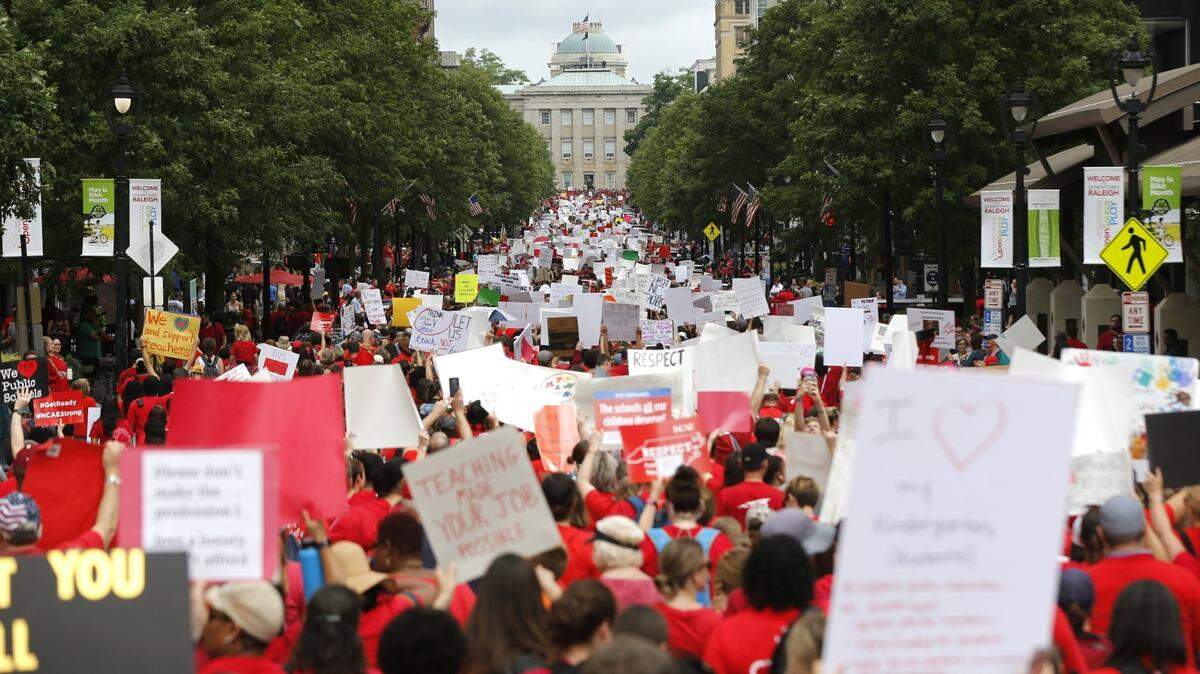
This Friday, North Carolina teachers will march in downtown Raleigh to demand higher pay and more funding for public schools. Thousands of teachers are expected to participate, which has prompted nearly 20 school districts across the state to close.
It’s not convenient, and it’s unfortunate that parents will have to bear some of that burden by making alternative arrangements for their children.
But the inconvenience is the point.
The conditions that teachers are protesting are nothing short of a crisis. North Carolina is one of the worst states in the entire nation for teacher pay. Teachers are moving to other states or leaving the profession altogether. Many of the ones who stay don’t earn a living wage and struggle to make ends meet. On top of that, public schools are sorely underfunded, forcing educators to do more with less.
GOP leaders, however, deny it’s an issue at all. House Speaker Destin Hall said the NCAE cares more about “left wing political interests” than pay raises and doesn’t think they’ll “move the needle.” Instead, he encouraged teachers to “call their [state] senator and tell them to approve the House budget,” as if they haven’t tried that already.
Meanwhile, Senate leader Phil Berger acknowledged the need to increase teacher pay and education funding but insisted that Republicans have been doing that for the past 15 years. In reality, the nominal raises given to teachers over the years haven’t lifted North Carolina from the bottom of the barrel on teacher pay. In 2011, when Republicans took control of the legislature, teacher salaries had been frozen for two years prior due to the financial crisis, and North Carolina’s spot in the national rankings had plummeted. That did improve some under Republican leadership — peaking at 30th in the country in 2020, after similar marches in 2018 and 2019 — but we’re back to being one of the worst again.
In reality, teacher pay hasn’t even kept up with the cost of living. The average teacher salary was $46,514 in 2011, which is equivalent to about $68,733 today after adjusting for inflation. But the actual average teacher salary today is only $59,971, which makes it a nearly 13% pay cut.
Yet North Carolina Republicans have failed to pass a state budget for nearly a year, which has left teacher salaries frozen and school districts uncertain about funding. The House and Senate can’t seem to agree whether to slash income taxes further, which would primarily benefit the wealthy, or pay teachers more. House Republicans, to their credit, have proposed a significant increase in starting teacher salaries and the restoration of master’s pay, though veteran teachers would see little benefit. But the Senate thinks negligible raises and keeping starting teacher pay around $41,000 is perfectly fine.
Obviously, teachers have tried to address the issue in less disruptive ways. There are countless advocacy groups that lobby for higher public school funding. They’ve called and emailed lawmakers and shared their stories with the media. They’ve run for public office themselves. None of that has meaningfully changed the situation they find themselves in, and the state’s ban on collective bargaining by public sector employees gives them very little power.
Nobody is glad to see it come to a point where teachers feel their only recourse is to call out of work and protest. But the fuss about how teachers are choosing to advocate for themselves is a distraction from why they are doing it in the first place. Apparently, one single day of protest is more outrageous than the years of government failure and neglect that got us here.
The expectation seems to be that teachers should ask more nicely, or, better yet, just not complain at all. Some have criticized the organizers for caring more about politics and power than schools and students. The North Carolina Republican Party called it a “stunt.” Sure, this is about politics, at least to the extent that budgets are political documents, and education has sadly become a political issue. But it’s insulting to the thousands of teachers who will march on Friday to suggest that their primary goal isn’t to demand better for themselves and their students. There’s always room to disagree with their methods, but that doesn’t mean there’s anything nefarious about them.
Protests should always be peaceful, but that doesn’t mean they have to be without disruption. Sometimes, being disruptive is the only way to capture people’s attention and affect real change. Our nation’s history is proof of that. If teachers are so important that students and parents will suffer from a day without them, then perhaps the way we treat them should reflect that.
Deputy Opinion Editor Paige Masten is covering politics and the 2026 elections for The Charlotte Observer and The News & Observer.
This story was originally published May 1, 2026 at 5:00 AM with the headline "Yes, the NC teacher march is disruptive. That’s kind of the point | Opinion."