
I thought I was prepared as an ICE watcher in NC. Then Minnesota happened | Opinion
Editor’s note: This op-ed is adapted from an essay that appeared on Down from DC, a Substack that addresses how the decisions made in Washington affect North Carolinians:
In the weeks after Renee Nicole Good was shot to death in Minneapolis by an Immigration and Customs Enforcement officer, I pored over videos from that scene, and I’m now doing the same with the videos of Alex Pretti being shot to death this weekend.
I’m still processing the horror of it all, trying to understand how it unfolded. I’ve spent these weeks wondering what I would have done in Good’s place and now in Pretti’s.
Like hundreds of other North Carolinians this year, I’ve volunteered through the immigration rights organization Siembra NC to serve as an observer at immigration enforcement raids. At one of their training sessions, I practiced how to politely question officers, film their actions at a safe distance, blow a whistle and say “la migra está aquí” to warn people in the neighborhood.
My phone is set to notify me of any reports to Siembra’s regional text message network. If I get an alert, I am ready to drop what I’m doing, grab my phone and head to the scene to meet other volunteers. And thanks to the training, I feel prepared for what I’ll find when I get there. Or at least I did until these recent fatal shootings. Patrols by heavily armed agents continue across Minneapolis and Saint Paul, seemingly now bringing the city to a tipping point. As the fallout from Pretti’s killing roils the nation, my mind still wanders back to Good.
There she is in her maroon Honda Pilot, snow-covered streets and neat houses in the background. She is unruffled in the clearest shot in the footage, which then becomes a blur of confusion as officers and her wife yell outside the car. Good backs up, then moves forward, turning the steering wheel away from the officer at her passenger side. Then shots and a crash. Onlookers cry out.
I wonder if I would be calm, as she seemed in videos, in an encounter with an armed agent. Am I opening myself up to a federal criminal investigation – or worse, physical harm? And whose narrative would prevail about me and my intentions?
I trained to be an observer in November, and a few weeks later, hosted some friends for a training session at my home. I walked them through the training slides provided by Siembra, which emphasize our First Amendment rights to photograph what law enforcement is up to without interfering or putting ourselves in danger. “There’s a chance we might get arrested,” I said at one point, which led to a round of jokes about the discomfort of hard benches, sore backs and the other inconveniences of aging we imagined we’d face in a jail cell.
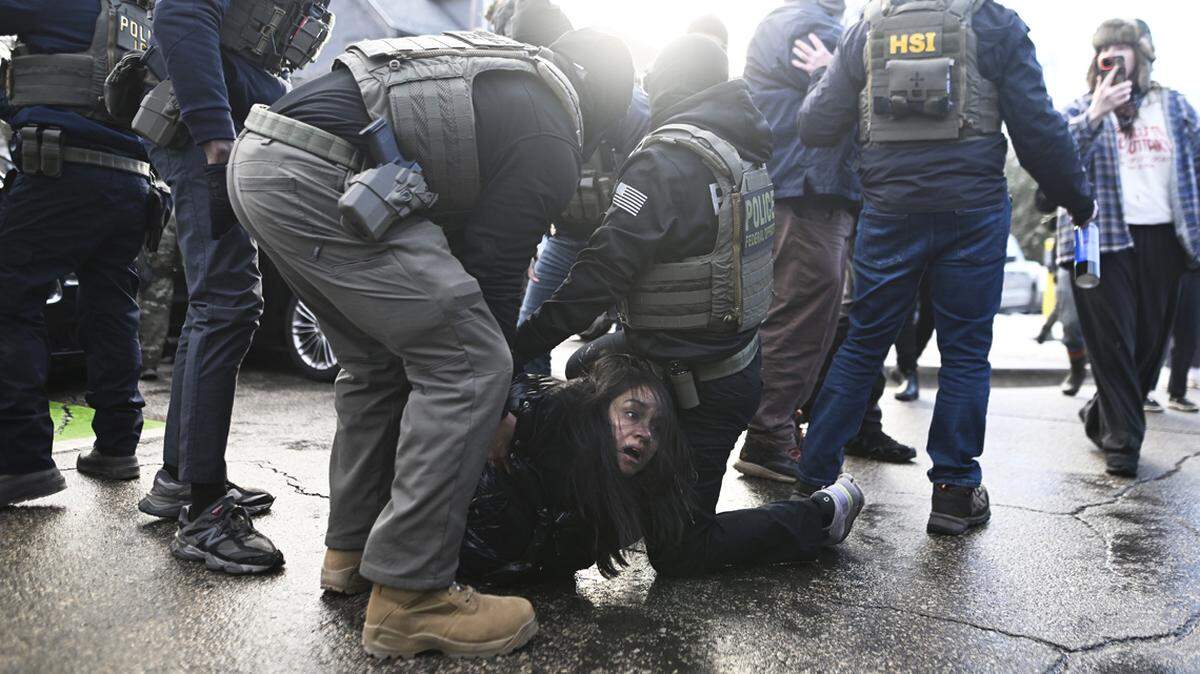
Immediately following Good’s death, President Trump, Vice President J.D. Vance, Secretary of Homeland Security Kristi Noem and a slew of commentators and influencers said that the officer fired at her in self-defense – that Good was a radical “domestic terrorist,” and her car a lethal weapon she intended to use on him. This gaslighting replayed over the weekend, with senior federal officials contradicting what the rest of us could see with our own eyes in videos of Pretti pinned, face down on the ground when an officer shot him in the back. Like Good, he was immediately labeled the aggressor, a “would-be assassin.”
Thousands of Minnesotans and their elected officials refuse to be cowed by this violence. It was comforting to me to join a vigil in honor of Good’s life in Greensboro earlier this month. The attendees, hundreds of them, didn’t buy attempts by those officials to label her a terrorist and distort what we can see from several angles on video with our own eyes.
After all my time scouring the videos I still have questions, like exactly what led up to her shooting. But other things about the encounter are clear: Good was turning her car away from the officer, Jonathan Ross, and I can discern no clear intent to harm him. There is, however, an unsettling menace in the male voice in the video Ross himself took. “F-----g bitch,” the voice mutters, just after Ross shot her.
I read several remembrances and profiles of Good this month. She was 37, a mother of three, including a 6-year-old son, a gifted writer and a Christian. In the photos that accompanied those pieces, her smile is radiant.
I imagine Good’s training was similar to mine before she arrived on that snowy street to warn people about ICE. Her wife wears an orange whistle in some of the footage. As officers surrounded the car, Good’s voice was even, her expression calm and questioning. “That’s fine dude, I’m not mad at you,” Good told Ross as he approached her window, seconds before he shot her.
In a statement released to news organizations shortly after Good’s death, her wife, Becca Good, summed up the catastrophic day. “On Wednesday, January 7th, we stopped to support our neighbors,” she wrote. “We had whistles. They had guns.”
The Department of Justice is now investigating Becca Good for association with local activist groups, which some federal officials equate with domestic terrorist organizations. That phrase has been redefined by Attorney General Pam Bondi to include activities I and others think of as protest, a hallmark of what it means to be an American.
There haven’t been any large-scale raids here in Winston-Salem, where I live, like the ones in Charlotte and Raleigh back in November. So far, I have been out on only two calls, both false alarms.
That’s not to say volunteers here aren’t doing anything: they are debunking the false information that tends to run rampant when people are afraid, as many immigrants are now. Many are keeping their children home from school, missing work, putting off doctor visits, skipping church.
I’ve also been reading with apprehension about the growing danger to protesters in Minnesota. The Pentagon has ordered 1,500 soldiers to be ready for deployment there. The Department of Justice has arrested protesters who disrupted a church service. And the president continues to rant against the ordinary people resisting ICE, calling them “agitators and insurrectionists” and “troublemakers who should be thrown in jail, or thrown out of the Country.”
These words don’t describe the volunteers I’ve come to know, including a funeral home worker who showed me how to use the text messaging system, a college student who is buying groceries for her neighbors and a retired police officer from Long Island named William Herrera.
Herrera told me this week that he decided to volunteer with the local ICE watch group after federal agents broke the window on his cousin’s car in New York, arrested him, and shipped him in shackles to detention facilities out west, where he was just released. He said his cousin is a law-abiding immigrant from El Salvador whose application for legal residency is under review.
“They’re labeling people as criminals just because of their legal status,” Herrera told me. “That’s a violation, not a crime, and to be treated like a criminal, that’s where I have a problem and draw the line. I can’t stand by and watch that happening and not do anything about it.”
The trainees in my living room the week before Christmas were ready to join those volunteer ranks. Some of them knew immigrants who were now living in fear. Others were angry that most of those swept up in raids have no record of violent crimes, even though the president insists he is going after the worst of the worst.
We tossed around lofty words like “decency” and “patriotism” and discussed how we hoped not to be among the historical examples of good people who did nothing in the face of tyranny until it was too late. And we devolved into jokes about spending retirement in jail.
I joined in the laughter. Having rushed to dozens of accident and crime scenes in my early years in journalism, the idea of checking out reports of potential ICE activity hardly felt dangerous to me.
But my husband broke in, dampening that moment of levity.
“There’s a risk,” he said. “Remember, they’re armed.”
At the time, a brief stint in the county jail seemed the most likely risk. Now, everyone is taking the risk as seriously as he did.
Phoebe Zerwick is the co-author of Down from DC, the author of “Beyond Innocence: The Life Sentence of Darryl Hunt,” and the former director of the Journalism Program at Wake Forest University.
This story was originally published January 27, 2026 at 6:35 AM with the headline "I thought I was prepared as an ICE watcher in NC. Then Minnesota happened | Opinion."