
Small protests against Israel’s war in Gaza feel hopeless and hopeful | Opinion
The International Association of Genocide Scholars is the latest group to say that the Israeli government is committing genocide in Gaza. Each time such a finding is made, it shocks the conscience because Israel was birthed in the shadow of one of the 20th century’s worst evils.
The scholars’ three-page resolution, dated Sunday, offered numerous reasons, including:
“that the actions of the Israeli government against Palestinians have included torture, arbitrary detention, and sexual and reproductive violence; deliberate attacks on medical professionals, humanitarian aid workers and journalists; and the deliberate deprivation;” of food, water, medicine, and electricity essential to the survival of the population;
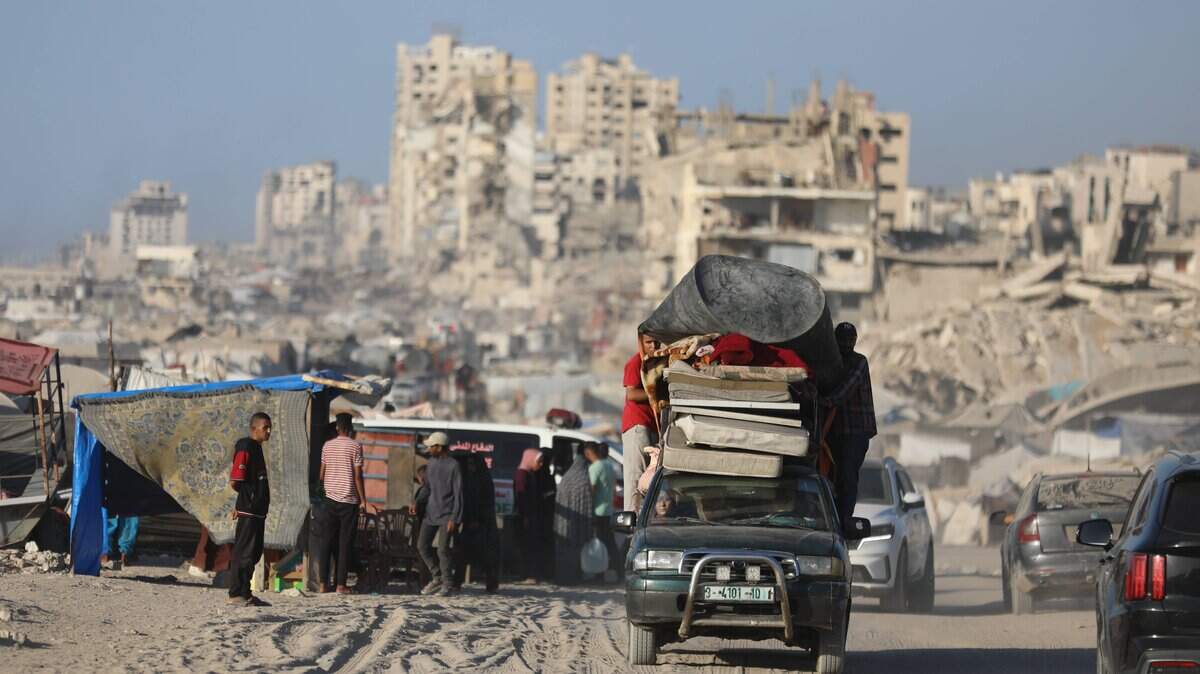
“that Israel has forcibly displaced nearly all of the 2.3 million Palestinians in the Gaza Strip multiple times, and demolished more than 90% of the housing infrastructure in the territory;” and
“that the consequences of these crimes have included destroying entire families and multiple generations of Palestinians.”
Though Amnesty International, a United Nations special committee and other organizations have said Israel is committing genocide in Gaza, the new declaration carries weight because it’s from an organization that warned the world 20 years ago about the genocidal intentions of Iran against Israel.
At the time, the scholars expressed “profound alarm at openly aggressive statements made by the President of Iran, Mahmoud Ahmadinejad, calling for Israel to be ‘wiped off the map’ and inciting students to scream ‘death to Israel’ at a government-sponsored conference.”
The group also wrote then that, “President Ahmadinejad publicly denied the Holocaust and declared it a ‘myth’ created by Europeans to justify creation of a Jewish state in the heart of the Islamic world. Direct and public expression of genocidal intent by a national leader coupled with a clear and present danger that genocidal acts will be committed is incitement to genocide. The risk of genocide against Israel is not yet imminent, but once Iran has nuclear weapons, it will be.”
There is some debate within the group about the designation, though 86% of those who voted were in favor of the resolution. In accusing Israel of atrocities and crimes against humanities on a large scale, genocide scholars add the nation to an inglorious list that includes the Islamic State group, China, President Basher al-Assad’s Syrian government and the governments of Sudan and Zimbabwe.
Israel is accused of using food as a weapon in Gaza, just as Zimbabwe was accused in 2005.
Israel’s inclusion is more sobering than the rest, not because it’s supposed to be perfect in ways no nation can or ever has been without sin, but because it’s a nation that knows the horrors of genocide like no other.
It had a right to defend itself against countless threats in the region and in the aftermath of the Oct. 7, 2023, terror attack by Hamas. But it also had an obligation — like every democratic nation believing itself to be good — to not become the monsters it was trying to defeat.
On that front, Israel has failed, and the United States has been its biggest enabler. Scores of protesting college students were willing to say this last year, long before a renowned group of genocide scholars and humanitarian outfits acknowledged that painful truth.
Fear is not a justification for Israel’s actions, nor does it justify Americans’ complicity in the form of U.S. tax dollars, which are the primary source of the weapons Israel continues using to kill innocent Palestinians long after the Israeli government defeated Hamas militarily.
A relatively small but growing number of Israeli reservists — cited as “365 and counting” — are speaking out against their country’s actions. And yet it seems Israel’s far-right government is impervious to criticism, which is why watching small protests like one recently held at the corner of Concord and Main in downtown Davidson, North Carolina, felt both hopeless and hopeful.
I saw young people and old people, many of whom had driven from as far away as Charleston to take part in the event. Some carried angry signs. Others carried provocative blood-stained pillows shaped in the image of Palestinian children killed by Israel’s relentless bombing.
It was a far cry from the large protests that erupted on college campuses around the country in 2024. But it was a cry nonetheless, a sign that people here are still speaking out.
Issac J. Bailey is a McClatchy opinion writer in North Carolina and South Carolina.
This story was originally published September 4, 2025 at 5:00 AM with the headline "Small protests against Israel’s war in Gaza feel hopeless and hopeful | Opinion."