
In NC, university leaders need to join the fight against Trump’s attack on higher education | Opinion
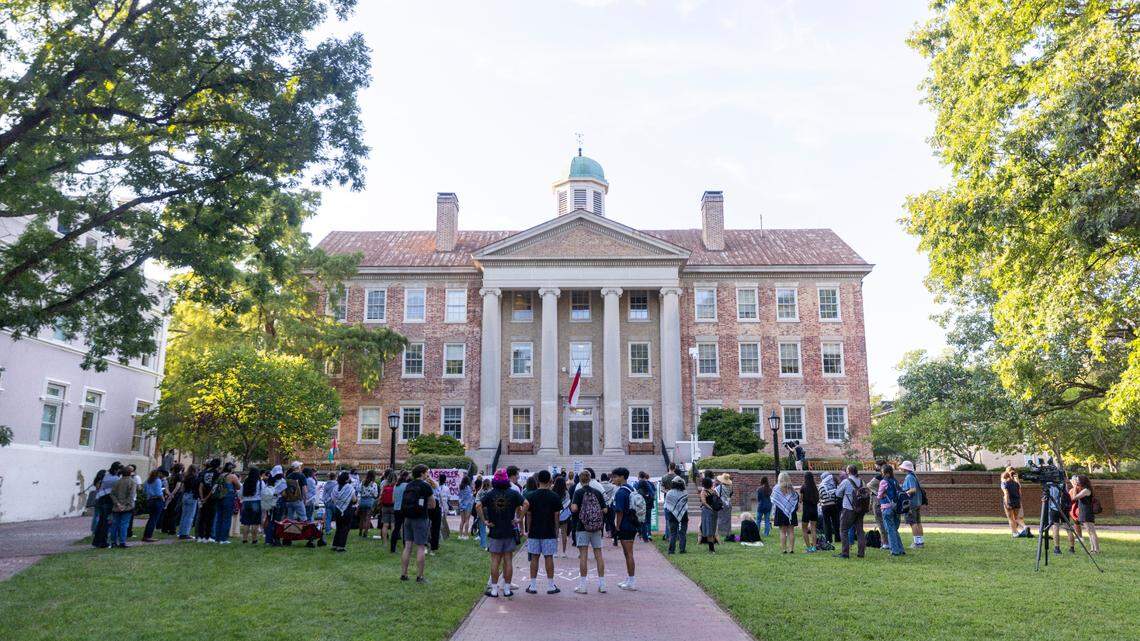
Walter Robinson, an N.C. state University professor, thinks the proper response to President Trump’s assault on higher education should go like this: If bulldozers were lined up and prepared to rip through campus, the chancellor would rush out and yell – “Stop!”
Metaphorical bulldozers are currently ripping through the nation’s universities as the Trump administration revokes international students’ visas, cuts off research grants and threatens students who protested Israel’s war on Gaza. Yet university leaders across North Carolina and the nation have been largely silent.
“We’ve been told many times that we are an industry. Well, leaders of industry speak up when they’re being threatened,” said Robinson, a professor of marine, earth and atmospheric sciences and the incoming leader of N.C. State’s Faculty Senate.
Robinson is especially miffed by the university leaders’ lack of defense of international students. He said, “They’ve been completely silent and I don’t understand that silence.”
What Robinson really means is that he can’t accept that silence. Understanding it is actually easy. Some university leaders may think that resistance will only invite more pressure. Better to be quiet and hope the Trump administration focuses elsewhere.
The incentive not to resist is doubled for schools within the UNC System. They rely on funding from a Republican-controlled legislature that shares Trump’s desire to restrict schools they see as progressive indoctrination centers. For good measure, UNC campus administrators are required by a 2023 law to remain neutral “on the political controversies of the day.”
Public universities have few options, said Robert Kelchen, a professor at the University of Tennessee, Knoxville, who studies educational leadership.
“It’s clear that the Trump administration is trying to get higher education — especially elite universities — to bend to its will. And the challenge is how to respond,” he said. “For public universities, they don’t really have a choice of how to respond, especially in a state that has a Republican majority. They have to find a way to go along with the administration.”
But going along will not spare deep damage, Kelchen said.
“Even if it’s a temporary blip over a couple of years, it will likely take decades to rebuild the infrastructure of higher education just in terms of the people who are leaving the industry and the research that’s getting paused,” he said.
But now the assault on higher education is at a point where even cautious leaders in North Carolina’s public and private universities should take a public and common stand.
Harvard has shown the way by defying the Trump administration’s efforts to intimidate international students and dictate what is taught and researched. That should be the spark for general revolt by all universities that are worthy of being called one.
Jeffrey Sachs, an Acadia University professor who studies authoritarianism and threats to free speech, put the situation in perspective in a recent New Republic podcast.
“The way that the Trump administration has gone after Harvard — and higher ed in general — doesn’t really have any precedent in U.S. history that I know about,” Sachs said. “The energy, the focus, and frankly, the resourcefulness with which the administration is targeting these institutions is deeply alarming.”
Belle Boggs, an N.C. State English professor, is president of the North Carolina chapter of the American Association of University Professors (AAUP). She thinks higher education is facing an “all hands on deck moment. We all have responsibilities to speak out.”
Those who can speak loudest, Boggs said, are university leaders. “We want them to say their first responsibility is to protect the rights of their students and their faculty,” she said.
In a statement published in N.C. State’s student newspaper, the Technician, the AAUP said: “At a moment when the future of higher education and free speech are in peril, universities have obligations beyond doing no harm. If the university fails to protect all students and scholars, it jeopardizes the safety and academic freedom of all students and scholars.”
While they wait for university leaders to act, faculty and students are taking action on their own. Students staged protests Thursday at some 150 colleges and universities, including Duke, as part of a National Day of Action to defend higher education.
Boggs said Harvard’s resistance and campus demonstrations encourage her and others, too.
“One of the things we learn when we get involved in solidarity movements is that there are a lot of people out there who feel the same way and feel empowered when they see others standing up,” she said. “That’s why we want to hear from our leaders that our international scholars and students deserve protection. That doesn’t mean the fight is won. It means that someone in a position of higher power has your back.”
This story was originally published April 20, 2025 at 4:30 AM with the headline "In NC, university leaders need to join the fight against Trump’s attack on higher education | Opinion."