
NC Supreme Court’s ruling in Griffin case has some big, glaring problems | Opinion
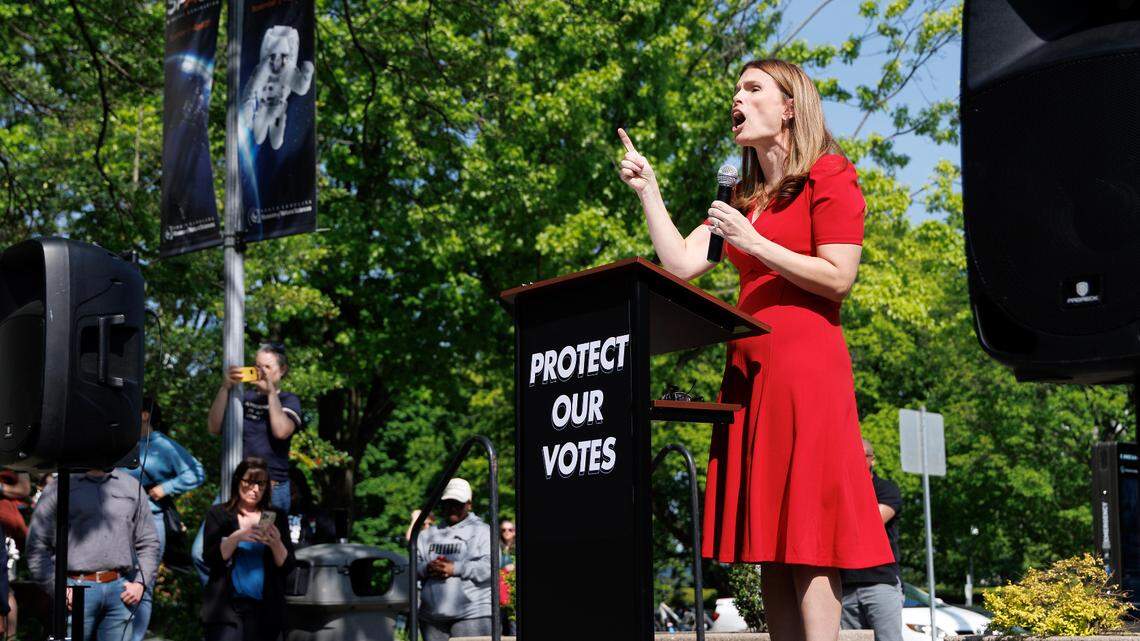
If you weren’t paying close enough attention, you might think that the North Carolina Supreme Court just did a good thing. In a ruling issued Friday, the court rejected a request to nullify around 60,000 votes in a race for one of its own seats, overturning a disastrous ruling made by an appeals court the week prior.
But take a second look, and you’ll realize that the ruling still might throw out enough votes to overturn the election results.
In the ruling, the court denied Republican candidate Jefferson Griffin’s request to throw out tens of thousands of votes over an administrative error. But it granted his request to potentially invalidate thousands of other votes that Griffin challenged for different reasons. That alone could be enough to overturn the victory of the Democratic candidate, incumbent Justice Allison Riggs, who won by 734 votes.
The most egregious of those decisions involves several hundred votes cast by “never residents,” a term used to refer to voters who have ties to North Carolina through their parents, but have never lived in the state themselves. The ruling agreed those ballots could be thrown out entirely, without giving voters an opportunity to correct them.
There’s just one big, glaring problem. According to reporting from freelance journalist Bryan Anderson, some of those “never residents” are, in fact, residents of North Carolina. At least 29 people were wrongly labeled “never residents,” further reporting found. Included in the list is a college professor who has owned a home in Guilford County for more than 20 years, and a Jackson County voter who played high school basketball and owns a business in western North Carolina.
The latter one, according to Anderson’s reporting, voted by mail because he was studying abroad in Spain during the election. Per the court’s ruling, he currently has no way to appeal and make sure his vote is counted.
Thousands of votes cast by military and overseas voters are now in jeopardy as well. Those voters must prove their identity within 30 days or risk having their ballots invalidated, despite the fact that they were in full compliance with current guidance when their ballots were cast.
There’s a big, glaring problem with that, too. Not every military or overseas vote is at risk, because Griffin was extraordinarily selective in the votes he chose to challenge. He limited his challenges to only a handful of counties, each of them Democratic-leaning counties whose votes were less likely to favor a Republican candidate.
The exact number of affected votes is unclear, because that’s just how chaotic the court’s ruling is. It doesn’t specify whether the ruling applies to the 1,400 votes Griffin initially challenged from Guilford County, or to the five counties he tried to add after the deadline, or to the three counties he had challenged directly in court filings. Four of those voters, along with the League of Women Voters of North Carolina, filed a federal lawsuit Monday seeking to block the state from retroactively changing the election rules.
As Justice Anita Earls wrote in her scathing dissent, “The Court’s acceptance of these selective challenges compels the Board to cancel the votes of some but not all identically situated voters, and thus violate state constitutional guarantees of equal protection under law.”
How the state is expected to comply with such a vague order is equally unclear. The N.C. Board of Elections is still working to clarify which votes are affected, a spokesperson told me in an email.
It doesn’t matter whether the court throws out 300 votes, 3,000 votes or 60,000. The effect is the same: it robs legitimate voters of their electoral power, potentially overturning the result of a fair and lawful election. For the state’s highest court to engage in such blatant political maneuvering is an affront to North Carolina voters and to the oath the justices swore to uphold.
This story was originally published April 15, 2025 at 10:18 AM with the headline "NC Supreme Court’s ruling in Griffin case has some big, glaring problems | Opinion."
