
“A game changer”: With CHIPS Act, NC is poised for a new manufacturing boom
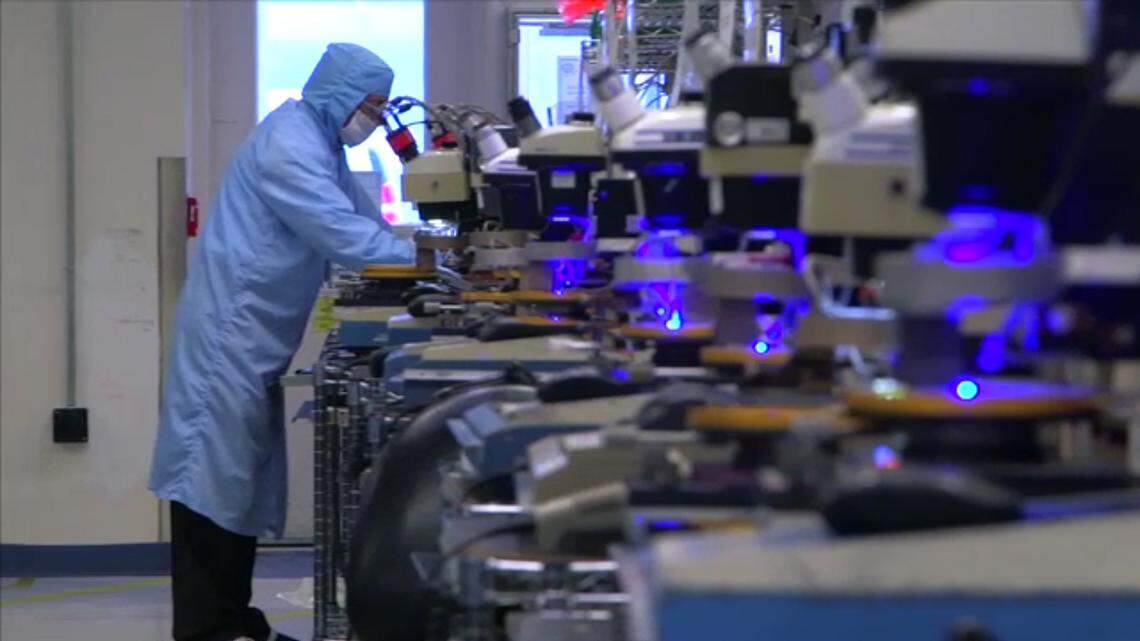
North Carolina’s shuttered textile and furniture mills are symbols of the devastation caused when manufacturing shifted to nations with cheaper labor, but new federal legislation could help make the state a manufacturing power again.
This time, the boom won’t be about apparel and furnishings. It will be centered on tiny, but essential and proliferating devices – semiconductors, the basis of chips used in computers or other electronic equipment.
The CHIPS and Science Act passed by Congress and signed by President Joe Biden in August will provide $52 billion to spur semiconductor research and production in the U.S. It comes after the COVID-19 pandemic slowed chip production by foreign manufacturers and exposed the nation’s vulnerability to relying on offshore supply lines for a vital technology.
Ronnie Chatterji, a Duke professor who took a leave to serve as the U.S. Commerce Department’s chief economist, has been named as the White House Coordinator for CHIPS Implementation at the National Economic Council. The CHIPS Act, he told me, “is really about building an industrial base in the United States. It’s going against the conventional wisdom of outsourcing.”
The new law includes $13.2 billion for research and the training of people to work in the development, design and manufacturing of semiconductor wafers and the chips that are built on them. The R&D funding could be a boon to North Carolina’s research universities, especially N.C. State.
“We are entering a new paradigm where policy is focused on bringing investment here. That will benefit states that have invested (in tech),” Chatterji said.
Fortunately Chatterji, the 2020 Democratic nominee for state treasurer, knows how heavily North Carolina has invested.
Spurred by $76 million in state tax incentives over 20 years, the Durham-based manufacturer Wolfspeed announced in September that it would build a $5 billion manufacturing campus in Chatham County to produce silicon carbide wafers. Gov. Roy Cooper called the deal “the largest economic development investment in North Carolina’s history.” It could be the catalyst for other companies to open plants in North Carolina where the necessary natural and electric resources are available and universities are turning out more graduates trained in semiconductor technology.
North Carolina has invested in new technology since the creation of Research Triangle Park in 1959. But in recent years that investment has focused on producing a tech workforce that will help attract chip-makers. An initiative by the General Assembly called Engineering North Carolina’s Future will provide $20 million over the next two years to enable N.C. State’s School of Engineering to train 4,000 more students in engineering and computer science.
John Muth, a professor of Electrical and Computer Engineering at North Carolina State University, said other states dominate in the design and production of silicon-based chips, but N.C. State is at the forefront of developing a new generation of silicon carbide semiconductors that can endure higher temperatures and higher voltages, qualities that will be increasingly needed in electric automobiles, data processing centers and clean energy production.
“In general, we need to do more manufacturing, do it cleaner and employ people with better paying jobs and the CHIPS Act helps out with that,” he said.
Veena Misra, an N.C. State electrical engineering professor, directs the university’s ASSIST Center funded by the National Science Foundation. The center’s work is focused on adapting chip technology into wearable and implantable sensors to monitor health. One application is developing military uniforms that can measure a soldier’s vital signs and detect airborne threats.
That work symbolically closes a circle. The state’s textile industry, once hobbled by manufacturing moving overseas, could become a leader in the production of monitors built into clothing.
“It’s really a game changer,” Misra said of the CHIPS Act. “It’s really far reaching in any direction you look.”
This story was originally published October 13, 2022 at 4:30 AM with the headline "“A game changer”: With CHIPS Act, NC is poised for a new manufacturing boom."