NC’s Senate race proves national Democrats still don’t understand the Tar Heel state
You don’t often hear a U.S. Senate race in North Carolina characterized as a “sleeper” race. Especially not when that race has, according to polling averages, become one of the most competitive in the country.
Ted Budd and Cheri Beasley are virtually tied in the polls. But with less than a month until Election Day, national Democrats have invested relatively few resources in the race, much to the frustration of their North Carolina counterparts.
Republicans have dwarfed Democrats in outside spending, despite Beasley’s significant fundraising advantage. It’s a marked difference from years past — the high-profile matchup between Sen. Thom Tillis and Cal Cunningham in 2020 was a nearly $300 million affair that set a record for the most expensive Senate race in U.S. history.
Have national Democrats given up on North Carolina, or are they just overlooking it this year? Other battleground states, like Pennsylvania, seem to be a bigger priority for Democrats right now. But in neglecting the state that has long eluded them, Democrats are once again showing how much they still don’t understand it.
The ‘white whale’
Demographically speaking, North Carolina is a true purple state, but it hasn’t elected a Democratic senator (or president) since 2008. Democrats have come tantalizingly close, though: incumbent Kay Hagan narrowly lost re-election to Tillis in 2014 in a hard-fought and expensive race. Cunningham lost by less than two percentage points in 2020 despite leading in the polls for much of the campaign.
Regardless of the outcome, 2022 is also likely to be close, and national media has picked up on it. The New York Times considered whether North Carolina would “break Democratic hearts again,” while FiveThirtyEight speculated that the party could be headed for “another disappointment.”
“I think they feel like they’re Charlie Brown, and North Carolina is Lucy with the football,” Western Carolina University political science professor Chris Cooper told me. “They’ve given her a shot, it didn’t work, and they’re gonna go somewhere else where they’ve had more success.”
But onlookers — particularly those who know North Carolina well — are questioning whether that’s the right calculation. Some Democrats have begged their party’s campaign arm to invest more heavily in the race, complaining they “give up on the South way too easy.”
“They’ve lost a few close races, and instead of trying to figure out how they could have won, they decided to take their toys and go home,” Cooper said. “I don’t think that’s the way to build a party.”
Of course, Democrats can and do win statewide elections in North Carolina (just ask Roy Cooper and Josh Stein). The problem is that Democrats in Washington just don’t have North Carolina figured out.
Mistakes of the past
Democrats have long tried to win the South by recruiting bland and ostensibly non-polarizing candidates. If moderate voters are the key to victory, as they seem to believe, then a moderate candidate should help capture that support.
That didn’t work in 2020. Senate Democrats opted for the safe bet when they practically handpicked Cunningham, the generic white guy, to challenge Tillis. In the end, that safe bet backfired, and it wasn’t simply because Cunningham had an affair, a late-in-the-race scandal that was handled quite poorly. It also was because he was a substance-free candidate who never gave the public a compelling reason to forgive — or vote for — him.
(Democrats originally had state Sen. Jeff Jackson in mind for 2020. Jackson declined because then-Senate Minority Leader Chuck Schumer reportedly wanted him to spend the campaign “in a windowless basement raising money” instead of barnstorming across the state.)
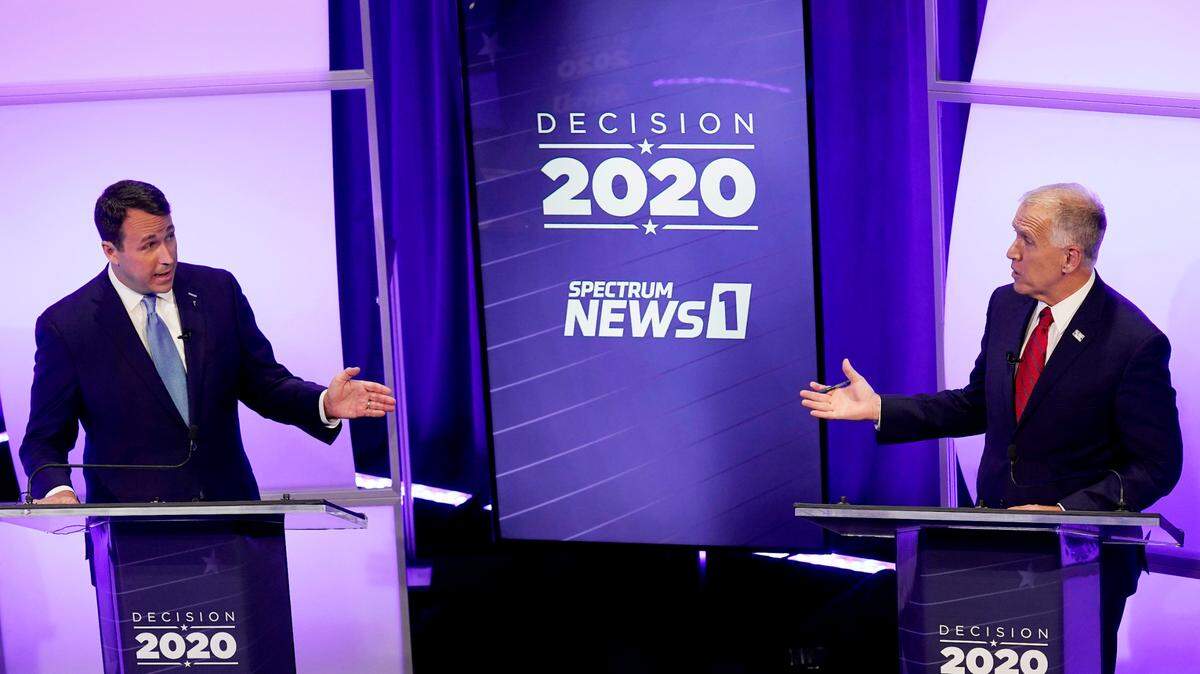
What Democrats often fail to understand is that boring candidates don’t get anyone to the polls, no matter how much you spend on them. Elections in battleground states are won on turnout: the party that does a better job of mobilizing its supporters usually wins.
In North Carolina, registered Republicans consistently have the highest turnout, Michael Bitzer, professor of political science and history at Catawba College, said.
“Republicans learned what Barack Obama was able to do in 2008, and they’ve kept that level of exceeding the state turnout rate,” Bitzer told me. “Democrats, after ‘08, did not put forth the infrastructure and the resources to battle that turnout advantage.”
Despite some backing from groups like Senate Majority PAC and EMILY’s List, Beasley isn’t receiving nearly as much national support as Cunningham did in 2020. Part of that, of course, is because Democrats have more seats to defend this year in order to keep their Senate majority. Still, it suggests that in an environment with finite resources, the party has decided that North Carolina is less worthy of investment.
“it seems to be that their strategy is if they can hold on to what they have, then they’ll maintain a narrow majority, and that it’s a better investment than expanding,” Cooper said. “I’m not entirely sure that’s right. I don’t know what signal they could receive that would make them pay attention, if the combination of an open seat in a purple state with a qualified woman of color as their candidate didn’t do it.”
Could Beasley be different?
Beasley, for her part, is better than past Democratic candidates. While she hasn’t completely escaped the flatness that often troubles establishment candidates, she comes across as more genuine and has found a strong voice on issues like abortion. Since May’s primary, she’s done a better job of defining herself (though she has not put up a tough defense against attacks on her judicial record). Most of all, her campaign seems to understand the need to adopt a coast-to-coast outreach strategy — one that focuses on all 100 counties, not just the state’s metropolitan areas. Democrats often take Black voters for granted and overlook rural voters, but Beasley has been actively courting both.
Contrast that with Cunningham: a relatively unknown figure with minimal political experience who seemed to do little more than recite the same talking points on the campaign trail. Though he consistently led in polling, his campaign wasn’t strong enough to weather scandal: it largely ignored rural voters, and Cunningham’s emphasis on “principles” backfired after voters learned of his affair.
.jpg "Image from iOS (1).jpg")
Jonathan Felts, senior adviser to the Budd campaign, said in an email that “Cheri Beasley’s lackluster campaign has given [Democrats] no reason to feel confident.”
“Beasley is your classic example of a candidate who is a lot better on paper than in reality,” Felts wrote. “That doesn’t inspire the DC Decision Makers to share limited resources.”
Dory MacMillan, Beasley’s campaign spokeswoman, said in an emailed statement that the race is a “dead heat even though Congressman Budd’s national allies are spending millions of dollars to bail out his flailing campaign.”
But Beasley’s campaign does seem to have a keen sense of what it takes to win in North Carolina — she has, after all, won statewide before — and the competitiveness of the race reflects that. It’s a midterm year, one in which Republicans are favored, yet Budd and Beasley remain neck-and-neck in the polls. Bitzer said Beasley’s grassroots strategy, fundraising prowess and messaging ability have helped make the race closer than expected.
A state as predictably unpredictable as North Carolina can seem puzzling, especially from an outsider’s perspective. It’s a Southern state, but it’s different from Georgia, where Democrats are trying to replicate the historic success they had in 2020. Nor is it the same as Florida, which has long been competitive for both parties. But it’s not unsolvable — you just have to take the time to solve it.
Win or lose, there are plenty of lessons for national Democrats to learn from this race. Chief among them is that they sometimes struggle to win races in North Carolina for a reason, and it’s not necessarily the state itself that’s to blame.
“To build a party for the future, you have to invest,” Chris Cooper said. “So to see North Carolina and say, ‘It’s not there yet,’ is to assume it will be without taking care of it. But the electorate has to be cared for, like a plant or a pet. You can’t just ignore it and hope that it grows.”
This story was originally published October 15, 2022 at 7:00 AM with the headline "NC’s Senate race proves national Democrats still don’t understand the Tar Heel state."