Restricting abortion won’t make us like Europe. North Carolina is already worse.
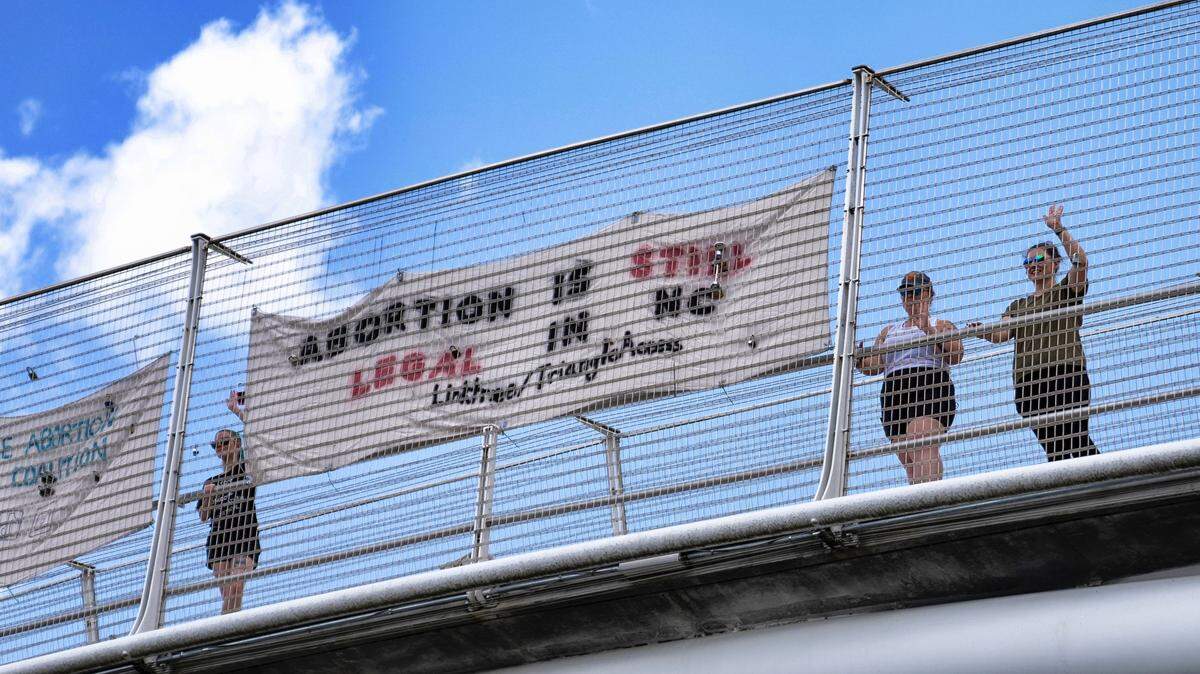
We often think of abortion access through the lens of arbitrary gestational limits: at what stage of pregnancy does a person lose the right to terminate it?
“I would say that after the first trimester, the state has has an absolute interest in regulating the incidence of abortion,” Senate leader Phil Berger told reporters last week.
The state already regulates the incidence of abortion, however, from the very moment a pregnancy begins. Patients face a dismal health care landscape and laws that create needless barriers to care. Despite this, it’s suggested that the United States has been some kind of liberal worldwide outlier on abortion.
That’s something Supreme Court justices fixated on in Dobbs v. Jackson, which upheld a Mississippi law banning abortion after 15 weeks, eliminating the protections that had been in place under Roe v. Wade. Chief Justice John Roberts argued that Mississippi’s law matched “the standard that the vast majority of other countries have.”
It was a point raised by Senate Minority Leader Mitch McConnell, who complained that, under Roe, “every state had to handle abortion like China and North Korea and no state could handle it like France or Germany.”
And it seems to be what lawmakers like Berger are thinking when they say that drawing the line at 20 weeks, as North Carolina does now, goes “too far down the road.”
But the state of abortion access in North Carolina and across the nation is fundamentally different than in other developed countries.
“We don’t often hear our health policies compared to European health policies here in North Carolina, at least not in a much more liberal kind of way,” Alison Kiser, executive director of Planned Parenthood Votes! South Atlantic, said. “There are significantly fewer financial and legal barriers to abortion throughout Europe.”
In France, for example, abortion is limited after 14 weeks, with exceptions. But birth control is free for people under 25, there is generous paid parental leave and child care is heavily subsidized. Denmark may appear to be stricter, since it draws the line at 12 weeks, but the law provides broad exceptions that consider a person’s social and economic circumstances. It’s easier to find a provider in most European countries, and the procedure is typically covered by universal health care.
Compare that to Mississippi, a state with just one abortion clinic, or North Carolina, where 15 abortion clinics serve more than 10 million people. Even a first trimester abortion typically costs upwards of $400. It may take someone a while to even confirm that they’re pregnant, because going to the doctor for an ultrasound is itself a burden.
“I have not seen any one patient who just feels like it was no big deal — like it was a piece of cake,” Jenna Beckham, an OB-GYN who provides abortions in North Carolina, told me. “There’s some kind of impact or barrier or challenge for every patient.”
North Carolina requires patients to receive biased, state-mandated counseling, then wait 72 hours before receiving the procedure — a longer waiting period than almost any other state. Such restrictions, Beckham said, are politically motivated and not medically necessary.
You may have to travel pretty far, and telehealth isn’t an option. If you’re on Medicaid, you’ll have to pay for the procedure out of pocket unless it’s an emergency; if you’re a teacher or public employee, insurance won’t cover it either.
That’s the reality, whether you’re in the fifth or 15th week of pregnancy.
“Their agenda is to put up all these unnecessary barriers that force people to delay care and then ban abortion earlier and earlier in pregnancy, until eventually they’re going to stop people from being able to access care at all,” Kiser said.
Even when abortion is legal, it’s not always accessible. What if your job doesn’t offer much flexibility, and the clinic only does abortions on Wednesdays? What if all the appointments are booked? What if you can’t afford it? And what if, on top of all of that, you don’t even know you’re pregnant until the first trimester is nearly over?
No matter where politicians draw the line, the red tape alone will strip many North Carolinians of the right to make choices for themselves and their families. It already does. That doesn’t make us like other countries — it makes us worse.
This story was originally published August 28, 2022 at 5:00 AM with the headline "Restricting abortion won’t make us like Europe. North Carolina is already worse.."