
Why is it so hard for progressives to win in North Carolina?
For a while, it seemed like 2022 might be a pretty good year for progressives in North Carolina.
Two of the state’s longest-serving congressional Democrats, U.S. Reps. David Price and G.K. Butterfield, announced last year they would not seek re-election, leaving two blue seats wide open. It resulted in two fiercely competitive primaries that epitomized a long-standing and ever-deepening divide among the party’s progressive and moderate wings.
In the end, though, progressive candidates lost. And it wasn’t even that close.
A battle of the blues
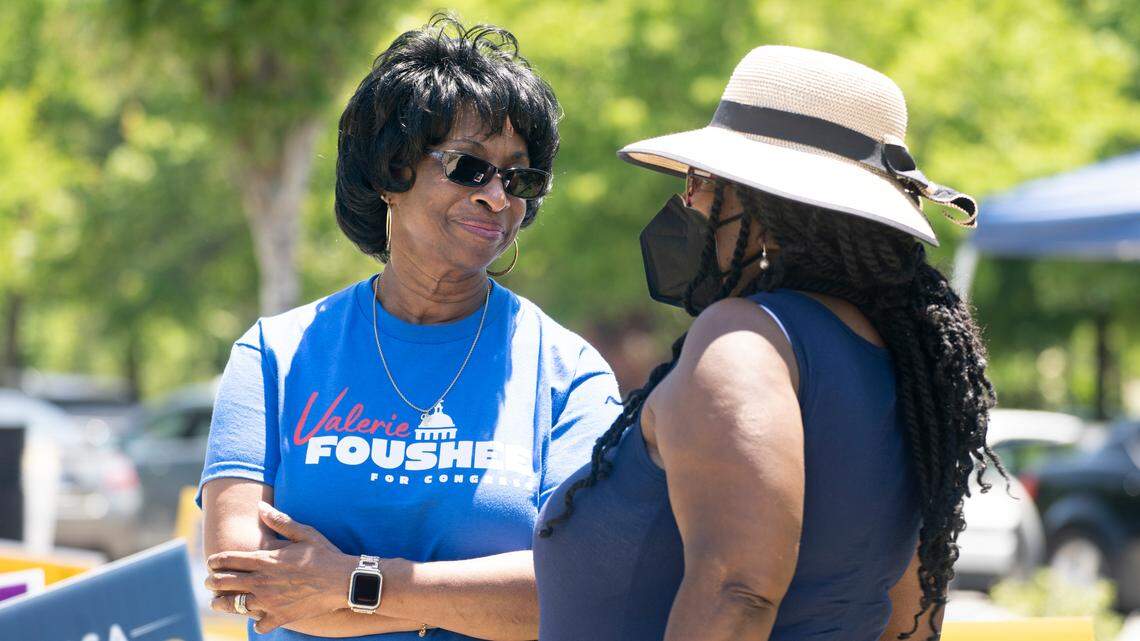
In Price’s 4th Congressional District, state Sen. Valerie Foushee defeated Durham County Commissioner Nida Allam and six other candidates with just over 46% of the vote Tuesday.
And in the 1st Congressional District, voters elected state Sen. Don Davis over progressive former state Sen. Erica Smith to succeed Butterfield as the Democratic nominee. Davis received more than double the votes Smith did.
The race to replace Price in the state’s bluest district was the most expensive Democratic congressional primary in state history. Foushee was seen as the establishment candidate, though her politics are still fairly progressive. She was backed by millions of dollars in outside money from pro-Israel lobbyists and a cryptocurrency billionaire, which resulted in sharp criticism, lost endorsements and fear that the seat was being bought.
Allam, who in 2020 became the first Muslim woman elected to public office in North Carolina, was the progressive favorite. She had the endorsement of big-name progressives like Alexandria Ocasio-Cortez, Elizabeth Warren and Bernie Sanders.
In Butterfield’s eastern North Carolina district, it was a similar story. As far as Democrats go, Davis might be as moderate as they come. He’s sided with Republicans in the state legislature, and was accused of being anti-abortion (which he denied). Davis was also backed by outside, pro-Israel money and earned the endorsement of Butterfield himself, while Smith was endorsed by Warren and the Congressional Progressive Caucus.
For progressives, an uphill climb
Meanwhile, the far-right wing of the Republican Party doesn’t seem to have a whole lot of trouble winning elections. A Trump endorsement and major spending by a conservative super PAC called Club for Growth helped lead Ted Budd and Bo Hines, once relatively obscure candidates, to victory in their respective primaries. Both Budd and Hines positioned themselves as the most Trump-friendly choice and labeled their opponents RINOs, or Republicans in Name Only.
It’s an interesting contrast: Republicans lose because they’re too moderate, while Democrats lose because they’re not moderate enough. Why?
The core of the Republican Party has moved into a strong conservative position, Michael Bitzer, political science professor at Catawba College, told me, with no real sense of moderates being acceptable anymore.
“Both parties contain distinctive hard-core ideologies, but it’s just that the Republican Party is dominated by conservatives, while the Democratic Party still has a noticeable tension between moderates and progressives, with a strategic imperative that to win, Democrats can’t go too far left without suffering at the polls,” Bitzer said.
Money is a key factor, too, Western Carolina University political science professor Chris Cooper says. Like Foushee and Davis, Hines and Budd had lots of outside money being spent in their favor. But money does often follow ideology.
“When we look at who Club for Growth funds, which is the reason why Hines and Budd, of course, had so much money, they’re not going to support a moderate Republican,” Cooper said. “So it’s the incentive structure created in some ways by these massive funding organizations.”
In many cases, those with money and power in politics seem more willing to push back on progressive candidates than conservative ones. But when the Republican establishment makes an effort to expel those running to the right of them, they, too, can be successful. Cooper pointed to Madison Cawthorn as an example: outside spending and endorsements from the establishment wing of the party cost Cawthorn a second term.
Both parties seem to be following the votes — and the money. Republicans seem to have accepted that moving further to the right helps them win elections. Democrats, on the other hand, are trying to keep their progressive side in check. On the left, including in North Carolina, it still pays to be moderate.
This story was originally published May 20, 2022 at 6:00 AM with the headline "Why is it so hard for progressives to win in North Carolina?."
