
As the former State Board of Education chairman, here’s my take on NC teacher pay
Welcome to NC Voices, where leaders, readers and experts from across North Carolina can speak on issues affecting our communities. Send submissions of 300 words or fewer to opinion@newsobserver.com.
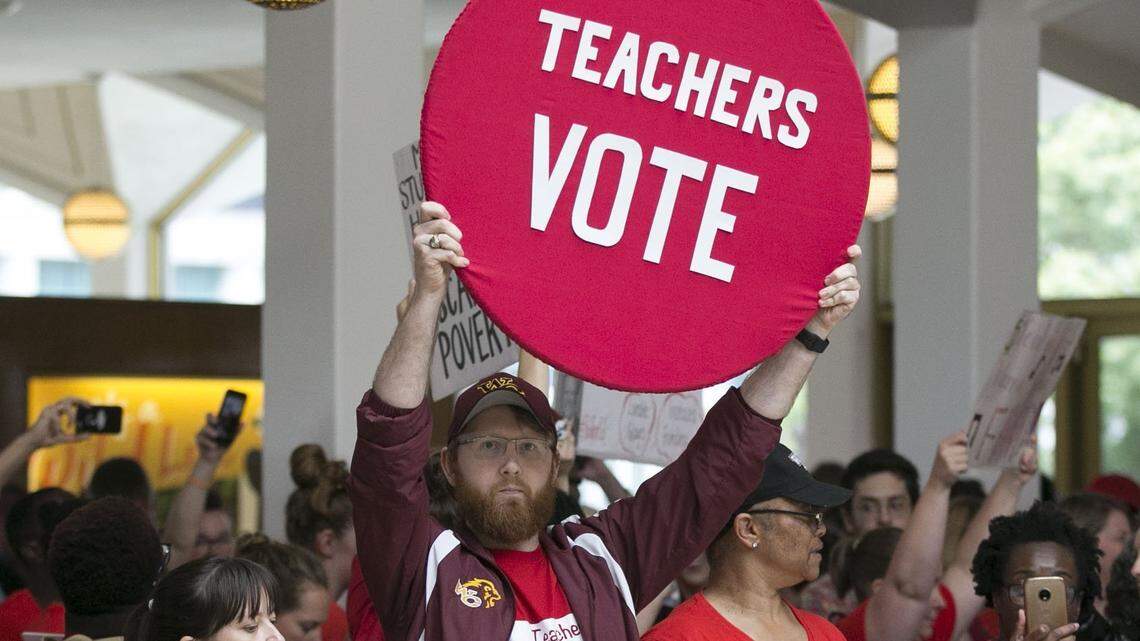
NC teachers deserve better
The writer is chairman emeritus of the State Board of Education.
Regarding Our View “A think tank’s insulting pitch to North Carolina teachers,” (Oct. 1 Editorial):
This editorial missed the mark on several points regarding the North Carolina Association of Educators.
The NCAE no longer represents a majority of teachers in our state and has not for many years.
The reason? The NCAE has little influence in the Republican-led N.C. General Assembly because of its historic ties to the Democratic Party.
The editorial said teacher pay in NC ranks 33rd in the country, but failed to point out that when Pat McCrory became governor, we ranked a dismal 47th in 2013. Three years ago we reached the 29th position. However, Gov. Roy Cooper’s 2019 state budget veto pushed us back to 33rd.
Our teacher compensation system is outdated and unrelated to student success. I would hasten to add that we are not paying the excellent teachers what they deserve, but the trend had been in the right direction. Hopefully, we will see meaningful raises this year.
When Republicans gained control of the N.C. legislature, pay for principals ranked last in our region and nearly last in the country. Because of historic and deserved raises from 2015-16 to 2019-20, averaging $20,000 per year, North Carolina average principal pay rose from last to an estimated top-5 among states in the Southeast.
When I was elected to the N.C. Senate as a 25-year-old senator in 1970, the partisan NCAE did not interview nor endorse me because I was running on the wrong party label to suit their taste. Nothing has changed, except teachers abandoning the partisan ships. Teachers deserve better.
Phil Kirk, Raleigh
Do this to reduce colon cancer in NC
The writer is founder of Brooks Bell, Inc. and serves on the boards of the Colorectal Cancer Alliance and CDC Foundation.
The N.C. budget has the potential to save hundreds of lives from colon cancer. To do so, it needs to include one important thing: Medicaid expansion.
If expanded, thousands of North Carolinians who don’t have access to colonoscopies will benefit from the life-saving procedure — which helps diagnose and prevent cancer.
I learned this firsthand when diagnosed with stage 3 colon cancer at age 38. Having private insurance and access to good healthcare helped me get a timely colonoscopy. Catching my cancer before it spread probably saved my life.
Unfortunately, North Carolina now has a “hot spot”’ for colon cancer. Several mostly northeastern counties, including Caswell, Halifax, Bertie and Washington have colon cancer deaths up to two times higher than the rest of the nation.
Colon cancer matters because it isn’t a rare disease. It’s the third most common cancer in men and women. More people die of it each year than breast or prostate cancer. But what makes it unique is that it is one of the few truly preventable cancers. That’s because we know what causes it: polyps. Today, one in three of us have at least one polyp by our 45th birthday.
People with private insurance are 2.5 times more likely to be screened for colon cancer than the uninsured. Drs. Stephanie Wheeler, Dan Reuland and Seth Crockett of the UNC Gillings School of Public Health have spent years researching the best ways to increase colon cancer screening rates in N.C. They say one of the best interventions is expanding Medicaid.
It is predicted to increase screening across the state by .3%, which translates to 200 N.C. lives saved. It will also save the state $30 million in colon cancer treatment costs over three decades.
North Carolina is one of 12 states that haven’t expanded Medicaid. Now is the time to access the healthcare support that should have been available to all since the Affordable Care Act passed.
Dr. Otis Brawley, former Chief Medical Officer of the American Cancer Society, has said, “If you are uninsured, and you are diagnosed with cancer, you have a 60% greater chance of dying from cancer than if you were insured.”
If I hadn’t been able to afford to get a colonoscopy when I did, I may not have been here today to write this. Every North Carolinian needs the same opportunities to save their lives as I had.
Brooks Bell, Raleigh
This story was originally published October 5, 2021 at 2:12 PM with the headline "As the former State Board of Education chairman, here’s my take on NC teacher pay."