
We need a new ‘giant leap for mankind’
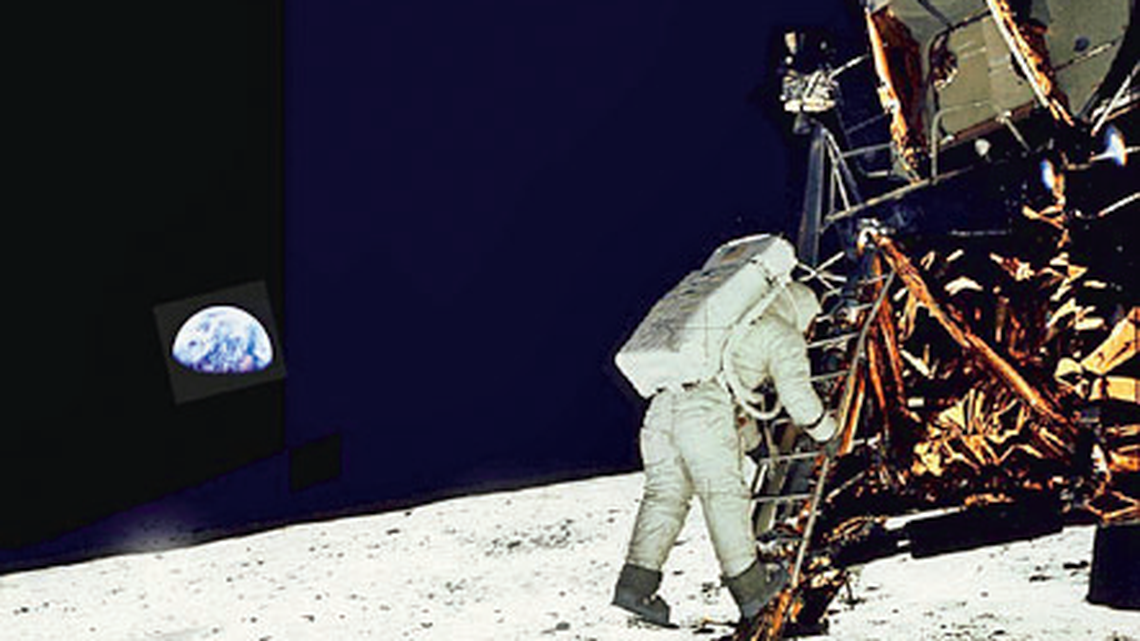
It is astounding to consider ― particularly for those who were glued to television sets with Walter Cronkite in the summer of 1969 ― that next July 20 will mark a half century since astronaut Neil Armstrong proclaimed a giant leap for mankind from the Moon. The prediction by astronomer Fred Hoyle in 1948 that the first photographs of the Earth from space would transform history turned out to be stunningly correct. So was this 1969 statement by environmental and cultural activist Wendell Berry:
“We have lived our lives by the assumption that what was good for us would be good for the world. We have been wrong. We must change our lives so that it will be possible to live by the contrary assumption, what is good for the world will be good for us. And that requires that we make the effort to know the world and learn what is good for it.”
Today’s troubled relationship between humanity and the natural world would be well served by rekindling the we-are-all-in-this-together spirit that surged with the enthralling Apollo missions. As recently summarized by the Rockefeller Foundation and the medical journal Lancet, research in the sciences and humanities has concluded that the Earth’s health is equal to the health of human civilization and the state of the natural systems on which it depends.
There’s good news. Learning about the world no longer routinely ends with our school and college years. Already encouraged to do well and do good, corporations are increasingly drawn to a triple bottom line approach with people, planet and profit metrics. Consumer choices friendly to the environment are rising. We recoil, for example, when confronted with news of beached whales with their bellies full of plastic debris. Called citizen science, people of all ages and backgrounds can now join data collection and research projects. Co-hosted by the NC Museum of Natural Sciences, NC State University and regional environmental justice organizations with public-private sector sponsorships, the US Citizen Science Association conference comes to the Raleigh Convention Center from March 13-17. Attended by a wide range of skillsets and interests, this convening will showcase the accelerating, and much needed, progress of transdisciplinary approaches taking a long view of the challenges and opportunities which are before us.
From the Moon, ironically, the Earth appears as a lonely blue-green orb with no visible signs of humanity under a skinny envelope of swirling cloud patches. The website for the network of Earth Day ― a global event on the first day of spring which began in 1970 ― recalls that “air pollution was commonly accepted as the smell of prosperity [and] ‘environment’ was a word that appeared more often in spelling bees than on the evening news.” Although the Apollo missions were a great technological leap and their photos of the Earth are forever iconic, two decades passed by before the future of this planet and its life began to be viewed as the focus of a needed leap of another kind. In 1987, the UN published Our Common Future to warn generations against exceeding their share of the Earth’s resources. Unprecedented numbers of scientists, including most Nobel Laureates, began imploring society to tackle humanity’s impacts on the natural world. Endorsed in 1992 by over 1,700 researchers from 71 countries, the Union of Concerned Scientists issued a call for a great movement. A reminder by over 15,000 researchers from 184 countries was published in 2017.
The history of the early 21st Century will surely record that not heeding the warnings by an overwhelming majority of scientists became the world’s leading problem ― particularly climate warming, icecap and glacier melting, sea level rise, and ecosystem disruptions. Long-term lessons already need to be learned from two types of calamities. First, as humanity swells and occupies riskier places, instant disasters from floods, heatwaves, fires, earthquakes, eruptions, and tsunamis can cause widespread devastation with human death tolls exceeding one hundred thousand. Second are hazards still widely viewed as inconsequential because they are imperceptibly slow in human lifetime terms. Costing far more over coming centuries will be the greater protection and eventually the relocation of vulnerable coastal communities, airports, industries and military bases.
Global solutions are within reach. In the Earth’s Time Scale, the Anthropocene is the emerging term for humanity’s adverse impacts on the natural world. In Climate Change and Human Rights, published in 2015, the UN Environment Program and the Columbia Law School stated that Anthropogenic climate change is the largest, most pervasive threat to the natural environment and human societies the world has ever experienced. Just 11 years remain before the UN reviews progress of its 17 sustainable development goals with their 169 performance targets aimed at human and environmental improvements. Society is overdue in regarding this global agenda as its collective grassroots-to-government responsibility. Our children, grandchildren and those beyond are depending on us taking a giant leap of common sense. Now.
Director of the NC Museum of Natural Sciences from 2013-2018, Emlyn Koster, PhD is an adjunct professor in Marine, Earth and Atmospheric Sciences at NC State University and an ambassador for the International Coalition of Sites of Conscience.
This story was originally published January 26, 2019 at 3:49 PM with the headline "We need a new ‘giant leap for mankind’."