‘Like a race track.’ Raleigh residents seek relief from cars speeding on their streets
Bart Street in Southeast Raleigh is like countless others in the Triangle. Lined with houses, a cemetery and a city park, the street is too narrow for lane markings, and drivers must weave around parked cars.
But that doesn’t keep people from driving too fast, according to many residents. Nearly all of those who filled out a ballot as part of Raleigh’s traffic-calming process supported a city plan to install three traffic circles and four speed humps along Bart’s .6-mile length.
“We need them bad,” said Charles Collins, a semi-retired brick mason who has lived on the street for 15 years. “These nuts come through here half flying.”
Bart is one of 18 residential streets throughout Raleigh where the city will install speed humps and other traffic-calming measures in 2023. They’ll join 49 other streets that have been altered under the city’s program since it started more than a decade ago.
Each project begins with one or more residents asking the city to try to slow traffic on their street, says Will Shumaker, Raleigh’s traffic calming administrator.
“They don’t feel safe pulling out of their driveways. They don’t feel safe walking their dogs. They don’t feel safe gardening in their front yards,” Shumaker said. “And a lot of that has to do with the speed at which drivers are driving on neighborhood streets.”
Speeding on residential streets is not a problem unique to Raleigh or the Triangle. Nationwide, residents have pressed local leaders to find ways to slow cars down in their neighborhoods. Among them:
▪ In Denver, the city council voted 11-1 to reduce the default speed limit on residential streets from 25 mph to 20, following a campaign by the Denver Street Partnership that included thousands of #20isPlenty and #SlowTheFunkDown yard signs.
▪ In New York, the city began operating a network of 2,000 speed cameras, capable of automatically issuing tickets, in and around school zones 24/7 this year. The city saw a 72% decline in speeding where and when the cameras were operating and has expanded their use to non-school hours.
▪ In Charlotte, the city council this year made it easier for residents to request traffic calming measures, by eliminating the need to gather signatures on a petition. Now if a resident requests a change, and the city deems it reasonable, other nearby residents are given a chance to object before construction begins.
There are about 5,000 residential streets in Raleigh, many of them built when the primary concern was moving cars as swiftly and efficiently as possible, Shumaker says. His office averages about 300 requests a year from residents seeking help with speeding on their streets.
“We’ve been building auto-centric streets since the ‘40s and ‘50s,” he said. “So there is not a lack of demand out there.”
It often begins with lowering the speed limit
The first step in every case is to lower the speed limit if possible. State law sets the default speed limit within cities and towns at 35 mph. That may seem reasonable to a driver but not someone outside the car, Shumaker said.
“Thirty-five to a pedestrian — if you’re walking your dog, if you’re out in your yard — 35 is going to feel like a race track,” he said. “It’s going to feel way too fast.”
It’s also less safe. A person hit by a car going 20 mph will survive 90% of the time, according to the Institute of Traffic Engineers, a trade organization. The survival rate goes down to 20% if the car is going 40 mph.
Shumaker’s office asks residents to vote on lowering the speed limit, to either 25 mph on neighborhood streets with fewer than 4,000 cars a day, or 30 mph on collector streets that funnel traffic to busier thoroughfares. If fewer than half object, the City Council has the final say and generally approves the reductions a few at a time throughout the year.
Since 2015, the city has reduced speed limits on 341 neighborhood streets, including 213 this year.
The city measures average speeds on each street before lowering the limit and again afterward to see how drivers respond. In about 70% of cases, most drivers abide by the lower speed limits, Shumaker said. That’s especially the case where most of the drivers also live in the neighborhood.
“It’s your neighbors, and they want a safe and happy and vibrant neighborhood as well,” he said. “So it’s kind of like, ‘Oh, OK, the appropriate speed through here is 25; I’m going slow down.’”
Where large numbers of drivers are just passing through, though, the lower speed limits are less effective. Bruce Stanley asked the city to lower the speed limit on Ridge Road, where he lives on a side street. The speed limit was 35 mph, but drivers frequently went faster, Stanley said.
“You can’t pull out fast enough,” he said. “You look each way, and it being clear is still not enough to pull out without a car being right on you.”
The city reduced the speed limit to 30 mph earlier this year. Stanley says people may be driving slower on parts of Ridge but not near his street at the northern end where drivers are coming on and off the Beltline.
“I’ve been disappointed,” he said. “It was a nice try, but it hasn’t worked.”
Enforcing speed limits isn’t easy, as anyone who drives on North Carolina’s interstate highways knows.
Lt. William Harding heads a small speed enforcement unit for the Wake County Sheriff’s Office and often gets requests to patrol residential streets in unincorporated areas. He says the impact can be fleeting.
“Say you’ve got a speeding problem and you go out there and you work it pretty aggressively for a week, two weeks,” Harding said. “And people see it and they reduce their speeds. But then you’ve got other areas in the city or the county that you have to pay attention to. And then when you’re not seen out there, the speed just kind of comes back. It’s kind of like a revolving door.”
Where drivers won’t slow down on their own
That’s where traffic calming comes in. The term refers to physical changes on the street that compel drivers to slow down even when peer pressure or fear of getting a ticket does not.
The prescription for each street differs based on factors such as traffic patterns, the width of the pavement and the presence of hills or curves.
Common measures include speed humps, roundabouts at intersections and bumping out the curbs to narrow the street in places. It sometimes includes adding stop signs to intersections, though that can have the opposite effect farther down the street, according to the city’s guidelines.
The process begins with another ballot. Among those who participate, if 70% of residents on a street and 60% of those living within two blocks vote to consider traffic calming, the city will develop a strategy. After soliciting feedback, the city will refine its ideas and present them again to residents for their input. Then it puts the final design to an up-or-down vote. Again, if 60% to 70% of voters approve, the project goes to the City Council.
The balloting is all anonymous, as are the initial requests to lower the speed limit or calm traffic. The process can be polarizing, Shumaker said, and the city doesn’t want to discourage people from asking for help.
Even after traffic calming measures are in place, debates can remain fierce and often play out on online forums such as NextDoor or Reddit.
Last year, the city installed several traffic-calming measures along a 1.2-mile stretch of Brentwood Road, between Capital Boulevard and New Hope Church Road in North Raleigh. Among them were nearly a dozen “chicanes” or small islands built in pairs to create an S-curve.
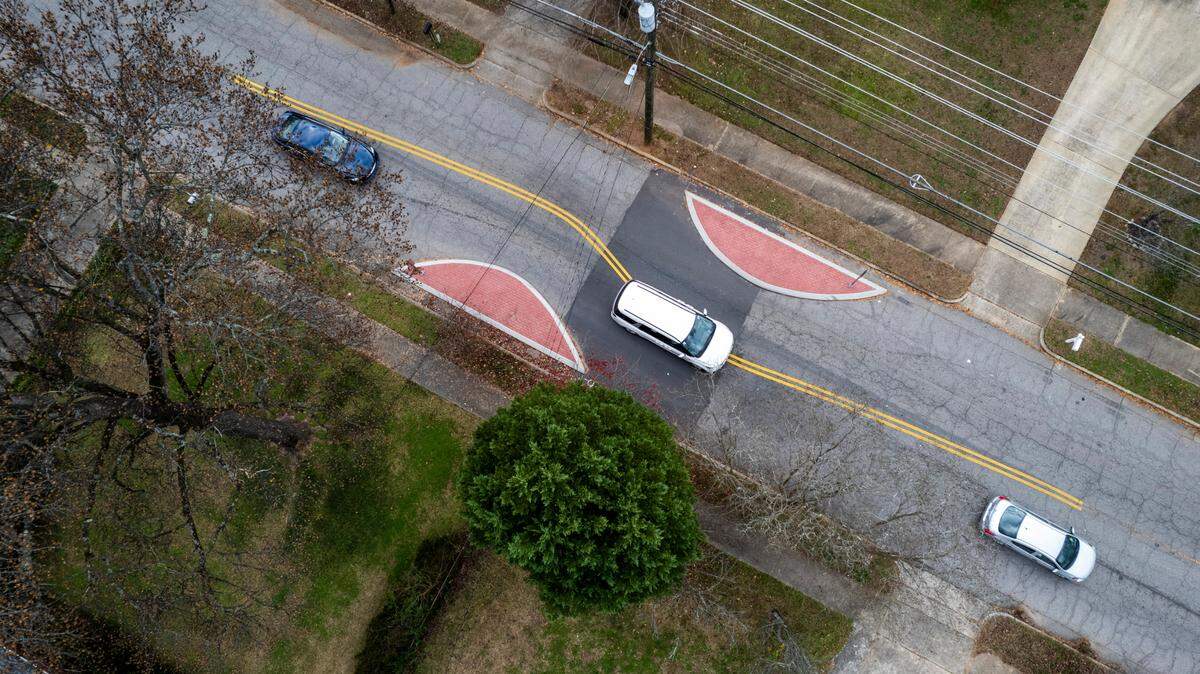
A Reddit discussion began last winter with a photo of one of the chicanes and the question: “Dear Brentwood, what are these absolute abominations?” The ensuing exchange produced 234 comments, including many sympathetic to the initial post.
“Ya this road is a s*** show,” one person wrote. “I think they put those in to get people to take other roads. It works, I avoid that road like the plague.”
But others praised the chicanes, saying they work to slow people down and drive closer to the speed limit of 25 mph.
“I think they’re great — people need to start slowing down, and they need to start paying better attention,” one person wrote. “It ain’t hard to navigate if you’re driving at the speed you’re supposed to be driving at.”
Magie Gainey has lived on Brentwood for 10 years and says she loves the chicanes. Gainey says they’re a big improvement over the speed humps that used to be in front of her house. She says she witnessed at least three accidents when people slowed for a hump and were hit from behind.
“I haven’t seen anybody wreck over these things,” she said, gesturing to the chicanes. “Plus you have to slow down.”
The chicanes work best when cars are coming from both directions and both have to slow down to safely navigate the S-curve. Cars coming alone tend to drift out over the yellow line and drive down the middle. But even then, they go slower than they would before, Gainey said.
A hump that ‘reminds us to slow down’
After it installs traffic-calming measures, the city returns to again record traffic speed and volume. On Brentwood, the average speed dropped nearly 16%, Shumaker said, from nearly 37 mph to 31 mph.
And the Reddit poster who spoke of avoiding Brentwood isn’t alone. The amount of traffic on the street dropped nearly 15%, to just over 4,000 trips a day on average, Shumaker said.
That kind of reduction is typical, Shumaker said, and the city rarely sees an uptick in traffic on parallel residential streets, leading him to conclude that drivers are sticking to major thoroughfares such as Capital and New Hope Church rather than cutting through a residential neighborhood.
Perhaps more importantly, Shumaker said, the city has logged a 45% reduction in the number of crashes reported on Brentwood since the traffic-calming measures were put in and a 75% reduction in speed-related crashes.
Some residents along Bart Street hope to see similar reductions in speed and traffic. Spencer Mertes, who frequently walks his dog on Bart, lives a block over on Pettigrew Street, where he’d like to see the same treatment. Cars speeding through the neighborhood make it “scary to bike and walk around,” he said.
“Unless there’s a cop sitting there, what are you going to do?” Mertes said. “It would just be nice to slow them down.”
Daniel Coleman said he’s pleased to hear Bart Street is finally getting some traffic calming. Coleman headed the Citizens Advisory Council for the neighborhood for years and remembers an elderly woman who no longer lives on the street asking about it frequently.
“Some of us, when we get in a car, our minds get so caught up in everything else that we’re doing that we may forget,” Coleman said. “So sometimes if there’s a hump it reminds us to slow down.”
To learn more about Raleigh’s Neighborhood Traffic Management program, go to raleighnc.gov/transit-streets-and-sidewalks/neighborhood-traffic-management.
This story was originally published December 22, 2022 at 5:30 AM with the headline "‘Like a race track.’ Raleigh residents seek relief from cars speeding on their streets."