
Why NC school leaders won’t give up after Leandro ‘disappointment’ for kids

When Bill Harrison said the word “Leandro,” a shared groan seeped through the room.
“I must express my disappointment for the kids,” Harrison, the chair of the board of directors at NC Public School Forum, said Tuesday morning. “This was an opportunity to come close to getting things right with education funding in North Carolina.”
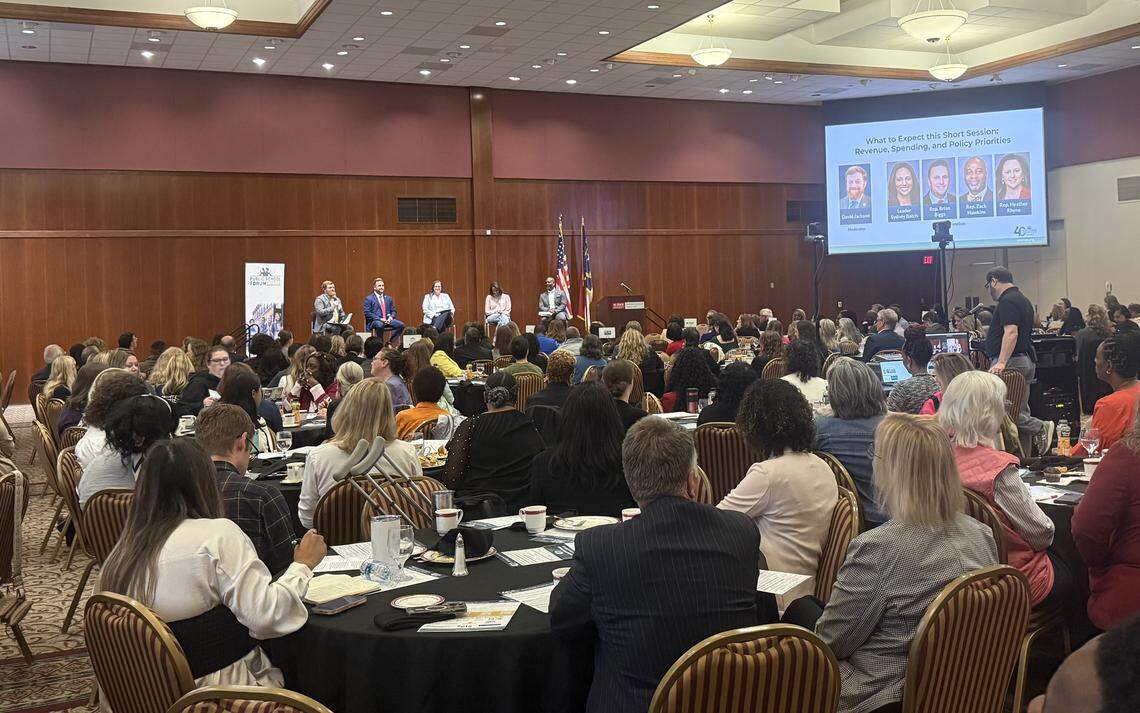
Hundreds of public education advocates and educators gathered at NC State University for NC Public School Forum’s yearly “Eggs and Issues” breakfast. The forum is a statewide nonprofit education policy think tank.
This year, the breakfast happened five days after the NC Supreme Court made a ruling 32 years in the making — one that could ensure NC public schools never see up to $1.75 billion in additional funding promised in a 2022 ruling in what’s known as the “Leandro” case.
Proponents of the decision say courts should not intervene in funding decisions, which is the prerogative of state lawmakers.
“For decades, liberal education special interests have improperly tried to hijack North Carolina’s constitutional funding process in order to impose their policy preferences via judicial fiat,” N.C. Senate leader Phil Berger said following Thursday’s ruling. “Today’s decision confirms that the proper pathway for policymaking is the legislative process.”
Opponents of the decision — many of whom were in the room Tuesday — say the state still isn’t adequately funding its schools.
“It’s not about good schools for a few; it’s about great schools for every child,” said Lauren Fox, interim president and CEO of NC Public School Forum. “We need policymakers who will put politics aside and put our students and communities first.”
Advocates on Tuesday discussed a way forward amid their letdown, including pressuring state legislators to increase school funding and teacher pay. Meanwhile, the North Carolina Association of Educators is encouraging teachers to call out of work on May 1 for a march in Raleigh to call attention to the cause.
Ann McColl, a constitutional scholar and former general counsel for the North Carolina Association of Educators, suggested the issues Leandro addressed may be in North Carolina courts again.
“Imagine that there is this loose network of lawyers, private attorneys, lawyers that work for nonprofit organizations, lawyers that are professors at university law clinics, and they are working together on litigation across North Carolina that’s going to hit different constitutional issues,” McColl said. “And then let’s imagine that this network of lawyers is then connected into those who do policy.”
That network, McColl said, could tackle Leandro’s various parts issue by issue, deciding whether it’s better to address it through legislation or litigation, and if they need to take it to court, what the best way to do that is.
“We’re going to reframe what it means to have a constitutional right to education in North Carolina,” McColl said to the room. “We can all work on this together.”
What is Leandro?
The Leandro case first started in 1994, when plaintiffs sued over whether North Carolina was fulfilling its constitutional obligation to provide a “sound basic education” for all students. In 2004, a court ruled it was not.
But that wasn’t the end of the story.
In 2019, after over 10 years of hearings, education consulting firm WestEd released the “Leandro Plan” which outlined recommendations for how North Carolina could begin providing a sound basic education. The plan included, among other things, $1.2 billion in increased funding for disadvantaged and at-risk students, $808 million in increased investment in public education over eight years and $743 million for increased school support personnel like nurses, psychologists and counselors.
On Thursday, however, the Republican-led N.C. Supreme Court issued a 4-3 ruling that overturned a 2022 decision by the former Democratic majority court, which would have required state officials to transfer hundreds of millions of dollars to public schools. Instead, the current court ruled they do not have that authority.
“In our constitution, the people established a tripartite system of government,” Republican Chief Justice Paul Newby wrote in the majority ruling Thursday. “In doing so, the people did not vest the judicial branch with the power to resolve policy disputes between the other branches of government or to set education policy.”
The court’s two Democratic justices dissented, along with Republican Associate Justice Richard Dietz.
“Today, this Court breaks a promise that constitutional drafters made to the people,” said Democratic Associate Justice Allison Riggs in her dissent. “The majority discards our constitutional commitment to the children of the state instead of acting to meet it.”
Technically, the court decided all previous rulings after 2017 are void. That doesn’t negate the decisions prior to that time, McColl said.
“This was a political decision cloaked in procedural language,” McColl claimed. “The first rulings are still intact – there is plenty in there to work with.”
Some celebrated the ruling as a long-sought win.
“This is a victory for the Constitution, the rule of law, and the people of North Carolina,” Donald Bryson, CEO of Raleigh-based think tank The John Locke Foundation, told The Raleigh News and Observer. “Budgets must be written by elected representatives who are accountable to the people — not by litigants who lost at the ballot box and went fishing for a judicial bailout.”
Others, including the Charlotte-Mecklenburg Board of Education, disagreed.
“By not providing funding to support a sound basic education as Leandro requires, North Carolina sends a clear message to our 139,000+ students and their families, and that message is, ‘Public education students are not the priority,’” Board of Education Chair Stephanie Sneed said in a statement Thursday.
However, Charlotte-Mecklenburg Schools said in a statement Thursday that the ruling has no immediate impact on its operations.
Legislative action
State lawmakers who attended Tuesday’s meeting said increasing school funding and teacher pay is a “main priority” – especially since the state has yet to pass a comprehensive budget for this year.
“I can tell you, from the House side…we want meaningful raises,” said Republican State Rep. Brian Biggs of Randolph County. “Education, to me, is not something we can trade off or something we can negotiate.”
The N.C. House of Representatives passed a budget bill that included an average raise for teachers of 8.7%, bringing beginning teacher pay to $50,000 and restoring increased pay for teachers with master’s degrees. In the Senate, however, proposed raises for teachers were less robust, coming in at an average of 2.3% and bringing beginning teacher pay to just $41,510.
The two chambers have been embroiled in a long stalemate over property tax cuts and have failed to pass any new comprehensive budget since 2023. As a result, teachers and other state employees have not gotten any raises this school year.
North Carolina currently ranks 50th in the nation in per-student spending and ranked 43rd for teacher pay in 2025, lagging behind neighboring states like South Carolina and Virginia, according to the National Education Association.
State Senate Democratic Leader Sydney Batch blamed senate Republicans for failing to pass higher raises for teachers.
“They have not, in my opinion, come to the table in a genuine way,” she said.
Meanwhile, she’s concerned about how the state can increase school funding while heading for planned tax cuts that will significantly tighten the state’s purse strings in the coming years.
“We have increased needs and increased costs,” Batch said. “We cannot, as a state, have champagne tastes on a beer budget.”
When it comes to her prediction for this year’s short legislative session, Batch offered a bleak prediction for lawmakers’ ability to work across the aisle: “Politics will win,” she said.
Republican State Rep. Heather Rhyne offered a more optimistic outlook on this year’s session, saying she believes it represents “lots of opportunity.” She advocated for examining areas where the state could save money in order to invest in education.
Rhyne did not advocate for taking money from the state’s $625 million school voucher program to fund public schools.
“Any money invested in a child’s education is incredibly important,” she said.
This story was originally published April 8, 2026 at 5:00 AM with the headline "Why NC school leaders won’t give up after Leandro ‘disappointment’ for kids."