
On flight to Charlotte, toxic fumes got into cabin. Their lives changed forever.

Editor’s note: This story includes references to suicide, which may be distressing to some readers.
For Sylvia Baird, Charlotte is the stuff of nightmares.
Just the thought of setting foot in the city is enough to elicit panic attacks.
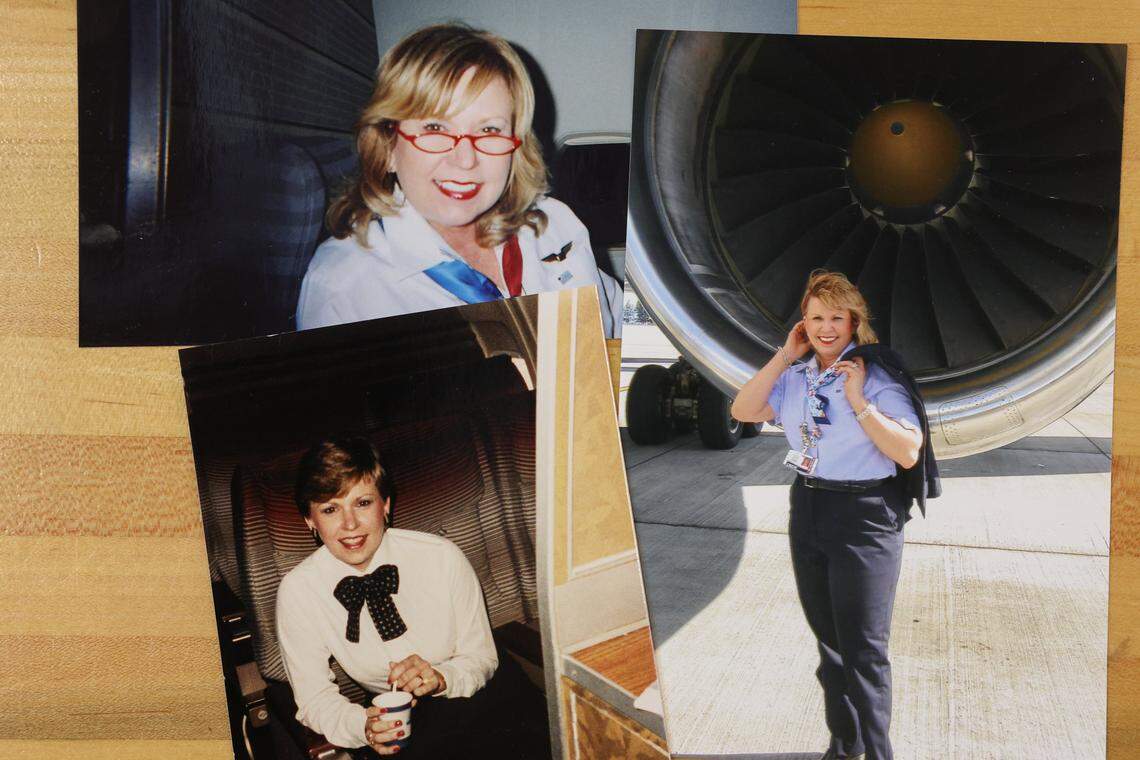
It wasn’t always this way. For years, Baird made the 90-mile drive to Charlotte Douglas International Airport from her home in High Point all the time, back when she was working as a flight attendant — the fulfillment of a dream her mother once had but never got to live herself — for US Airways.
But in late January 2010, she climbed into her car, drove out of the employee lot at the airport and onto I-85 North, toward High Point, away from the place where her career abruptly ended when her health suddenly started to decline.
She made a point to avoid Charlotte at all costs after that.
So this is a big, frightening deal for Baird, returning, as she did this past summer, for the first time in 15-plus years. “I had two panic attacks yesterday, and one this morning,” she says, shortly after driving herself down in August. “Because ... everything flashes back.”
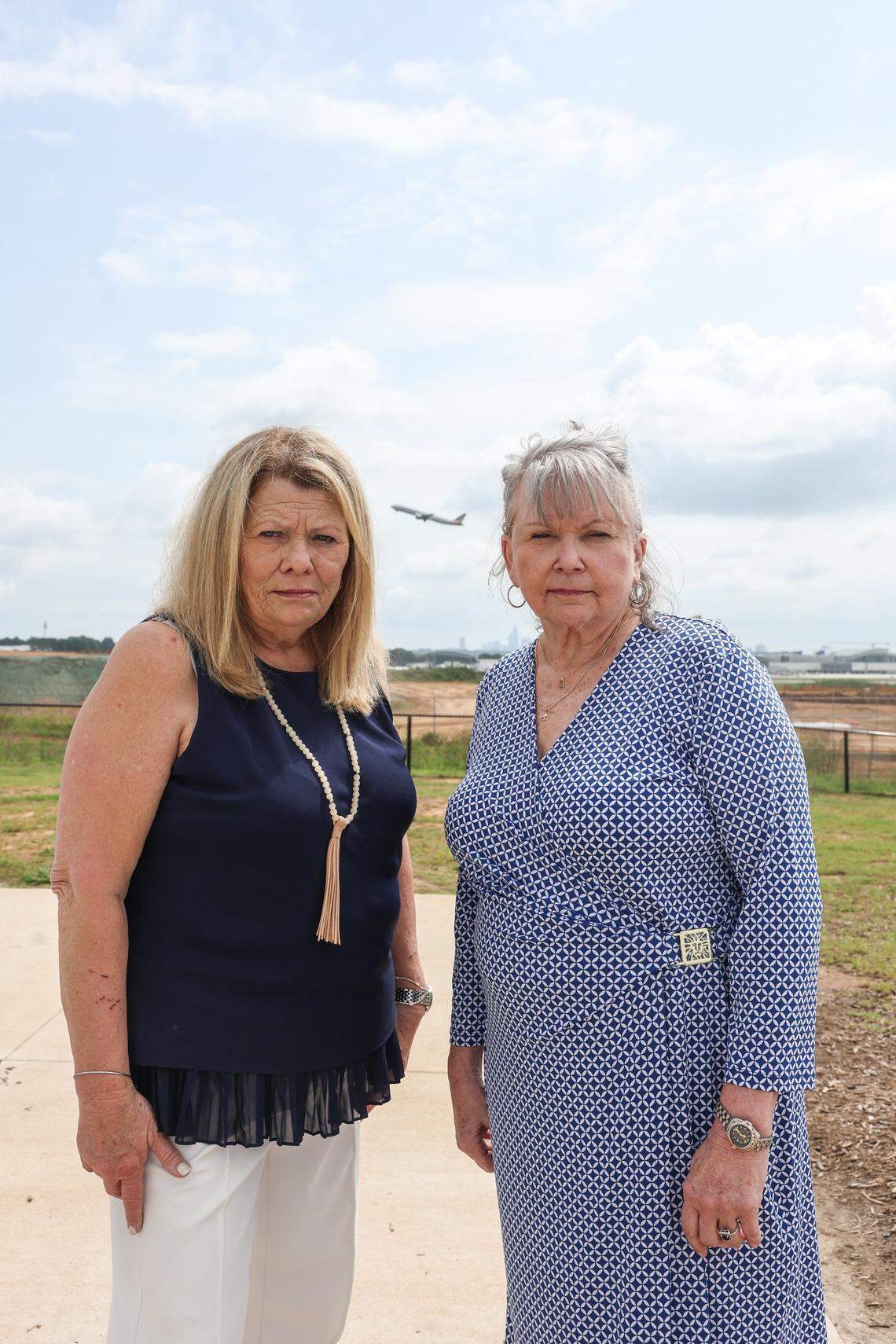
She came to reunite with Denise Weiss, a fellow former flight attendant, so they could revisit the day their lives took a horrendous turn: Jan. 16, 2010, when the two of them were part of a seven-person US Airways crew that suffered a prolonged, high-level exposure to toxic fumes that seeped into the cabin and cockpit of the Boeing 767 they were assigned to for the day.
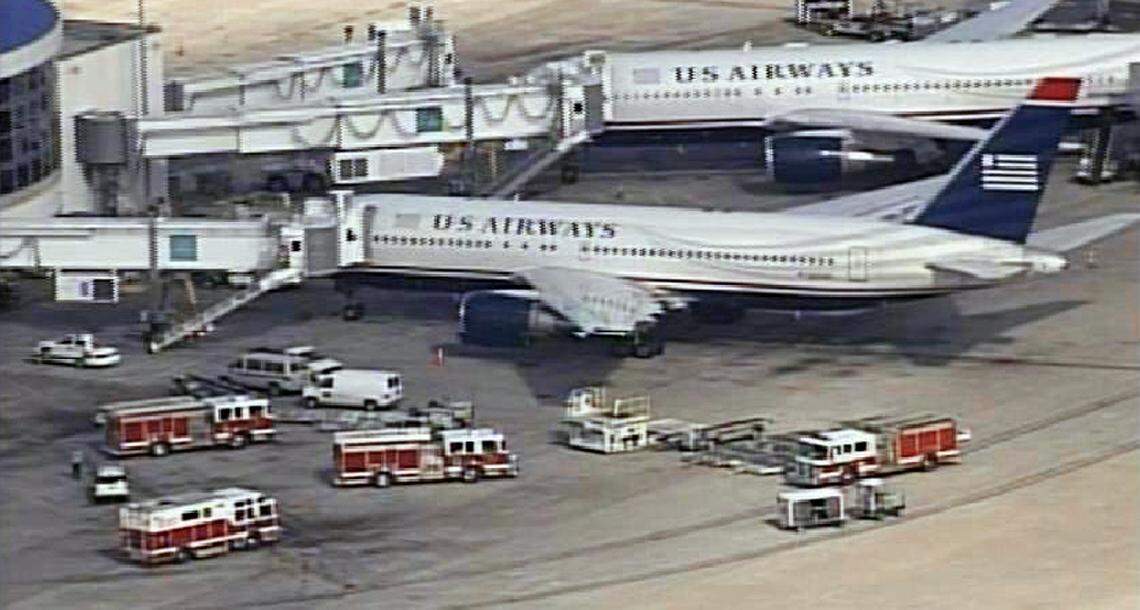
The flight was met at the Charlotte airport by ambulances and local TV crews. The crew members were transported to the hospital per standard procedure.
But while all seven were treated and released from the hospital relatively quickly, and none needed acute medical care, the fallout was alarming. Five found themselves stricken with enough serious health problems, namely neurological damage, that they would never be well enough to work on an airplane again. The pilot became depressed and killed himself in 2016, while two other crew members have since died of cancer.
Now, following years of suffering in silence, Baird and Weiss joined Penny Hill — the widow of Capt. Dave Hill, who took his own life in 2016 — to speak with The Charlotte Observer about their respective ordeals.
They allege that their exposure to toxic fumes in the cabin on that January day triggered the crew members’ downward turns and demises, even if the claims are challenging to prove. And they’re angry at an airline industry they feel has done little over the past 15 years to improve measures that could protect crew and passengers alike from these so-called “fume events,” which although rarely as severe as theirs still carry health risks.
“We just want people to be aware. To stop it from happening,” Baird says. “Because it ruined my life. It ruined all of our lives.”
The trouble started in paradise
It’s not like fume events didn’t exist before 2010. There just was a much more limited awareness of them, certainly among travelers but even among flight crews.
Baird and Weiss say they had never received any training related to such things.
And so off they went on that particular January day, obliviously, on a Boeing 767-200 registered to US Airways set to take a planeload of vacationers from Charlotte to the island of St. Thomas in the U.S. Virgin Islands.
Nothing seemed out of the ordinary for the first half of the less-than-four-hour trip, but red flags started going up as they closed in on paradise — flight attendants noted an unpleasant odor, almost like smelly feet; redness in each other’s eyes; an uptick in requests for ice packs from passengers.
The warm, sunny weather that greeted them upon arrival at Cyril E. King Airport did not, unfortunately, make it all better.
Crew members had about an hour and a half on the ground before they would need to get back on the same plane for the return to Charlotte, and there was briefly a debate about whether they should.
Weiss, the lead flight attendant, was overcome by a general sense of fatigue, to the point of drowsiness. Baird felt like she was coming down with the flu. Others also were feeling either sick or tired, if not both. Hill, the captain, who seemed to be feeling least-bad, thought medical attention might be warranted.
But the flight attendants just wanted to get back to the U.S. They just wanted to push through.
So they did. And the situation got worse.
As they were pushing back from the gate and taxiing out to take off, flight attendants were again catching whiffs of a foul smell that they surmised was coming from someone’s feet (an odor that today is much more widely known to be a potential indicator of a fume event). After they took a pass up the aisle to see if someone had taken their shoes off and couldn’t find a culprit, one of them called the captain to report the odor in case something with the plane was out of the ordinary. Hill told them all systems were good to go.
But by the time flight attendants had begun in-flight meal service, their ailments were piling up. Headaches, sore throats, neck pain, and most concerning of all, unsteadiness on their feet. Most of them felt like they’d been served one too many drinks, even though they hadn’t had a drop.
Said Baird to Weiss, out of earshot of any passengers: “There’s something wrong.”
(In November 2016, not long before Hill’s death, he and Weiss appeared in this ABC News segment:)
A rocky return flight to Charlotte
As the trip wore on, several of the 174 passengers started having coughing fits, and the flight attendants tried to ignore or at least disguise their own discomfort while fulfilling an increasing number of requests for water.
Their concern was bordering on panic. Weiss, her legs wobbling and her eyes watering, headed to the cockpit.
“Guys,” she said to Hill and First Officer Macon “Mick” Fowler, “we’re all sick in the back. Something is not right.” She explained what they were experiencing.
Hill looked at Fowler and asked, “Are you having any of those symptoms?” Fowler replied, “Yeah! I thought it was just me.” Hill said, “And I thought it was just me!” The two men had been holding it in. But as they both fessed up to feeling unusually groggy and discombobulated, they for the first time noticed that one another’s eyes were so red there was almost no white in them to be seen.
As they began their descent — with Fowler, the co-pilot, taking his scheduled turn at the controls — they briefly considered declaring an emergency, but ultimately opted to transmit a message requesting precautionary medical assistance upon arrival in Charlotte.
They didn’t want to make too big a deal out of it.
And initially, they succeeded. Though TV news crews were waiting, along with nearly a dozen ambulances, not a single passenger accepted a ride from one.
(Eight passengers were evaluated and treated on the scene, but were cleared in time to catch their connecting flights. There was never any formal follow-up with passengers on board either flight. It’s also worth noting that the crew was exposed for twice the amount of time that the passengers were.)
The seven crew members were transported to a local hospital, per policy under the circumstances, and treated with supplemental oxygen after doctors found elevated levels of carboxyhemoglobin, which can occur when someone is exposed to higher-than-normal amounts of carbon monoxide. But despite the fact that they all still felt fairly lousy, none required acute care at the time.
They all were released the same night.
It wouldn’t be until later that US Airways would confirm what caused all of this trouble: Engine oil had leaked through a faulty seal into the “bleed air” that was being extracted from jet engine compressors and used in the plane’s cabin pressurization and air conditioning systems.
It wouldn’t be until later that pilots would admit this to their former crew: “Another 15 to 20 minutes longer in the air, we’d have been so disoriented that we would have crashed the plane.”
Nor would it become clear until later that theirs would go down as one of the worst fume events on record in aviation history — and that most of them would never get the chance to work on an airplane again.
Judith Anderson, an industrial hygienist for the AFA-CWA flight attendants’ union and renowned global expert on fume events, puts it like this, for context: “I mean, talking about (this) 2010 (fume event) makes me a little uncomfortable, because I feel like there’s been so much since then as well, right? But it’s a very powerful story.
“It’s a powerful example,” she says, “of a larger problem.”
‘I wish I had picked up on the signs’
Prior to Jan. 16, 2010, Capt. Dave Hill was a flight attendant’s dream.
“He was fun and just an all-around great guy,” Baird says. “He was one of those that if you got a trip with him, you knew it was going to be a good trip. That it would be safe. He was very conscientious about anybody he flew with.”
Outside the cockpit of a commercial airliner, Hill seemed to find great pleasure in living a full, close-to-the-edge life, whether that meant cruising the countryside on his motorcycle, swishing down a snow-covered trail on his skis, cutting through the water on his sailboat, or bouncing around in the driver’s seat of an off-road vehicle.
But after he was exposed to those toxic fumes, Hill — who previously had been in excellent physical and mental health, his wife Penny says — seemed to find less room for joy in his life.
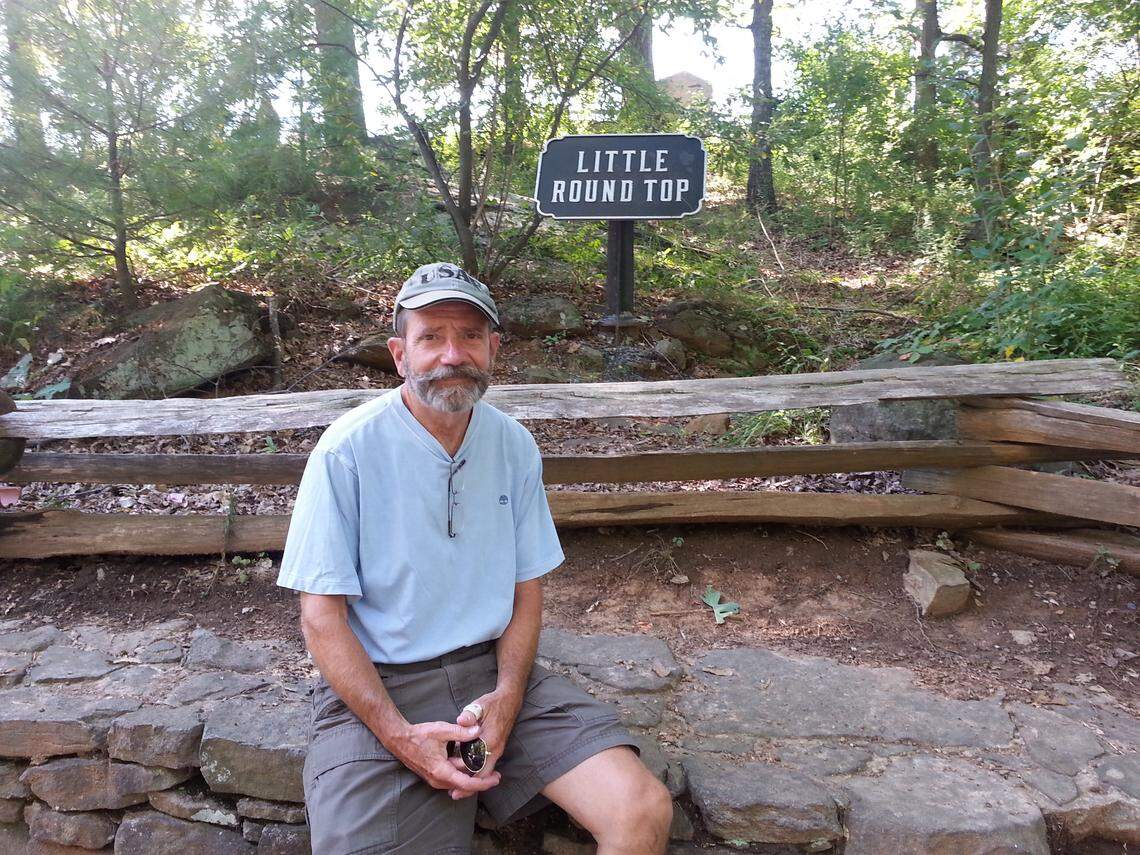
Practically overnight, he became a chronic sufferer of headaches and balance problems. His voice weakened. He developed slight but persistent tremors in both his head and his hands. This all was compounded by the fact that, in the weeks and months afterward, he remained grounded due to his various ailments.
The Hills tried to remain hopeful that he would eventually be well enough to get back to flying. His problems then might be solved.
But in May, less than four months after the fume event, the Federal Aviation Administration sent Hill a letter requesting all of his medical records since Jan. 16. He complied.
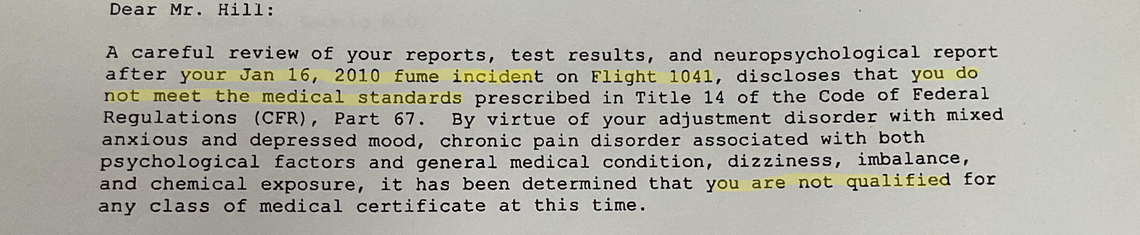
Two months later, the FAA sent another letter stating that due to his health problems, “it has been determined that you are not qualified for any class of medical certificate at this time.” The FAA said the decision was made “in your interest as well as that of aviation safety.” (That last part, Penny Hill says, drove them mad, given what had led to Dave’s predicament in the first place.)
From there, the slow pace of the pilot’s downward spiral accelerated.
He started experiencing memory issues. His balance got even worse. He could still be easygoing and mild-mannered, as he was prior to the fume event, but his mood would sometimes darken, and his temper would sometimes flare. As the months turned into years, Penny found him to be increasingly despondent.
She did not, however, think he was prone to killing himself — even on the day in early 2016 when he grabbed a loaded gun and a bottle of scotch before climbing into his Jeep, having convinced Penny he just wanted to go drink alone somewhere and felt safer with protection. In hindsight, she believes she was oblivious, and that if he hadn’t blacked out and crashed into another motorist, he probably would have shot himself that day.
Instead, toward the end of that year, on Dec. 16, 2016, Dave Hill flew into a random rage and started screaming at Penny in their Evergreen, Colo., home. As Penny searched frantically for her phone so she could call 911, he went upstairs to their bedroom.
Then he grabbed a pistol and fired a bullet into his head. He was 67 years old.
Penny’s voice shakes as the worst memory of her life washes back over her. “I just wish I had picked up on the signs earlier, but” — she pauses for a moment, then finishes the thought — “I didn’t.”
Lots of problems, but few solutions
According to a recent Wall Street Journal investigation, it’s estimated that there are at least about 100 and possibly as many as 800 fume events per million flights (meaning, at minimum, a handful per day) in the U.S.
While these statistics can read as troubling, it’s important to note: 1) by any measure within that range, fume events are rare occurrences; 2) the level of toxicity of a fume event varies based on the leak severity and engine temperature; and 3) some exposures pose little to no threat.
This makes the flight Sylvia Baird and Denise Weiss were working on Jan. 16, 2010, a significant outlier. And a significantly alarming one.
Baird, who was 56 at the time, and Weiss, then 53, could fill thick volumes chronicling their ailments in the months and years since that fateful out-and-back from Charlotte to the Caribbean.
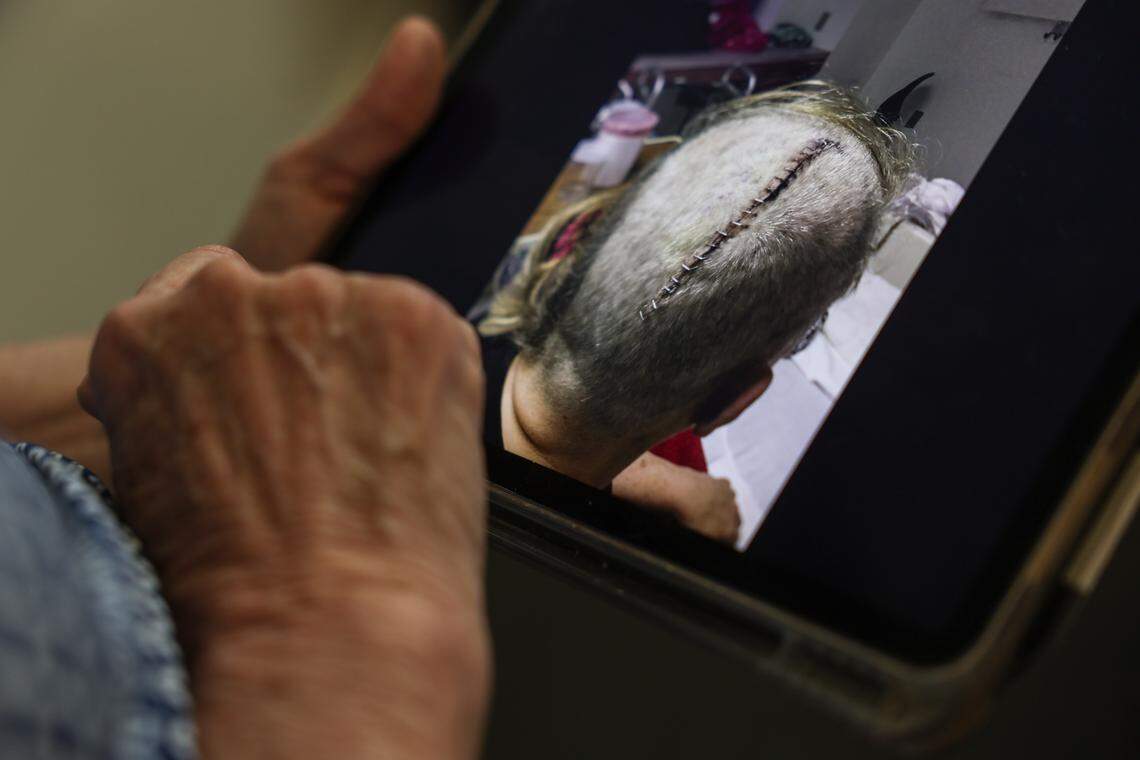
Some of the problems — like the variety of tumors that have attacked Baird’s vital organs, including an inoperable one on her brain, or the suspected stroke that felled Weiss a couple of years ago — aren’t easily attributable to the fume event.
But a clearer link can be drawn between the chemical exposure and the central nervous system damage that they were both diagnosed with post-1/16/10. Later that same winter, Judith Murawski, an industrial hygienist for the Association of Flight Attendants who examined the crew, told CNN that “they continue to experience neurological symptoms that impair their daily living.”
Baird, similar to Hill, has suffered from significant balance issues ever since. She also has battled brain fog, and went through a period of 10 months during which she lost the ability to speak. At times, she’s been crippled by anxiety, something she never had dealt with before.
Weiss, similar to Hill, has since developed head and hand tremors, and started taking medication to deal with depression (which Hill did not). She’d had no experience with depressed feelings before the fume event.
She held out hope of returning to work for almost a year — until the day she asked her neurologist to give it to her straight, to which he bluntly replied, “Let’s put it this way: I would not fly as a passenger on your aircraft if you were part of the working crew.” With that, Weiss gave up on her career as a flight attendant permanently.
But Baird tried to remain optimistic, for years. “I always thought that someday I would wake up and this would all be in the past,” she says today. “And that never happened.”
Meanwhile, it would eventually become clear that the aircraft at the root of their problems had also caused some for others.
The plane with the registration number 251AY had generated dozens of FAA “service difficulty” reports, including fume events that sickened other crews in December 2009 and March 2010. In 2011, the January 2010 crew joined a lawsuit filed against ST Aerospace, alleging the maintenance company didn’t properly maintain or repair the ventilation system. But the suit was thrown out by a judge, who gave no opinion.
(The only payouts the crew ever received were in the form of workers’ compensation for the flight attendants and a combination of workers’ comp and long-term-disability benefits for the pilots.)
In the years that followed, Weiss, Hill and other crew members from the 2010 flight started pouring their energy into advocating for change — any change that might help protect pilots, flight attendants and passengers — from better training and reporting to more-thorough investigating and monitoring.
In November 2016, not long before Hill’s death, he and Weiss appeared in an ABC News segment titled “What could be in the air you breathe onboard.”
Roughly a year later, Weiss, Baird and fellow former crew members converged on Capitol Hill, to share their concerns with a variety of government officials, including Sen. Richard Blumenthal — who has long tried to pass legislation aimed at reducing toxic fume events — and new National Transportation Safety Board chairman Robert Sumwalt, himself a former pilot who shared similar concerns.
The trip wasn’t as productive as they’d hoped, particularly when it came to their meeting with the NTSB.
One of the crew’s requests was that the NTSB formally reclassify their fume event as an “accident” instead of an “incident.” They say Sumwalt asked them to compile all of their medical records and mail them up to Washington, which they did.
But the records were eventually shipped back to them, and the package clearly was never opened. Baird showed the box to the Observer, but she and former crewmates agreed it should remain sealed, because they view it as a powerful symbol of the treatment they’ve received since the fume event.
They say no one ever explained to them why the box was returned without being opened.
‘How do you put a price on a life?’
Weiss says that during their time in Washington, D.C., an NTSB official told them “there would have to be body bags in order for change to happen.”
But she and Baird felt then like there was one, in Captain Hill.
They also point to Fowler, the co-pilot, who like Hill had his medical certificate revoked, had health problems for years, and died of cancer at age 71 in April 2023. And they point to Ashlea Harrington, their friend and fellow flight attendant on that trip, who like Baird and Weiss was forced into medical retirement, suffered from central nervous system damage, and died of cancer at 61 in July 2024.
Baird and Weiss realize they can’t link the deaths directly to the fume event. That too many years and too many other possible variables separate them.
At the same time, Weiss continues, “It’s so sad that that’s what we were told, ‘There have to be body bags.’ I mean, out of the crew, every single one of us ... had impacts from this chemical. If I worked in an office and we” — she pauses, to point out a tremor that has suddenly appeared in her hand — “and we were all in a room, and we were ingesting these chemicals, the office would do something with the air system. ...
“I understand it’s costly, but you know what? How do you put a price on life? I think that’s the most frustrating thing for me.”
(US Airways merged with American Airlines in 2015, and through a spokesperson the current company declined to comment for this story.)
She shakes her head and sighs, looking defeated.
Penny Hill, Captain Hill’s widow, is even more pessimistic. She agreed to an interview with The Observer after initially declining, thinking it might be a waste of time. Past efforts to create awareness or fight for change, she says, “just didn’t seem to make a difference at all. That’s why I’m a little weary of all of this. The airlines don’t care, and people — you know, it’s like stuff happens, and then people forget.”
Baird, meanwhile, is flabbergasted by the industry’s seeming refusal to institute even the most basic of safeguards.
“You put a carbon monoxide thing in your home, so that you don’t die in your sleep because something goes wrong,” she says. So why not on an airplane?, she asks. Then, “if the air got to the point that it was dangerous, it would go off, and you would know, and it would be like, ‘Hey guys, we got this problem in the back, and we need to get on the ground.’”
Air quality monitoring detectors are a key part of Sen. Blumenthal’s Cabin Air Safety Act, a bill he’s been fighting to be made law for coming up on three years now, unsuccessfully, in no small part due to pushback from the airline industry.
The FAA has studied the idea of requiring airlines to outfit their planes with detectors, but has given no indication that it ever will.
“To me, it’s a simple solution to a big problem,” Baird says. “And it doesn’t have to be a problem at all.”
Former staff writers Ames Alexander and Gavin Off contributed to this story.
This story was originally published October 29, 2025 at 5:00 AM with the headline "On flight to Charlotte, toxic fumes got into cabin. Their lives changed forever.."
