
Officials in counties outside Charlotte censored LGBTQ+ content. Can they do that?
As Charlotte’s in-person Pride events continue in earnest this week through Sunday, outside the Queen city, officials have censored Pride publicity and programming about LGBTQ+ communities.
Officials abruptly canceled seminars about the LGBTQ+ community at the Union County Library scheduled for the county’s first Pride festival in September, an organizer said.
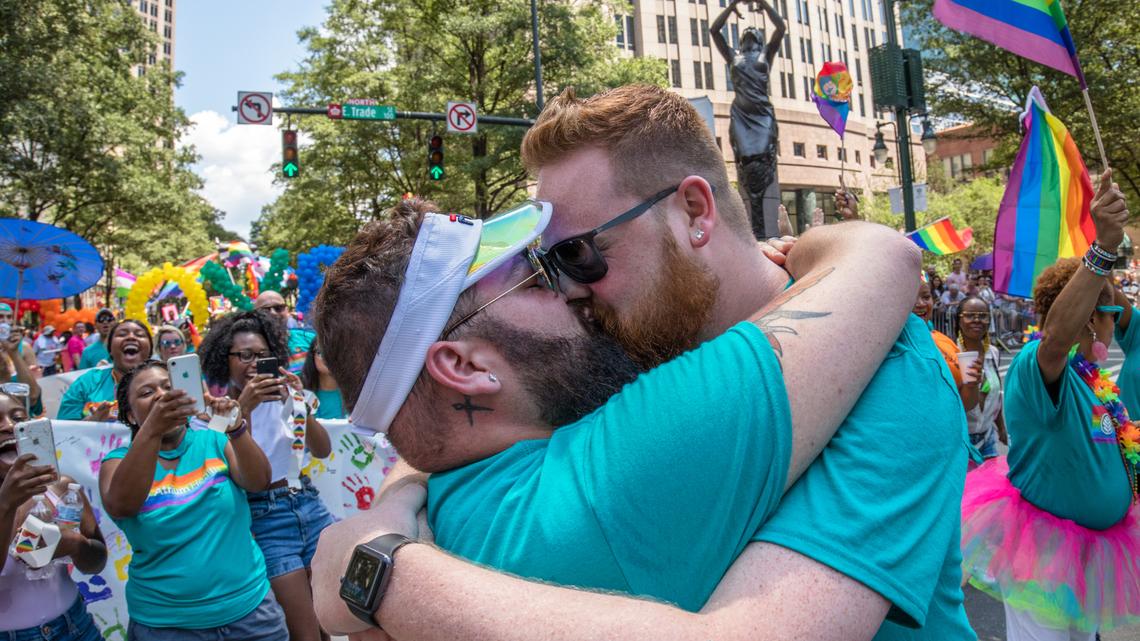
Earlier in June, Gaston County officials removed a photo of two men kissing set to be included in the county museum’s photography exhibit.
Both incidents stunned many involved and it raised a question. Can governments censor activities related to celebrating Pride in public forums or cultural centers funded with taxpayer money?
From canceled drag queen story hours at the library to taking down images of LGBTQ+ people in a county museum, a host of legal precedents oversee whether, and how, local officials can select what gets promoted in public spaces or on government platforms.
Situating controversial actions within that legal landscape is seldom straightforward, according to Bill Marshall, who teaches First Amendment law at the University of North Carolina School of Law.
The most basic distinction that Marshall makes when analyzing First Amendment cases is whether the issue involves a government’s expression or that of a non-government organization or citizen. “Government speech,” which includes any type of expression that appears to convey an official government opinion, has fewer requirements. In government speech, officials generally don’t have to pursue balance between the ideas they express.
“If the government decides that it wants to have a Mother’s Day announcement or something like that, but not a Father’s Day … it has its own discretion on how it governs its own speech,” Marshall said.
But there’s an exception: when American governmental organizations create virtual or physical platforms for private citizens and entities to express their own opinions, they open themselves up to a stricter set of standards.
Called “public forums,” Marshall defines these spaces – which can range from a licensed parade to an event held in a leased government building to comments on a county Facebook post – as places of heightened need for balance. If a government opens such a space to a person or group with one opinion on the topic, it must offer equal access to their opponent, Marshall said.
“The question of when the government can make its own decisions without review is a very difficult one,” Marshall said. “You know, if a library decides it doesn’t want to buy one kind of book, but buys all other kinds of books, is that a problem? And those are very difficult issues that people struggle with.“
While the ACLU of North Carolina has not been contacted on either incident, staff attorney Jaclyn Maffetore says it depends on how the public forum is being used.
If a government offers a public forum for speech, in essentially any context, the government is prohibited from discriminating based upon viewpoint — even if it is contrary to its own views, Maffetore told The Charlotte Observer.
If the library has opened itself for people to schedule and hold events there and is only refusing to host a private event because of ideological differences, Maffetore said the cancellation could be considered a First Amendment violation.
In the case of a museum exhibit, it can be tricky. Governments “can discern what it wants to post on its Facebook page,” Maffetore said.
Outside Charlotte
Before the pandemic put a pause to the Queen City’s in-person festivities, Charlotte Pride hired local photojournalist Grant Baldwin to document its 2019 parade. Among the shots, Baldwin snapped a portrait of two men — Justin Colasacco and Bren Hipp — kissing in celebration just after getting engaged.
As a rainbow-festooned gaggle of cheers erupted behind them, Baldwin thought the shot would be perfect for the Gaston County Museum’s roundup of artistic and documentary photographs. Museum officials agreed initially. They accepted the photo and displayed it as part of the summer 2022 “Into the Darkroom” exhibit, Baldwin said.
Ultimately, county manager Kim Eagle told museum staff to replace the photograph with one “more considerate of differing viewpoints in the community,” county spokesman Gaub said. It remains shelved, but the removal has sparked calls for more LGBTQ recognition in the county. It garnered praise for Baldwin and the couple elsewhere. The photo will take a place of honor in a New Mexico exhibit soon.
“It’s reaffirmed in me that there’s still more work to be done to live up to the motto of Gastonia being an All-American city – live, work and play – when a subset of the population is not viewed as equals,” Charlotte Pride spokesman and Gastonia resident Clark Simon said. “So there’s more work to be done.”
Union County Pride President Cristal Robinson told WSOC-TV she’d had plans with the county library to host seminars throughout the September festival and planned a drag queen story time. County government leaders said no.
County spokeswoman Liz Cooper said the discussions never progressed past “preliminary conversation” with a library employee. The county manager “determined it was prudent to review events the library and other departments participate in, to ensure consistency within the organization for municipal-sponsored events or with organizations that receive funding support from Union County Government.”
Experts have differed on what exactly constitutes equal access to public platforms, and under what circumstances governments are allowed to tamp down on people’s expressions. One exception, Marshall noted, is platforming speech that’s “really likely to incite violence.”
For example, in Apex, located in Wake County, “community feedback” including violent threats led Pride festival leaders in June to cancel plans to hold a drag queen story hour in the festival’s children’s section. Private sponsorship eventually salvaged the event, but performers had to stay on the main stage – a victory for critics who argued the event was inappropriate for the child-friendly zone.
Such threats are one of the stronger justifications that governments can point to when giving different platforms to opposing views, Maffetore said.
“There are ways around it, like extra security, but it would really depend on the specific situation,” she said. “Obviously we want to be viewpoint-neutral, but also we don’t want to ignore credible threats of violence.”
But officials don’t have to bend to general displays of disapproval, Maffetore noted. In June, a New Hanover County Public Library said they continued hosting a drag queen story hour as Proud Boys protested outside and eventually entered the building.
And violence didn’t seem to factor into instances like the Union County Library’s decision to back out of plans for the county’s first official Price festival, Robinson told WSOC-TV.
Government speech
Often it’s official proclamations that generate a backlash. Towns and counties can effectively formally recognize a person, place or season — like Pride Month — as an important part of community life. Doing so constitutes government speech, Marshall said, in perhaps its most distilled form.
Gaston County officials have made Pride proclamations in the past, Simon said. When the deadline passed to get another Pride proclamation on the agenda again this year, it raised his hackles.
“I don’t know why this year is any different,” Simon said. “That did seem to be a little more politically motivated, with everything going on with the county museum.”
But Marshall said that’s within the officials’ rights.
For every step back, Colasacco says he sees community push back as a good sign.
“It’s going to take time,” Colasacco told The Charlotte Observer. “But I’m glad to see that people are upset about it. There’s at least a conversation happening.”
This story was originally published August 18, 2022 at 6:00 AM with the headline "Officials in counties outside Charlotte censored LGBTQ+ content. Can they do that?."
